Effects of Long-Term Proton Pump Inhibitor Use on Serum Electrolytes and Vitamin Levels: A Quasi-experimental Study in Pakistan
Adil Khan, Mehmood Hussain, Ayaz Ahmed, Namra Nazir, Muhammad Khan Malik, Noshaba Saeed

TL;DR
This study finds that long-term use of proton pump inhibitors in Pakistan leads to lower levels of magnesium, calcium, and vitamin B12 compared to other acid-suppressive therapies.
Contribution
The study provides new evidence on the impact of PPIs on micronutrient levels in a South Asian population.
Findings
PPI users had significantly lower magnesium, calcium, and vitamin B12 levels after 12 months.
Other electrolytes and minerals showed no significant differences between the groups.
Long-term PPI use is linked to potential nutritional deficiencies in South Asian patients.
Abstract
Objective The study aims to investigate the effects of long-term proton pump inhibitor (PPI) use on various micronutrients and electrolytes as compared to other acid-suppressive therapies in the South Asian population. Study design and setting This quasi-experimental study was conducted at the Department of Family Medicine in a a tertiary care setup in Rawalpindi, Pakistan from January 2022 to March 2023. Materials and methods Forty-nine patients with known gastric acid secretion-related disorders were randomized in two groups. The PPI group was treated with oral omeprazole, while the non-PPI group were given sucralfate and famotidine. Patients were followed up for a period of 12 months and levels of sodium, potassium, calcium, magnesium, phosphate, iron, vitamin B12, folate and vitamin D were checked using blood samples at baseline, three-, six-, and 12-month duration. Results…
Genes, proteins, chemicals, diseases, species, mutations and cell lines named across the full text — each resolved to its canonical identifier and authoritative record.
Click any figure to enlarge with its caption.
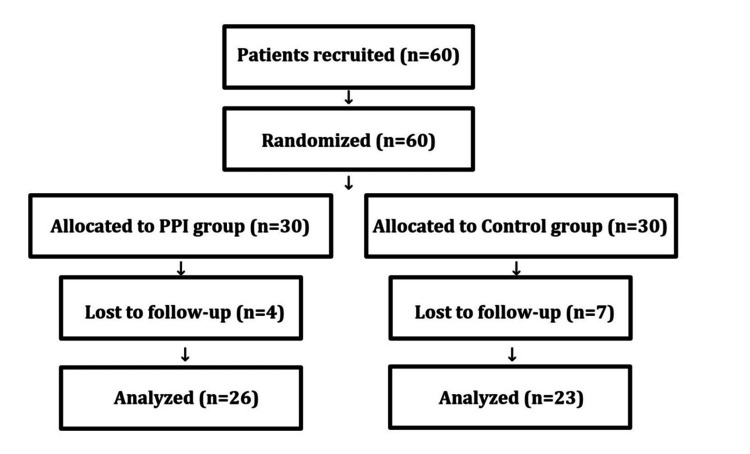 Figure 1
| Population (n=49) | Treatment group (n=26) | Control group (n=23) | t-value | p-value | ||
| Age, mean±SD | 47.918 ± 13.464 | 47.77 ± 13.36 | 48.09 ± 13.88 | -0.082 | 0.935 | |
| Gender | Male, n (%) | 25 (51.02) | 13 (50) | 12 (52.17) | 0.149 | 0.882 |
| Female, n (%) | 24 (48.98) | 13 (50) | 11 (47.83) | |||
| Education | Upto primary, n (%) | 16 (32.65) | 9 (34.62) | 7 (30.43) | 0.597 | 0.551 |
| Upto matriculation, n (%) | 10 (20.41) | 3 (11.54) | 7 (30.43) | |||
| Upto intermediate, n (%) | 12 (24.49) | 7 (26.92) | 5 (21.74) | |||
| More than intermediate, n (%) | 11 (22.45) | 7 (26.92) | 4 (17.39) | |||
| Comorbid | Diabetes, n (%) | 21 (42.86) | 10 (38.46) | 11 (47.83) | -0.649 | 0.519 |
| Hypertension, n (%) | 18 (36.73) | 10 (38.46) | 8 (34.78) | 0.261 | 0.795 | |
| IHD, n (%) | 10 (20.41) | 4 (15.38) | 6 (26.09) | -0.905 | 0.370 | |
| Thyroid disease, n (%) | 8 (16.33) | 4 (15.38) | 4 (17.39) | -0.185 | 0.854 | |
| OAD, n (%) | 13 (26.53) | 6 (23.08) | 7 (30.43) | -0.569 | 0.570 | |
| Others, n (%) | 15 (30.61) | 5 (19.23) | 7 (30.43) | -0.890 | 0.378 | |
| Sodium (mEq/L), mean ± SD | 139 ± 3.45 | 139.42 ± 3.71 | 138.52 ± 3.15 | 0.920 | 0.362 | |
| Potassium (mEq/L), mean ± SD | 4.19 ± 0.53 | 4.20 ± 0.49 | 4.17 ± 0.59 | 0.142 | 0.887 | |
| Magnesium (mEq/L), mean ± SD | 1.67 ± 0.24 | 1.65 ± 0.26 | 1.69 ± 0.21 | -0.595 | 0.555 | |
| Calcium (mg/dL), mean ± SD | 9.42 ± 0.56 | 9.41 ± 0.51 | 9.43 ± 0.63 | -0.141 | 0.889 | |
| Phosphate (mg/dL), mean ± SD | 3.66 ± 0.38 | 3.65 ± 0.42 | 3.68 ± 0.33 | -0.218 | 0.828 | |
| Iron (ug/dL), mean ± SD | 108.53 ± 51.94 | 108.85 ± 49.69 | 108.17 ± 55.49 | 0.044 | 0.965 | |
| Vitamin B12 (pg/mL), mean ± SD | 440.08 ± 214.71 | 417.58 ± 209.07 | 465.52 ± 222.79 | -0.774 | 0.443 | |
| Folate (ng/mL), mean ± SD | 10.49 ± 4.55 | 10.08 ± 4.25 | 10.95 ± 4.92 | -0.662 | 0.511 | |
| Vitamin D (nmoL/L), mean ± SD | 39.98 ± 12.16 | 40.12 ± 13.33 | 39.83 ± 10.99 | 0.083 | 0.934 | |
| Level at baseline (mean±SD) | Level at 12-month (mean±SD) | t-value | p-value | Mean difference | 95% lower confidence interval | 95% upper confidence interval | |
| Magnesium (mEq/L) | 1.64 ± 0.263 | 1.46 ± 0.152 | 4.239 | <0.001 | 0.191 | 0.068 | 0.313 |
| Calcium (mg/dL) | 9.41 ± 0.514 | 8.96 ± 0.416 | 3.790 | <0.001 | 0.450 | 0.183 | 0.717 |
| Iron (ug/dL) | 108.9 ± 49.6 | 89.4 ± 37.3 | 4.395 | <0.001 | 19.42 | -5.67 | 44.51 |
| Vitamin B12 (pg/mL) | 417.6 ± 209 | 329.5 ± 135 | 3.859 | <0.001 | 88.04 | -12.41 | 188.48 |
| PPI group, Mean±SD (n=26) | Control group, Mean±SD (n=23) | t-value | p-value | ||
| Sodium (mEq/L) | Baseline | 139.42 ± 3.71 | 138.52 ± 3.15 | 0.920 | 0.362 |
| 3 months | 138.62 ± 3.44 | 139.83 ± 3.07 | -1.302 | 0.199 | |
| 6 months | 139.19 ± 2.70 | 139.00 ± 2.89 | 0.240 | 0.812 | |
| 12 months | 138.62 ± 3.81 | 139.43 ± 2.83 | -0.862 | 0.393 | |
| Potassium (mEq/L) | Baseline | 4.20 ± 0.49 | 4.17 ± 0.59 | 0.142 | 0.887 |
| 3 months | 4.12 ± 0.36 | 4.10 ± 0.35 | 0.146 | 0.885 | |
| 6 months | 4.11 ± 0.37 | 4.16 ± 0.30 | -0.552 | 0.583 | |
| 12 months | 4.06 ± 0.37 | 4.11 ± 0.35 | -0.534 | 0.596 | |
| Magnesium (mEq/L) | Baseline | 1.65 ± 0.26 | 1.69 ± 0.21 | -0.595 | 0.555 |
| 3 months | 1.59 ± 0.24 | 1.69 ± 0.17 | -1.672 | 0.101 | |
| 6 months | 1.54 ± 0.22 | 1.69 ± 0.14 | -2.852 | 0.007 | |
| 12 months | 1.46 ± 0.15 | 1.70 ± 0.14 | -5.769 | <0.001 | |
| Calcium (mg/dL) | Baseline | 9.41 ± 0.51 | 9.43 ± 0.63 | -0.141 | 0.889 |
| 3 months | 9.32 ± 0.48 | 9.42 ± 0.37 | -0.773 | 0.444 | |
| 6 months | 9.17 ± 0.41 | 9.47 ± 0.41 | -2.500 | 0.016 | |
| 12 months | 8.96 ± 0.42 | 9.50 ± 0.48 | -4.180 | <0.001 | |
| Phosphate (mg/dL) | Baseline | 3.65 ± 0.42 | 3.68 ± 0.33 | -0.218 | 0.828 |
| 3 months | 3.60 ± 0.36 | 3.69 ± 0.35 | -0.909 | 0.368 | |
| 6 months | 3.63 ± 0.32 | 3.66 ± 0.29 | -0.399 | 0.692 | |
| 12 months | 3.55 ± 0.35 | 3.62 ± 0.27 | -0.809 | 0.423 | |
| Iron (ug/dL) | Baseline | 108.85 ± 49.69 | 108.17 ± 55.49 | 0.044 | 0.965 |
| 3 months | 103.31 ± 44.48 | 106.43 ± 49.37 | -0.232 | 0.818 | |
| 6 months | 100.85 ± 44.96 | 104.87 ± 42.76 | -0.321 | 0.750 | |
| 12 months | 89.42 ± 37.27 | 104.74 ± 38.34 | -1.414 | 0.164 | |
| Vitamin B12 (pg/mL) | Baseline | 417.58 ± 209.07 | 465.52 ± 222.79 | -0.774 | 0.443 |
| 3 months | 393.15 ± 167.02 | 462.22 ± 213.51 | -1.250 | 0.218 | |
| 6 months | 371.88 ± 153.87 | 465.43 ± 203.80 | -1.795 | 0.080 | |
| 12 months | 329.54 ± 134.67 | 462.30 ± 193.66 | -2.752 | 0.009 | |
| Folate (ng/mL) | Baseline | 10.08 ± 4.25 | 10.95 ± 4.92 | -0.662 | 0.511 |
| 3 months | 10.32 ± 3.65 | 10.96 ± 4.07 | -0.581 | 0.564 | |
| 6 months | 10.23 ± 3.96 | 10.76 ± 3.82 | -0.480 | 0.634 | |
| 12 months | 9.65 ± 3.34 | 10.69 ± 3.49 | -1.055 | 0.297 | |
| Vitamin D (nmoL/L) | Baseline | 40.12 ± 13.33 | 39.83 ± 10.99 | 0.083 | 0.934 |
| 3 months | 42.96 ± 12.91 | 39.13 ± 7.78 | 1.274 | 0.210 | |
| 6 months | 45.92 ± 12.72 | 41.48 ± 8.17 | 1.471 | 0.149 | |
| 12 months | 48.31 ± 12.44 | 42.22 ± 7.22 | 2.124 | 0.040 | |
Peer Reviews
No public reviews on file for this paper yet. If you reviewed it on a platform where reviews are public (OpenReview, ICLR, NeurIPS, ICML), you can paste yours below so the community can read it here.
Videos
No videos yet. Explain this paper in a talk, walkthrough, or lecture? Add one.
Taxonomy
TopicsGastroesophageal reflux and treatments · Diet, Metabolism, and Disease · Electrolyte and hormonal disorders
Introduction
Proton pump inhibitors (PPIs) are a class of medications that inhibit acid secretion in the stomach; therefore, they are used in the management of acid-related disorders, including peptic ulcer disease (PUD), gastroesophageal reflux disease (GERD) or Zollinger-Ellison syndrome [1]. They act by inhibiting the H^+^/K^+^ ATPase pump in gastric parietal cells, which is responsible for acid secretion [1,2]. By blocking this step of acid secretion, PPIs cause a reduction in the amount of gastric acid produced thus raising intra-gastric pH [3].
PPIs are among the most widely prescribed medications globally, and omeprazole is the most frequently prescribed PPI, ranking sixth among the most commonly prescribed drugs in the United States [4]. Despite their widespread use, studies suggest that a significant proportion of patients may be appropriately prescribed PPIs. In fact, estimates suggest that 30% to 50% of patients may receive PPIs inappropriately, either due to excessive treatment duration, inappropriate dosage, or inappropriate indications [5,6].
Although PPIs are generally well tolerated, this issue is a cause for concern because inappropriate use of PPIs can lead to unnecessary healthcare costs, potential drug interactions, and increased risk of adverse effects. Potential adverse effects of PPI use include increased fracture risk, electrolyte abnormalities such as hypocalcemia and hypomagnesemia, increased risk of infections, anaemia secondary to both iron and vitamin B12 malabsorption, Clostridium difficile infection, and increased cardiovascular risk among others [7].
The mechanism of hypomagnesemia secondary to long-term PPI use is not exactly known but is thought to be secondary to defective absorption through active or passive uptake channels or increased gut losses [7,8]. Hypophosphatemia and hyponatremia have also been described with injudicious use of PPIs especially in the elderly population [9].
Long-term PPI use is also linked with iron deficiency. Higher gastric pH is theorized to impair the absorption of non-heme iron by reducing the conversion of less absorbable ferric ions (Fe^3+^) to more absorbable ferrous ions (Fe^2+^) [10]. Few studies have revealed lower absorption of protein-bound vitamin B12 associated with PPI use and thus increased risk of vitamin B12 deficiency [8]. Some experiments have shown that gastric pH >4 results in an unstable form of vitamin C and is hydrolyzed to an ineffective and unabsorbable form resulting in its potential deficiency [11].
Malnutrition is a significant public health concern in Pakistan, with a high prevalence of undernourishment reported in many households. According to a United Nations International Children's Emergency Fund (UNICEF) report in 2017, over 40% of Pakistani households consume fewer calories than the recommended daily intake [12]. Consequently, borderline deficiencies of micronutrients are prevalent in the population. PPIs are widely prescribed and have the potential to exacerbate pre-existing nutritional deficiencies.
Therefore, the present study aims to investigate the practical effects of long-term PPI use as compared to other acid-suppressive therapies when clinically indicated and assess their effects on the levels of various micronutrients and electrolytes. The findings of this study may provide valuable insights into the potential nutritional implications of long-term PPI use.
Materials and methods
This study was conducted as a quasi-experimental trial in the Department of Family Medicine at a tertiary care setup in Rawalpindi, Pakistan. It was a non-sponsored study and was conducted from 1 January 2022 to 31 March 2023 after approval from the ethical review board of the same hospital. The trial was registered in the Iranian Registry of Clinical Trials with ID 81437 (IRCT20240505061656N1).
Sample size estimation was performed using the Epi-Info (Centers for Disease Control and Prevention (CDC), Atlanta, USA) with a 95% confidence interval and 80% study power, based on Pasina et al. as the reference study [13]. This study revealed a general prevalence of hypomagnesemia at 14.1% and an adjusted hazard ratio of 4.31 when comparing the prevalence of hypomagnesemia in patients on PPIs as compared to those who are not on this treatment. A target sample size of 43 was calculated. We aimed to target 60 patients in our sample (30 in each group) in order to achieve better results as well as counter failure to follow-up.
Inclusion criteria
Participants included in this study were adults ≥18 years of age, had an indication for long-term PPI therapy such as GERD, chronic gastritis or Zollinger-Ellison syndrome and were willing to participate in this study.
Exclusion criteria
Patients with PUD secondary to Helicobacter pylori, medical conditions causing malabsorption (such as celiac disease, chronic pancreatitis, gut resection, inflammatory bowel disease, and chronic diarrhoea), and those with pre-existing electrolyte or vitamin deficiencies requiring intervention were excluded from this study.
A convenience sampling technique was used to induct patients visiting family medicine clinics who fulfilled inclusion and exclusion criteria. Patients were randomly divided into two groups at 1:1 using a computerized balloting method. Neither the participants nor the investigators were blinded. Baseline data was collected from individuals including their age, gender, educational status, previous comorbid conditions and current symptoms. A stool sample was taken to rule out active H. pylori infection.
Blood samples were taken to check levels of sodium, potassium, magnesium, calcium, phosphate, iron, vitamin B12, folate and vitamin D levels. Assays for micronutrient analysis were performed using the Roche Cobas® Pure system (Roche Diagnostics International Ltd., Rotkreuz, Switzerland). Sodium and potassium were measured using ion-selective electrodes. Immunoassay methods were employed for analyzing vitamin B12, folate, and vitamin D levels, while the remaining parameters were assessed through photometry.
The PPI group was started on oral omeprazole 20 mg to 40 mg per day while the control group were given either famotidine or sucralfate. Patients were followed up for a period of 12 months. Repeat samples were taken at three-, six-, and 12-month duration. Patients were also interviewed for subjective side effects and the effectiveness of the given treatment. Individuals were advised not to take nutritional/vitamin/iron supplements during the course of the study. Patients failing to follow up were labelled as failure to follow-up and their data was removed from statistical analysis.
In this study, we initially included 60 individuals, with 30 participants in each group. However, due to follow-up losses during the course of the trial, our final analysis was conducted on 49 individuals, as shown in the Consolidated Standards of Reporting Trials (CONSORT) flow diagram (23 in the control group and 26 in the PPI group) (Figure 1).
CONSORT flow diagramCONSORT: Consolidated Standards of Reporting Trials; PPI: proton pump inhibitor
Data was collected and analyzed in Microsoft Excel (Microsoft® Corp., Redmond, WA, USA) and Statistical Package for the Social Sciences (IBM SPSS Statistics for Windows, IBM Corp., Version 25.0, Armonk, NY). Statistical analysis was done in order to determine any significant changes in levels of the abovementioned electrolytes, minerals and vitamins between the two groups. Student's t-test was used to compare the two groups and t-value was calculated. A difference in p-value <0.05 was considered significant.
Results
The mean age of our study population was 47.92 ± 13.46 years, with an even distribution of gender (25 males and 24 females). The most common comorbid conditions observed in our study population were diabetes (n=21, 42.86%) and hypertension (n=18, 36.73%) (Table 1).
Table 1: Baseline characteristics of study populationA p-value <0.05 was considered statistically significant. The Student’s t-test was used to compare the two groups.IHD: ischemic heart disease; OAD: obstructive airway disease
Our baseline characteristics analysis showed no significant differences between age, gender, educational status, and comorbid conditions among the two groups. Additionally, at baseline, there were no significant differences in levels of sodium, potassium, calcium, magnesium, phosphate, iron, folate, vitamin B12, and vitamin D between the two groups. The baseline characteristics of the study population and two groups are described in Table 1 in detail.
During the study period, levels of electrolytes and micronutrients remained relatively stable in the control group. However, in the PPI group, we observed significant changes in levels of magnesium, calcium, iron, and vitamin B12. Specifically, we found that levels of magnesium, calcium, iron and vitamin B12 were significantly lower, while levels of vitamin D were significantly higher compared to baseline. Details of the comparison are given in Table 2.
Table 2: Baseline versus 12-month serum levels of magnesium, calcium, iron and vitamin B12 in the PPI group (n=26)A p-value < 0.05 was considered significant. A paired t-test was used to compare baseline and 12-month serum levels within the PPI group.PPI: proton pump inhibitor
When comparing the two groups, we found significantly lower levels of magnesium in the PPI group at 6- and 12-month periods compared to controls (p=0.007 and p<0.001, respectively). Additionally, serum levels of calcium were significantly lower in the PPI group at 6- and 12-month periods compared to controls (p=0.016 and p<0.001, respectively). Levels of vitamin B12 were also significantly lower in the PPI group at 12 months compared to controls (p=0.008), while levels of vitamin D were significantly higher in the PPI group at 12 months compared to controls (p=0.03). Finally, we found no significant alterations in levels of sodium, potassium, phosphate, iron, and folate between the PPI and control groups at any time during the course of the study. Details of this analysis are given in Table 3.
Table 3: Comparison of electrolyte levels between the PPI and non-PPI groups was conducted at various time intervalsA p-value <0.05 was considered statistically significant. The Student’s t-test was used to compare the two groups.PPI: proton pump inhibitor
Discussion
Gastric acid is an important digestive instrument and plays a vital role in the absorption and homeostasis of various minerals and micronutrients such as magnesium, calcium, iron, cobalamin and ascorbic acid. Thus, PPIs can potentially cause deficiencies of these substances by reducing stomach acid secretion [14]. This unwanted effect of PPIs can lead to hematopoietic disturbances leading to micro- or macrocytic anaemia, electrolyte imbalance resulting in paresthesia, muscle cramps or even life-threatening arrhythmias, or effect bone formation resulting in osteoporosis among other side effects [14].
To better understand the true impact of these potential deficiencies, this study was designed to compare patients on long-term PPIs with other potential treatment options for stomach acid-related disorders. Patients were tested for potential deficiencies of sodium, potassium, calcium, magnesium, phosphate, iron, vitamin B12, folate and vitamin D and results have indicated a significant reduction in levels of magnesium, calcium iron and vitamin B12 in patients on long-term PPI therapy. When compared with patients on other therapies, levels of magnesium, calcium and vitamin B12 were significantly lower in the PPI group as compared to patients on other treatment options.
Low magnesium levels can decrease parathyroid hormone secretion, leading to both hypocalcemia and altered bone metabolism [7,8]. Lower parathyroid hormone concentration is linked to increased fracture risk seen with chronic PPI use. Low magnesium levels can also interfere with renal potassium reabsorption leading to hypokalemia [7,8].
Results of this study indicated that there was a significant reduction in serum levels of magnesium after 12 months in the PPI group (mean difference: 0.191 mEq/L, 95% CI: 0.068-0.313, p<0.001). Furthermore, the serum magnesium levels were significantly lower in the PPI group when compared to the non-PPI group (1.70 ± 0.14 mEq/L vs. 1.46 ± 0.15 mEq/L, p<0.01) after 12 months of treatment. Recart et al. (2021) also observed similar findings through a retrospective study of individuals receiving long-term PPI therapy (defined as more than six months). Specifically, 36% of patients on long-term PPI showed evidence of hypomagnesemia (magnesium level <1.3 mEq/dL) with a mean magnesium level of 1.56 mEq/L [15].
Likewise, a meta-analysis of 16 studies published by Srinutta et al. (2019) in November of that year demonstrated an adjusted odds ratio of 1.71 (95% CI: 1.33-2.19; p<0.001) for the risk of hypomagnesemia with chronic PPI use. This study also identified higher odds of hypomagnesemia with higher PPI doses as compared to lower doses (OR 2.13; 95% CI: 1.26-3.59; p=0.005) [16]. Lower levels of serum magnesium have been associated with life-threatening arrhythmia, Torsades de Pointes and it was observed by Lazzerini et al. (2018), that in unselected patients with this arrhythmia, more than 50% had evidence of concurrent PPI use [17].
The present study found a significant decrease in serum total calcium levels in patients on long-term PPI therapy, with a mean difference of 0.450 mg/dL at the end of the 12-month treatment period (CI: 0.183-0.717, p<0.01). Furthermore, there was a significant difference in serum calcium levels at the end of the 12-month treatment period between patients on PPI therapy and those not on PPI therapy, with the former group exhibiting lower levels (8.96 ± 0.42 mg/dL vs. 9.50 ± 0.48 mg/dL respectively, p<0.01). While there is a link between PPI use and osteoporotic fracture, the use of PPI has been inconsistently linked with hypocalcemia [8,18].
The mechanism of hypocalcemia has been theorized as secondary to a reduction in calcium absorption or an indirect result of hypomagnesemia. Recart et al. (2021) observed that in patients on long-term PPIs, hypocalcemia was seen more frequently in patients with hypomagnesemia as compared to those with normomagnesemia (57% vs. 38.7%, p<0.05) [15]. Similarly, O’Connell et al. (2005) observed a reduction in calcium absorption by up to 40% in females taking omeprazole for only 14 days [19]. This reduction in absorption is theorized to induce parathyroid hormone release which in an attempt to keep serum calcium levels constant can lead to osteoporosis.
Serum vitamin B12 levels were significantly lower at the end of the 12-month period in PPI users with a mean reduction of 88.04 pg/mL (95% CI: -12.41 to 188.48, p<0.01). In comparison to the non-PPI group, the PPI group had significantly lower serum vitamin B12 levels (462.30 ± 193.7 pg/mL vs. 329.5 ± 134.7 pg/mL respectively, p=0.009). This reduction is theorized due to reduced absorption. Gastric acid is required to convert pepsinogen to its active form pepsin. Pepsin is necessary for protein metabolism and the release of vitamin B12 from large proteins, thus reducing its absorption.
A meta-analysis of 25 studies published in 2023 has also revealed similar findings. Odds of vitamin B12 deficiency were higher in patients on PPI as compared to those not on PPI (OR 1.42, 95% CI: 1.16-1.73) [20]. Similarly, a systematic review on the effects of PPIs on vitamin B12 metabolism, published in 2022, has provided indirect evidence of vitamin B12 deficiency by studying markers of its deficiency such as elevated methyl-malonic acid or rise in mean corpuscular volume (MCV) [21].
Reduction in serum iron levels was also observed in patients on long-term PPIs. The mean reduction in serum iron levels was 19.42 ug/dL (CI: -5.67 to 44.51 ug/dL, p<0.01). Although there was an observed difference in 12-month iron levels between PPI and non-PPI groups (89.4 ± 37.27 ug/dL vs. 104.74 ± 38.34 ug/dL, p=0.164), the difference was not significant. Stomach acid helps iron absorption by converting it from less absorbable ferric iron (Fe^3+^) to more absorbable ferrous iron (Fe^2+^). Thus, reduction in stomach acid through any means is theorized to impair its absorption. Similar results have been seen in a case-control study published in 2018 with a sample size of 27,897 individuals. In this study, the odds ratio of iron deficiency was 3.60 (95% CI: 3.32-3.91) between PPI users and non-users [22].
This study did not see any significant reduction in sodium, potassium, phosphate, folate or vitamin D levels after 12-month PPI use. Few studies have noted altered absorption of vitamin D; however, results have not been consistent. Similarly, both hyponatremia and hypokalemia have been reported in case reports; however, few small-scale studies have been unable to find this correlation [23].
Even though the study was done on a smaller sample size, it did detect a potential adverse effect of excessive PPI use that includes deficiencies in essential micronutrients like magnesium, calcium, iron, and vitamin B12. This raises the question of whether these deficiencies will lead to significant clinical outcomes, highlighting the need for further research to explore the long-term health implications.
This study is limited by its small sample size and short follow-up period of 12 months. Furthermore, confounding factors such as undiagnosed malnutrition and other medications that may influence the absorption of micronutrients were not specifically accounted for in this study; however, these factors were addressed through randomization. Further research through larger, multicenter, randomized controlled trials and population-based studies may be needed to better understand the effects of PPIs on electrolytes and micronutrients.
Conclusions
The study aimed to investigate the potential impact of long-term PPI use on serum levels of minerals and micronutrients. The results suggest that long-term PPI use can lead to deficiencies of magnesium, calcium, iron, and vitamin B12. The reduction in serum levels of these nutrients can lead to various side effects, including hematopoietic disturbances, electrolyte imbalance, osteoporosis, and life-threatening arrhythmias.
The reference list from the paper itself. Each links out to its DOI / PubMed record.
- 1Proton pump inhibitors (PPI)Stat Pearls [Internet] Ahmed A Clarke JO Treasure Island (FL)Stat Pearls Publishing 2023 https://www.ncbi.nlm.nih.gov/books/NBK 557385/32491317 · pubmed ↗
- 2Proton pump inhibitors Liver Tox: Clinical and Research Information on Drug-Induced Liver Injury [Internet]Bethesda (MD)National Institute of Diabetes and Digestive and Kidney Diseases 2019 https://www.ncbi.nlm.nih.gov/books/NBK 547892/31643176 · pubmed ↗
- 3Omeprazole Stat Pearls [Internet] Shah N Gossman W Treasure Island (FL)Stat Pearls Publishing 2023 https://www.ncbi.nlm.nih.gov/books/NBK 539786/
- 4Comprehension of top 200 prescribed drugs in the US as a resource for pharmacy teaching, training and practice Pharmacy (Basel) Fuentes AV Pineda MD Venkata KC 43620182975793010.3390/pharmacy 6020043 PMC 6025009 · doi ↗ · pubmed ↗
- 5Proton pump inhibitor utilisation and potentially inappropriate prescribing analysis: insights from a single-centred retrospective study BMJ Open Liu Y Zhu X Li R Zhang J Zhang F 010202010.1136/bmjopen-2020-040473 PMC 769283333243802 · doi ↗ · pubmed ↗
- 6Inappropriate prescription of proton pump inhibitors in a community setting Can J Hosp Pharm Nguyen PVQ Tamaz R 26727171201830186000 PMC 6118833 · pubmed ↗
- 7Proton pump inhibitors: review of reported risks and controversies Laryngoscope Investig Otolaryngol Brisebois S Merati A Giliberto JP 4574623201810.1002/lio 2.187PMC 630273630599030 · doi ↗ · pubmed ↗
- 8Adverse effects of proton pump inhibitors-evidence and plausibility Int J Mol Sci Fossmark R Martinsen TC Waldum HL 52032020193164011510.3390/ijms 20205203 PMC 6829383 · doi ↗ · pubmed ↗