Ictal index finger pointing and politician's fist as localizing clinical signs in a pediatric patient
Joshua Chang, Mohamed Taha, Douglas Nordli

Abstract
Content available: Video.
Genes, proteins, chemicals, diseases, species, mutations and cell lines named across the full text — each resolved to its canonical identifier and authoritative record.
Click any figure to enlarge with its caption.
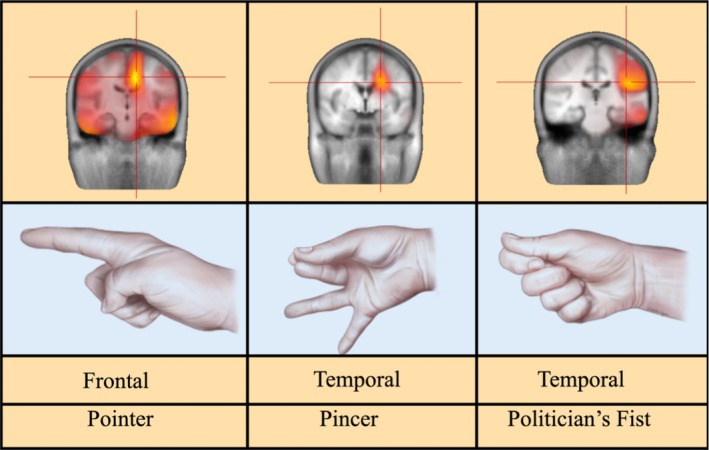 Figure 1
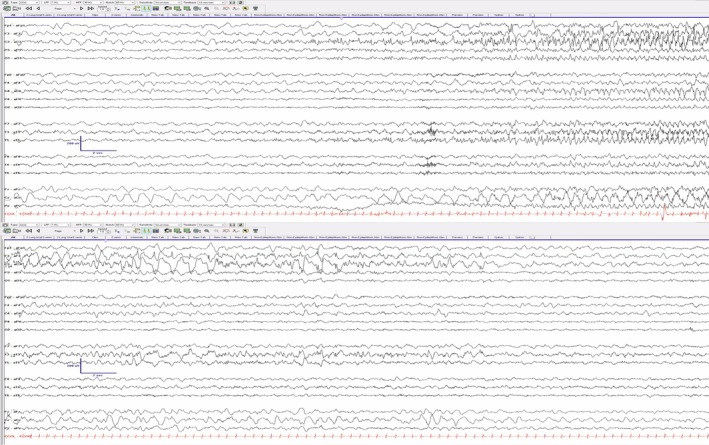 Figure 2
Peer Reviews
No public reviews on file for this paper yet. If you reviewed it on a platform where reviews are public (OpenReview, ICLR, NeurIPS, ICML), you can paste yours below so the community can read it here.
Videos
No videos yet. Explain this paper in a talk, walkthrough, or lecture? Add one.
Taxonomy
TopicsMyasthenia Gravis and Thymoma · Autoimmune Neurological Disorders and Treatments · Peripheral Neuropathies and Disorders
We report a case of a 3‐year‐old girl who presented with distinct, repetitive episodes featuring highly localizing clinical signs. Each episode began approximately 1 min and 50 s after the onset of electrographic changes, with the patient's right arm extending and her index finger assuming a pointed position (Video 1). Throughout the episode, her eyes largely remained closed, and she was unresponsive to her surroundings, unable to speak.
After about 20 s, the index finger flexed as her hand adopted a pincer posture, followed by the “politician's fist,” along with circular movements resembling “drawing circles in the air.” Electroencephalography (EEG) captured several episodes, with rhythmic spikes peaking in the left frontocentral region (F3/C3) and evolving into the left temporal chain (Video 1 and Figure 1).
As the seizure resolved, her eyes briefly opened, and she momentarily attended to her mother as her right hand lowered. She then blinked before slipping back into stage 2 sleep, remaining postictal and asleep afterward. This was the only semiology that was noted in her case. Brain magnetic resonance imaging (MRI) was unremarkable; however, lumbar puncture revealed a positive titer for anti‐NMDA receptor (NMDAR) antibodies.
While ictal hand signs are well documented in adults, their localizing significance in children remains less understood. Previous studies suggest that the “ictal pointer, pincer, and politician's fist” signs often indicate seizure activity in the contralateral frontal and temporal regions.1, 2 Source localization software mapped the symptomatic zone to the left fronto‐temporal region (Figure 2), commonly associated with anti‐NMDAR encephalitis seizures.3 This case demonstrates how ictal signs can assist in accurately localizing focal seizures, further corroborated by diagnostic testing. The delayed clinical onset and downward propagation of the ictal field highlight that ictal semiology reflects seizure propagation rather than the precise seizure onset zone.
CONSENT
Informed consent was obtained from the parents of the patient presented prior to beginning this work.
Test yourself
- Ictal fist and pointer localizes most commonly to which area of the brain?
- Ipsilateral fronto‐temporal region
- Contralateral fronto‐temporal region
- Ipsilateral parietal region
- Contralateral occipital region
- The “politician's fist” is an ictal hand sign that localizes most commonly to which area of the brain?
- Contralateral temporal lobe
- Contralateral frontal lobe
- Ipsilateral frontal lobe
- Ipsilateral parietal lobe
- Seizures in anti‐NMDAR encephalitis have most commonly been associated with abnormal EEG findings in what area of the brain?
- Fronto‐temporal region
- Parietal region
- Occipital region
- No specific location
Answers may be found in the Supporting information.
Supporting information
Data S1
Data S2
The reference list from the paper itself. Each links out to its DOI / PubMed record.
- 1Siegel J , Tatum WO . Index‐finger pointing in generalized tonic‐clonic seizures. Epilepsy Behav. 2016;58:18–21.26994878 10.1016/j.yebeh.2016.02.022 · doi ↗ · pubmed ↗
- 2Ferando I , Soss JR , Elder C , Shah V , Lo Russo G , Tassi L , et al. Hand posture as localizing sign in adult focal epileptic seizures. Ann Neurol. 2019;86(5):793–800.31498917 10.1002/ana.25589 · doi ↗ · pubmed ↗
- 3Wang T , Yu Y , Hu Y , Li Y , Song F , Wang Y . Clinical and electroencephalographic features of the seizures in neuronal surface antibody‐associated autoimmune encephalitis. Front Neurol. 2020;11:280.32431657 10.3389/fneur.2020.00280 PMC 7214674 · doi ↗ · pubmed ↗