Review of the genus Ageleradix Xu & Li, 2007 (Araneae, Agelenidae), with descriptions of three new species

Abstract
Genes, proteins, chemicals, diseases, species, mutations and cell lines named across the full text — each resolved to its canonical identifier and authoritative record.
Click any figure to enlarge with its caption.
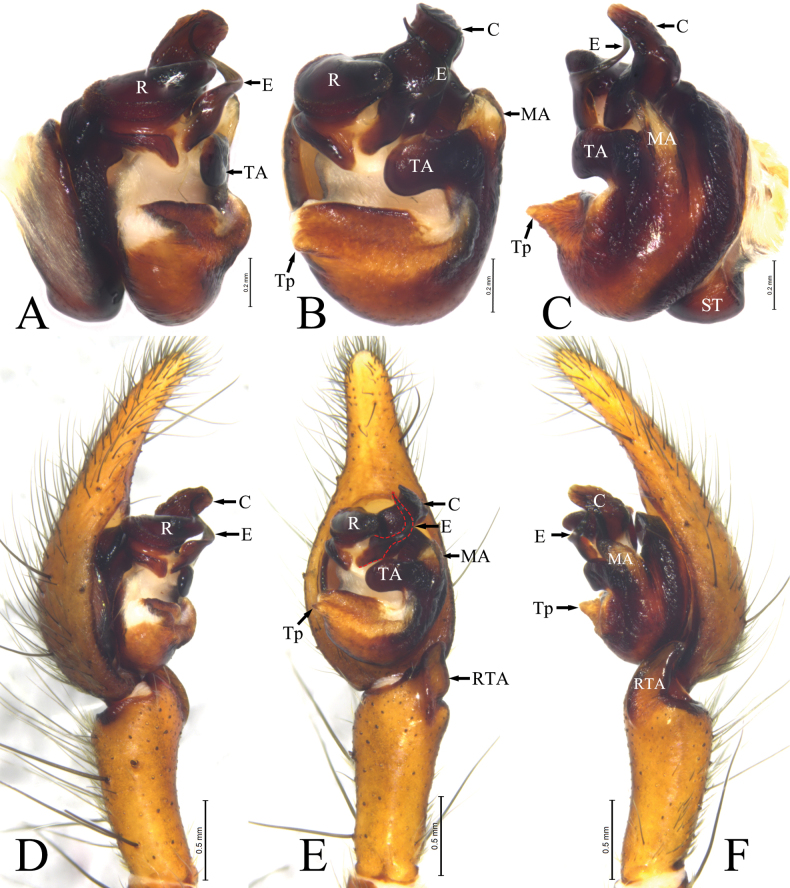 Figure 1
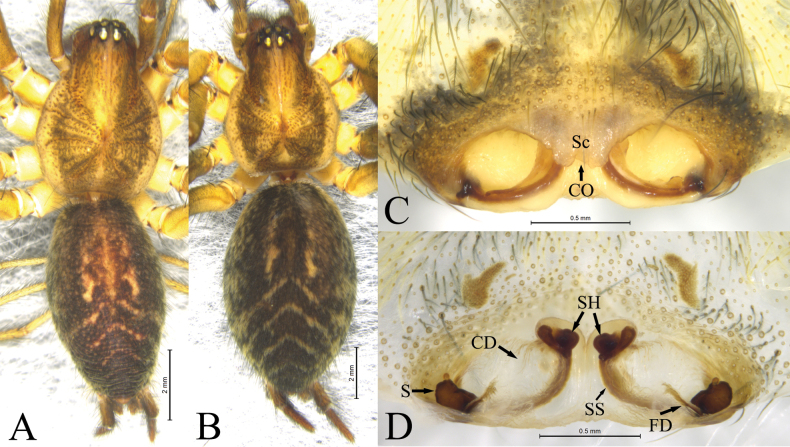 Figure 2
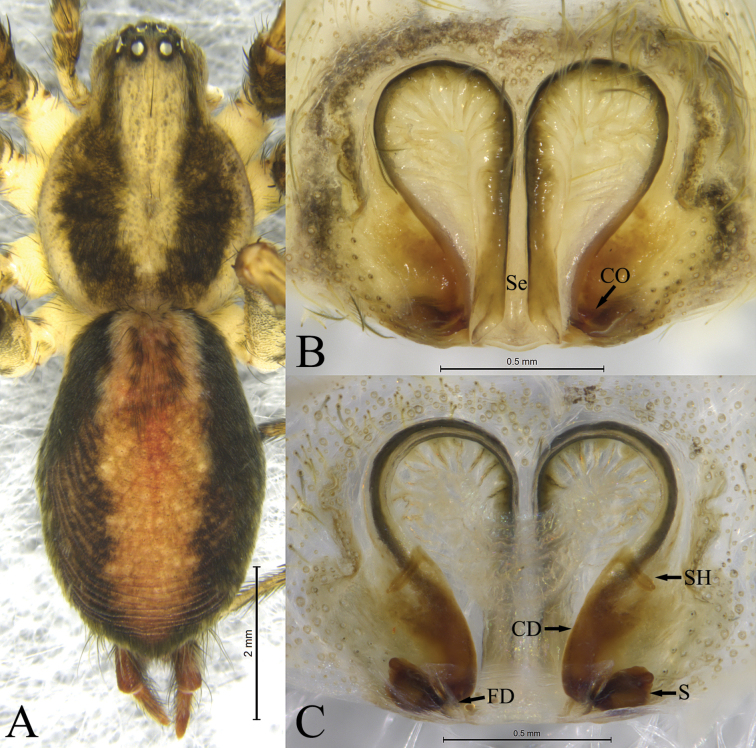 Figure 3
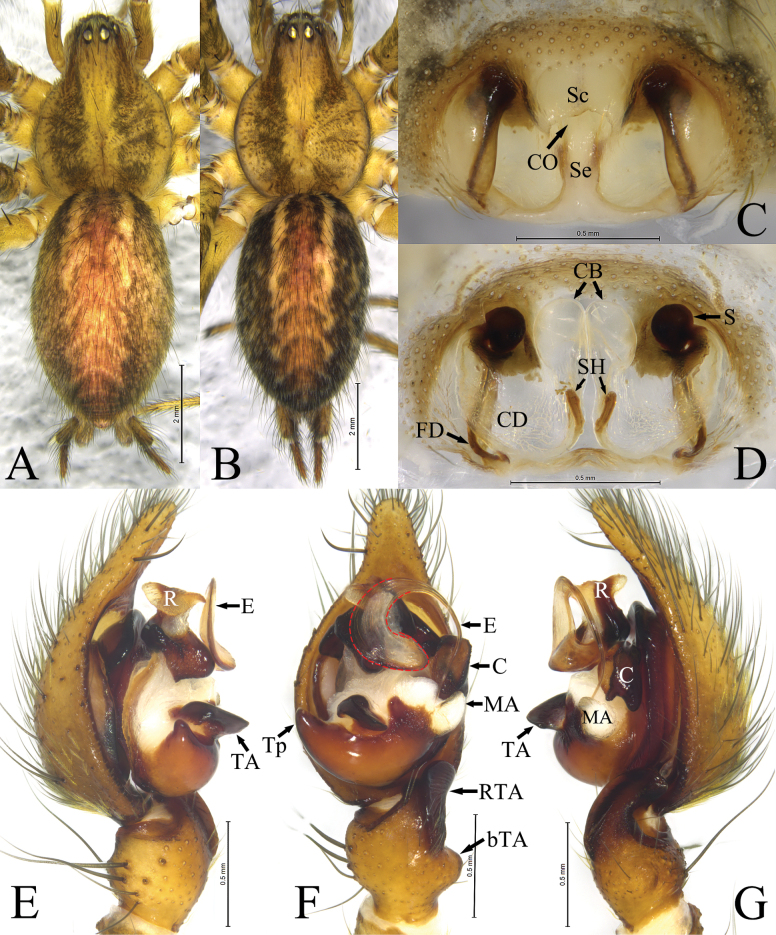 Figure 4
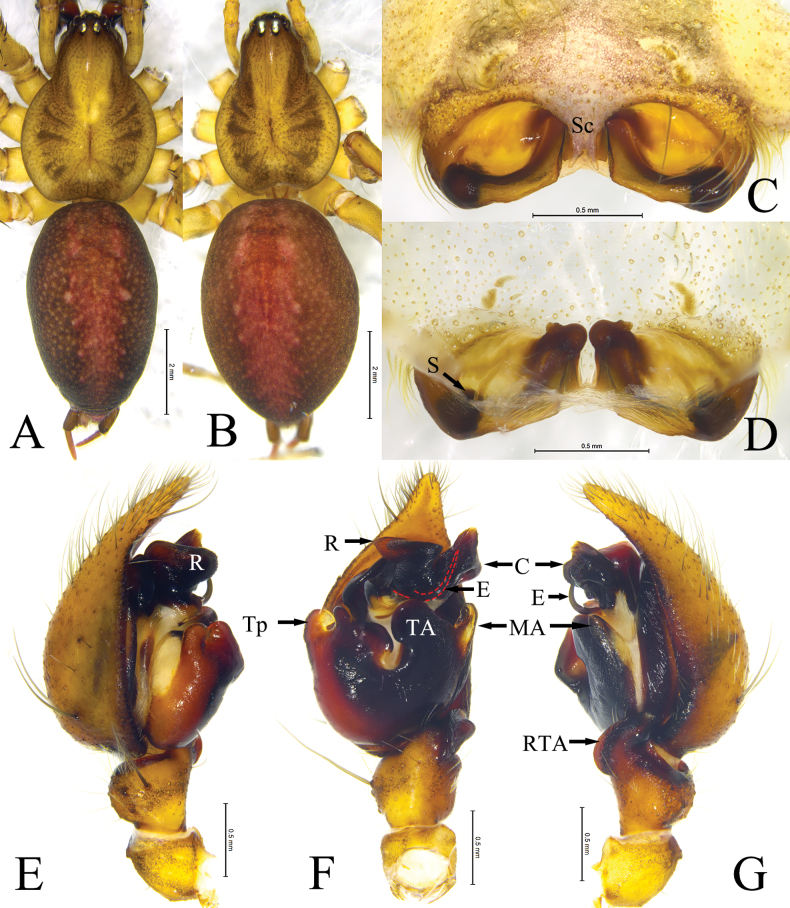 Figure 5
| 1 | Female |
|
| – | Male |
|
| 2 | Atrium posteriorly located |
|
| – | Atrium anteriorly located |
|
| 3. | Spermathecae (S) anteriorly located |
|
| – | Spermathecae (S) posteriorly located |
|
| 4 | Copulatory bursa (CB) oval |
|
| – | Copulatory bursa (CB) clavate |
|
| 5 | Scape ( |
|
| – | Scape ( |
|
| 6 | Scape ( |
|
| – | Scape ( |
|
| 7 | Atrium divided |
|
| – | Atrium undivided |
|
| 8 | Spermathecae (S) round |
|
| – | Spermathecae (S) oval |
|
| 9 | Septum (Se) lacking |
|
| – | Septum (Se) as long as atrium, with parallel margins |
|
| 10 |
| |
| – |
| |
| 11 | Embolus (E) reach mid part of bulb, filiform |
|
| – | Embolus (E) extending anteriorly |
|
| 12 | Tibia about 2/3 length of cymbium, embolus (E) S-shaped in retrolateral view |
|
| – | Tibia about 1/4 length of cymbium, embolus (E) C-shaped in retrolateral view |
|
| 13 | Embolus (E) long, filiform bent anticlockwise |
|
| – | Embolus (E) short |
|
| 14 | Conductor (C) longer than bulb, tibia wider than long |
|
| – | Conductor (C) about1/2 of bulb length, tibia longer than wide |
|
| Species group name | Diagnostic character | Species |
|---|---|---|
| conductor tongue-shaped | ||
| atrium posteriorly located; with scape | ||
| conductor long, with narrow and membranous tip | ||
| atrium anteriorly located; scape absent | ||
| conductor strong sclerotized, nubbly | ||
| atrium large, anteriorly located; scape present |
Peer Reviews
No public reviews on file for this paper yet. If you reviewed it on a platform where reviews are public (OpenReview, ICLR, NeurIPS, ICML), you can paste yours below so the community can read it here.
Videos
No videos yet. Explain this paper in a talk, walkthrough, or lecture? Add one.
Taxonomy
TopicsSpider Taxonomy and Behavior Studies · Coleoptera Taxonomy and Distribution · Lepidoptera: Biology and Taxonomy
Introduction
Agelenidae C.L. Koch, 1837 comprises 1427 species in 98 genera (including 1 extinct genus and 7 species) and is distributed almost worldwide. In China, the family is represented by 490 species, belonging to 39 genera in four subfamilies (Zhu et al. 2017; WSC 2024). Ageleradix Xu & Li, 2007 described based on A.sichuanensis Xu & Li, 2007, and placed in the subfamily Ageleninae C.L. Koch, 1837 (Zhu et al. 2017) currently comprising six species, all reviewed by Zhu et al. (2017). The genus is distributed in Guangxi, Guizhou, Sichuan, Xizang and Yunnan provinces of China.
While examining specimens collected from Yunnan and Chongqing, three new species of Ageleradix were recognized. This paper aims to describe these new species, provide a comprehensive review of the genus, and present an identification key for all its known species and notes on species grouping.
Material and methods
All specimens were preserved in 75% ethanol and examined, illustrated, photographed, and measured using a Leica M205A stereomicroscope equipped with a drawing tube, a Leica DFC450 Camera, and LAS v. 4.6 software. Male palps and epigynes were examined and illustrated after they were dissected. Epigynes were cleared by immersing them in pancreatin for about an hour (Álvarez-Padilla and Hormiga 2007). Eye sizes were measured as the maximum diameter. Leg measurements are shown as: total length (femur, patella and tibia, metatarsus, tarsus). All measurements are in millimeters. Specimens examined here are deposited in the Collection of Spiders, School of Life Sciences, Southwest University, Chongqing, China (SWUC).
Terminology follows Xu and Li (2007) and Zhang et al. (2008). Abbreviations used in the text: ALE = anterior lateral eye; AME = anterior median eye; PLE = posterior-lateral eye; PME = posterior median eye.
Taxonomy
Family Agelenidae C. L. Koch, 1837
Subfamily Ageleninae C. L. Koch, 1837
Ageleradix
Taxon classificationAnimaliaAraneaeAgelenidae
Xu & Li, 2007
2E88AEF6-C211-5DBA-8C06-08B47CE8ACF5
Type species.
Ageleradixsichuanensis Xu & Li, 2007 (by original designation).
Diagnosis.
This genus is similar to Allagelena Zhang, Zhu & Song, 2006 in having centrally originated, extending distally and proximally and sclerotized conductor (C), but can be separated from it by: palpal patella lacking apophysis (vs. with apophysis), retrolateral tibial apophysis (RTA) not well developed (vs. well developed), embolus (E) slender (vs. thick), tegular apophysis (TA) well developed (vs. not well developed); scape (Sc) extending to middle part of epigynal plate (vs. absent or not extending to middle part), and atrium shallow (vs. deep).
Composition.
A.cymbiforma (Wang, 1991) (♀), A.otiforma (Wang, 1991) (♀♂), A.schwendingeri Zhang, Li & Xu, 2008 (♀♂), A.sichuanensis Xu & Li, 2007 (♀♂), A.sternseptum Zhang, Li & Xu, 2008 (♀) and A.zhishengi Zhang, Li & Xu, 2008 (♀♂), A.dulong Mu, Wang & Zhang sp. nov. (♀♂), A.jinfoshan Mu, Wang & Zhang sp. nov. (♀) and A.nangunhe Mu, Wang & Zhang sp. nov. (♀♂).
Distribution.
Known only from China (Yunnan, Sichuan, Xizang, Guangxi, Guizhou).
Ageleradix
dulong
Taxon classificationAnimaliaAraneaeAgelenidae
Mu, Wang & Zhang sp. nov.
737D0EA2-2834-5CE0-901F-4592B3CD4283
https://zoobank.org/65098D5D-3675-4B82-8C02-EE84112EAFAD
Chinese name: 独龙盾漏斗蛛 Figs 1 , 2
Type material.
Holotype • ♂, China, Yunnan Prov., Nujiang Lisu Auton. Pref., Gongshan Dulong and Nu Auton. Co., Dulong River, dangbanglaka; 27°49'38.85"N, 98°19'35.52"E, elev. 1430 m, 20.04.2024, leg. L.Y. Wang, et al. Paratypes: • 2♂1♀, with same data as holotype. • 1♀, Hapang waterfall; 27°40'43.66"N, 98°16'13.25"E, elev. 1156 m, leg. L.Y. Wang.
Etymology.
The specific name is derived from the Dulong River; noun in apposition.
Diagnosis.
The new species resembles A.schwendingeri in having similar median apophysis (MA) and retrolateral tibial apophysis (RTA) (cf. Fig. 1D–F, Fig. 5E–G, and figs 10–11 in Zhang et al. 2008), but can be differentiated from by: 1) palpal tibia long, about 2/3 length of cymbium (Fig. 1D–F) (vs. short, about 1/4 length of cymbium, Fig. 5G and fig. 10–12 in Zhang et al. 2008); 2) embolus (E) with wide base and curved tip (Fig. 1D–F) (vs. thin base and straight tip, Fig. 5F and fig. 11 in Zhang et al. 2008); 3) conductor (C) tongue-shaped with narrow tip (Fig. 1D–F) (vs. not tongue-shaped, with wider tip, Fig. 5F, G and fig. 12 in Zhang et al. 2008); 4) scape (Sc) extending posteriorly to the center of atrium (Fig. 2C) (vs. scape extending to posterior edge of atrium, Fig. 5C and fig. 14 in Zhang et al. 2008); and 5) spermathecae (S) kidney-shaped (Fig. 2D) (vs. spherical, Fig. 5D fig. 16 in Zhang et al. 2008).
Ageleradixdulong Mu, Wang & Zhang, sp. nov., male left palp A bulb, prolateral view B same, ventral view C same, retrolateral view D prolateral view E ventral view F retrolateral view. Abbreviations: C—conductor; E—embolus; MA—median apophysis; R—radix; RTA—retrolateral tibial apophysis; TA—tegular apophysis; Tp—tegular process; ST—subtegulum.
Ageleradixdulong Mu, Wang & Zhang, sp. nov. Male holotype (A) and female paratype (B–D) A, B habitus, dorsal view C epigyne, ventral view D same, dorsal view. Abbreviations: CD—copulatory duct; CO—copulatory opening; FD—fertilization duct; S—spermathecae; Sc—scape; SH—spermathecal head; SS—spermathecal stalk.
Description.
Male (holotype, Fig. 2A). Total length 10.91. Carapace: 4.94 long, 3.60 wide. Abdomen: 5.83 long, 3.28 wide. Eye sizes and interdistances: AME 0.28, ALE 0.32, PME 0.25, PLE 0.30, AME–AME 0.09, AME–ALE 0.07, PME–PME 0.17, PME–PLE 0.16, ALE–PLE 0.07. MOA: anterior width 0.59, posterior width 0.67, 0.70 long. Clypeus 0.37 long. Chelicerae with 3 promarginal and 3 retromarginal teeth. Leg measurements: I 28.48 (7.65, 9.13, 8.04, 3.66), II 24.64 (6.81, 7.61, 6.78, 3.44), III 21.29 (5.89, 6.23, 6.18, 2.99), IV 25.88 (6.67, 7.60, 8.03, 3.58). Carapace yellow, with U-shaped brown pattern. Cervical groove and radial groove distinct. Fovea short, slightly depressed. Abdomen ovoid, gray; cardiac mark red-brown; posterodorsal part of abdomen with 3 distinct chevrons. Anterior spinnerets shorter than basal segment of posterior-lateral spinnerets.
Palp (Fig. 1A–F). Tibia about 2/3 length of cymbium, tibial apophysis (RTA) nubbly, extending towards dorsal part of cymbium. Cymbial tip long, about half length of cymbium. Bulb oval, about half length of cymbium. Tegulum with cuspides process (Tp) at middle of prolateral margin. Tegular apophysis (TA) transverse, tip round. Conductor (C) lamellar, heavily sclerotized, tongue-shaped, tip curved toward prolateral, with several sclerites at retro-surface. Radix (R) strongly sclerotized, tip blunt. Median apophysis (MA) straight, formed concavity in ventral view, with blunt end. Embolus (E) originating from anterior part of tegulum, hook-shaped in ventral view and S-shaped in prolateral view, tapering from base to tip.
Female (paratype, Fig. 2B). Total length 14.34. Carapace: 5.74 long, 4.46 wide. Abdomen: 8.29 long, 5.22 wide. Eye sizes and interdistances: AME 0.34, ALE 0.37, PME 0.31, PLE 0.36, AME–AME 0.12, AME–ALE 0.09, PME–PME 0.24, PME–PLE 0.21, ALE–PLE 0.10. MOA: anterior width 0.72, posterior width 0.82, 0.87 long. Clypeus 0.49 long. Leg measurements: I 23.52 (6.47, 7.69, 5.93, 3.43), II 20.65 (5.83, 6.58, 5.19, 3.05), III 18.55 (5.43, 5.61, 4.98, 2.53), IV 23.91 (6.65, 7.51, 6.73, 3.02). All other somatic characters same as in male.
Epigyne (Fig. 2C, D). Atrium oval, located posteriorly, binocular-shaped, anterior edge of atrium with kind of scape (Sc). Copulatory openings (CO) located anteromesally. Copulatory ducts (CD) transparent, membranous, “八” shaped. Spermathecae (S) kidney-shaped, located at posterior-lateral edge epigynal plate, spermathecal stalk (SS) tube-like, spermathecal head (SH) oval, anteriorly located in dorsal view. Fertilization ducts (FD) extending anteromesally.
Distribution.
Known only from the type locality.
Ageleradix
jinfoshan
Taxon classificationAnimaliaAraneaeAgelenidae
Mu, Wang & Zhang sp. nov.
00B65A4C-2CFC-5D9A-8C0E-8B1E229D5C18
https://zoobank.org/025747BE-8F6A-40DB-89A3-875AFC819008
Type material.
Holotype • ♀, China, Chongqing Mun., Nanchuan Dist., Jinfo Mt Reserve (Gufo Cave); 29°2'6.93"N, 107°11'32.14"E, elev. 2043 m, 4.09.2024, leg. Z.S. Zhang.
Etymology.
The specific name is derived from the type locality (jinfoshan = Jinfo mountain); noun in apposition.
Diagnosis.
The new species resembles A.zhishengi in having similar-shaped anterior part of atrium (cf. Fig. 3B, C, and fig. 29A, B in Zhu et al. 2017), but can be differentiated from it by: 1) septum (Se) reaching posterior edge of epigyne (Fig. 3B) (vs. epigyne with scape, fig. 29A in Zhu et al. 2017), and 2) copulatory duct (CD) nearly straight (Fig. 3C) (vs. strongly curved, fig. 29B in Zhu et al. 2017).
Ageleradixjinfoshan Mu, Wang & Zhang, sp. nov., female holotype A dorsal view B epigyne, ventral view C same, dorsal view. Abbreviations: CD—copulatory duct; CO—copulatory opening; FD—fertilization duct; S—spermathecae; Se—septum; SH—spermatheacl head.
Description.
Female. Total length 7.94. Carapace: 3.68 long, 2.91 wide. Abdomen: 4.70 long, 2.95 wide. Eye sizes and interdistances: AME 0.22, ALE 0.24, PME 0.20, PLE 0.21, AME–AME 0.07, AME–ALE 0.06, PME–PME 0.19, PME–PLE 0.12, ALE–PLE 0.07. MOA: anterior width 0.44, posterior width 0.55, 0.48 long. Clypeus 0.10 long. Chelicerae with 3 promarginal and 3 retromarginal teeth. Leg measurements: I 11.84 (3.18, 4.07, 2.73, 1.86), II 10.26 (3.00, 3.29, 2.33, 1.64), III 10.19 (2.79, 3.29, 2.57, 1.54), IV 13.96 (3.83, 4.32, 3.81, 2.00). Carapace white-yellow, with U-shaped dark brown pattern. Cervical groove and radial grooves distinct. Fovea short, slightly depressed. Abdomen ovoid, gray; cardiac mark nearly as long as abdomen, red-brown. Anterior spinnerets shorter than basal segment of posterior-lateral spinnerets.
Epigyne as in Fig. 3B, C. Atrium balloon-shaped, membranous, with distinct septum (Se) reaching posterior margin, more than 3 times longer than wide, with parallel margins. Copulatory opening (CO) located posteriorly. Copulatory ducts (CD) curved. Spermathecal head (SH) clavate. Spermathecae (S) fist-shaped, posteriorly located spaced by about 2 times diameter of spermathecae. Fertilization ducts (FD) extending antero-laterally.
Male. Unknown.
Distribution.
Known only from the type locality.
Ageleradix
nangunhe
Taxon classificationAnimaliaAraneaeAgelenidae
Mu, Wang & Zhang sp. nov.
5B913D7C-CCBF-5CC2-8054-B389B02A6D97
https://zoobank.org/0CD4166C-E283-4EF3-B3E4-181EE2084F2F
Type material.
Holotype • ♂, China, Yunnan Prov., Lincang City, Cangyuan Co., Nangunhe National Nature Reserve, Mengjiao station; 23°16'36.01"N, 99°11'24.13"E, elev. 1747 m, 29.09.2024, leg. Y.J. Cai and L.X. Cheng. Paratypes: • 2♀, with same data as holotype.
Etymology.
The specific name is derived from the type locality; noun in apposition.
Diagnosis.
The male of this new species resembles those of A.schwendingeri in having similarly shaped retrolateral tibial apophysis (RTA) and short tibia (cf. Fig. 4E–G and Fig. 5E–G, fig. 26D in Zhu et al. 2017), but can be differentiated from it by: 1) embolus (E) long, filiform (Fig. 4E–G) (vs. short, hooked, fig. 26D in Zhu et al. 2017); and 2) conductor (C) membranous, with rounded tip (Fig. 4E–G) (vs. strongly sclerotized, tip winding, Fig. 4E–G and Fig. 5E–G). The female of the new species resembles those of A.cymbiforma in having similarly shaped atrium located posteriorly (cf. Fig. 4C and fig. 24A in Zhu et al. 2017), but can be differentiated from it by: 1) septum (Sp) 2 times longer than wide (Fig. 4C) (vs. narrow, more than 4 times longer than wide, fig. 24A in Zhu et al. 2017); and 2) copulatory bursae (CB) balloon-shaped (Fig. 4D) (vs. clavate, fig. 24B in Zhu et al. 2017).
Mu, Wang & Zhang, sp. nov., male holotype and female paratype A male, dorsal view B female, dorsal view C epigyne, ventral view D same, dorsal view E left palp, prolateral view F same, ventral view G same, retrolateral view. Abbreviations: bTA—basal tibial apophysis; C—conductor; CB—copulatory bursa; CD—copulatory duct; CO—copulatory opening; E—embolus; FD—fertilization duct; MA—median apophysis; R—radix; RTA—retrolateral tibial apophysis; S—spermathecae; Sc—scape; Se—septum; SH—spermathecal head; TA—tegular apophysis; Tp—tegular process.
Habitus of Ageleradixschwendingeri Zhang, Li & Xu, 2008 A male, dorsal view B female, dorsal view C epigyne, ventral view D same, dorsal view E male left palp, prolateral view F same, ventral view G same, retrolateral view. Abbreviations: C—conductor; E—embolus; MA—median apophysis; R—radix; RTA—retrolateral tibial apophysis; TA—tegular apophysis; Tp—tegular process; S—spermathecae; Sc—scape.
Description.
Male (holotype, Fig. 4A). Total length 8.40. Carapace: 3.90 long, 2.82 wide. Abdomen: 4.90 long, 2.86 wide. Eye sizes and interdistances: AME 0.23, ALE 0.25, PME 0.19, PLE 0.25, AME–AME 0.08, AME–ALE 0.09, PME–PME 0.16, PME–PLE 0.13, ALE–PLE 0.11. MOA: anterior width 0.49, posterior width 0.56, 0.58 long. Clypeus 0.19 long. Chelicerae with 3 promarginal and 5 retromarginal teeth. Leg measurements: I 16.77 (4.37, 5.35, 4.42, 2.63), II 13.74 (3.80, 4.20, 3.50, 2.24), III 12.68 (3.46, 3.66, 3.64, 1.92), IV 17.07 (4.55, 5.08, 5.20, 2.24). Carapace yellow, with 2 rows of brown stripe. Cervical groove and radial groove distinct. Fovea short, slightly depressed. Abdomen ovoid, gray; cardiac mark red-brown. Anterior spinnerets shorter than basal segment of posterior-lateral spinnerets.
Palp (Fig. 4E–G). Tibia shorter than cymbium, about 1/3 length of cymbium, with small retrolateral lump (bTA). Retrolateral tibial apophysis (RTA) nearly as long as tibia, nubbly, roundly bent dorsally. Cymbial tip about 1/5 width of median part of cymbium. Bulb oval. Tegulum with horseshoe-shaped apophysis (TA) located almost medially, retrolateral margin with subconical baso-prolateral process (Tp). Conductor (C) nubbly, extending posteriorly, bifurcated at tip. Radix (R) with sclerotized base and membranous, tongue-shaped tip. Median apophysis (MA) membranous, thumb-shaped. Embolus (E), with wide base, gradually tapering into filamentous embolus proper, roundly clockwise bent embolus proper as long as half of bulb, tip resting on 3'clock position.
Female (paratype Fig. 4B). Total length 9.18. Carapace: 4.29 long, 3.17 wide. Abdomen: 5.28 long, 2.96 wide. Eye sizes and interdistances: AME 0.26, ALE 0.26, PME 0.23, PLE 0.25, AME–AME 0.09, AME–ALE 0.10, PME–PME 0.18, PME–PLE 0.14, ALE–PLE 0.11. MOA: anterior width 0.51, posterior width 0.59, 0.62 long. Clypeus 0.15 long. Chelicerae with 3 promarginal and 4 retromarginal teeth. Leg measurements: I 15.19 (4.06, 4.92, 3.74, 2.47), II 12.98 (3.66, 4.15, 3.21, 1.96), III 12.83 (3.56, 4.08, 3.34, 1.85), IV 17.42 (4.81, 5.21, 5.11, 2.29). Color darker than male, appearance of body similar as male.
Epigyne (Fig. 4C–D). Atrium large, posteriorly located, with distinct scape (Sc) and septum (Se). Copulatory openings (CO) located anteromesally. Copulatory ducts (CD) transparent, membranous, sclerotiozed part encircling spermatecae. Copulatory bursae (CB) balloon-shaped, transparent. Spermathecae (S) spherical, located anteriorly. Spermathecal head (SH) clavate. Fertilization ducts (FD) long, well sclerotized extending to posterior of epigynal plate.
Distribution.
Known only from the type locality.
Ageleradix
schwendingeri
Taxon classificationAnimaliaAraneaeAgelenidae
Zhang, Li & Xu, 2008
450E6290-141D-5CB4-AC13-A730885F6C9F
Material examined.
China, Xizang • 2♂3♀, Chayu Co., Xiachayu Town, Xiachayu Bridge, scrub-grassland near river, 28°27'24.72"N, 97°02'40.68"E, elev. 1464 m, 26.06.2018, leg. L.Y. Wang et al. • 1♀, Chayu Co., 28°39'35.88"N, 97°27'57.84"E, elev. 2323 m, 25.06.2018, leg. L.Y. Wang. • 1♂1♀, Chayu Co., 28°39'35.88"N, 97°27'57.84"E, elev. 2323 m, 25.05.2019, leg. L.Y. Wang and P. Liu. • 1♂, Chayu Co., 28°39'35.88"N, 97°27'57.84"E, elev. 2323 m, 27.05.2019, leg. L.Y. Wang.
Diagnosis and description.
See Zhu et al. (2017).
Distribution.
China (Xizang, Sichuan).
Key to species of Ageleradix
**: **
Discussion
The genus Ageleradix now comprises nine species, all distributed in southwest China. Although species within this genus appear similar in general appearance, they exhibit significant differences in copulatory organs. For instance, in A.zhishengi, the conductor is longer than the bulb, whereas in other species, it is shorter than the bulb. In addition, A.otiforma also display notable differences compared to the type species A.sichuanensis. For example, A.otiforma exhibits a filiform embolus, a conductor with a membranous tip, and the scape absent in the epigyne, while in contrast, A.sichuanensis has a short embolus, sclerotized conductor, and the scape extends to the middle part of the epigynal plate.
In summary, we propose that Ageleradix can be divided into three species-groups based on the shape of copulatory organs: the A.cymbiforma-group, the A.otiforma-group, and the A.sichuanensis-group. The diagnosis and composition of each species group are provided in Table 1.
Supplementary Material
XML Treatment for Ageleradix
XML Treatment for Ageleradix dulong
XML Treatment for Ageleradix jinfoshan
XML Treatment for Ageleradix nangunhe
XML Treatment for Ageleradix schwendingeri
The reference list from the paper itself. Each links out to its DOI / PubMed record.
- 1Álvarez-Padilla F Hormiga G (2007) A protocol for digesting internal soft tissues and mounting spiders for scanning electron microscopy.Journal of Arachnology 35: 538–542. 10.1636/Sh 06-55.1 · doi ↗
- 2Wang JF (1991) Six new species of the genus Agelena from China (Araneae: Agelenidae).Acta Zootaxonomica Sinica 16: 407–416.
- 3World Spider Catalog (2024) World Spider Catalog. Version 25.0. Natural History Museum Bern, online at http://wsc.nmbe.ch[Accessed on 2 December 2024]. 10.24436/2 · doi ↗
- 4Xu X Li SQ (2007) A new genus and species of the spider family Agelenidae from western Sichuan Province, China (Arachnida: Araneae).Revue Suisse de Zoologie 114: 59–64. 10.5962/bhl.part.80388 · doi ↗
- 5Zhang XF Li SQ Xu X (2008) A further study on the species of the spider family Agelenidae from China (Arachnida: Araneae).Revue Suisse de Zoologie 115: 95–106. 10.5962/bhl.part.80422 · doi ↗
- 6Zhu MS Wang XP Zhang ZS (2017) Fauna Sinica: Invertebrata Vol. 59: Arachnida: Araneae: Agelenidae and Amaurobiidae.Science Press, Beijing, 727 pp.