Eriolaenabacgiangensis (Malvaceae), a new species from Vietnam

Abstract
Genes, proteins, chemicals, diseases, species, mutations and cell lines named across the full text — each resolved to its canonical identifier and authoritative record.
Click any figure to enlarge with its caption.
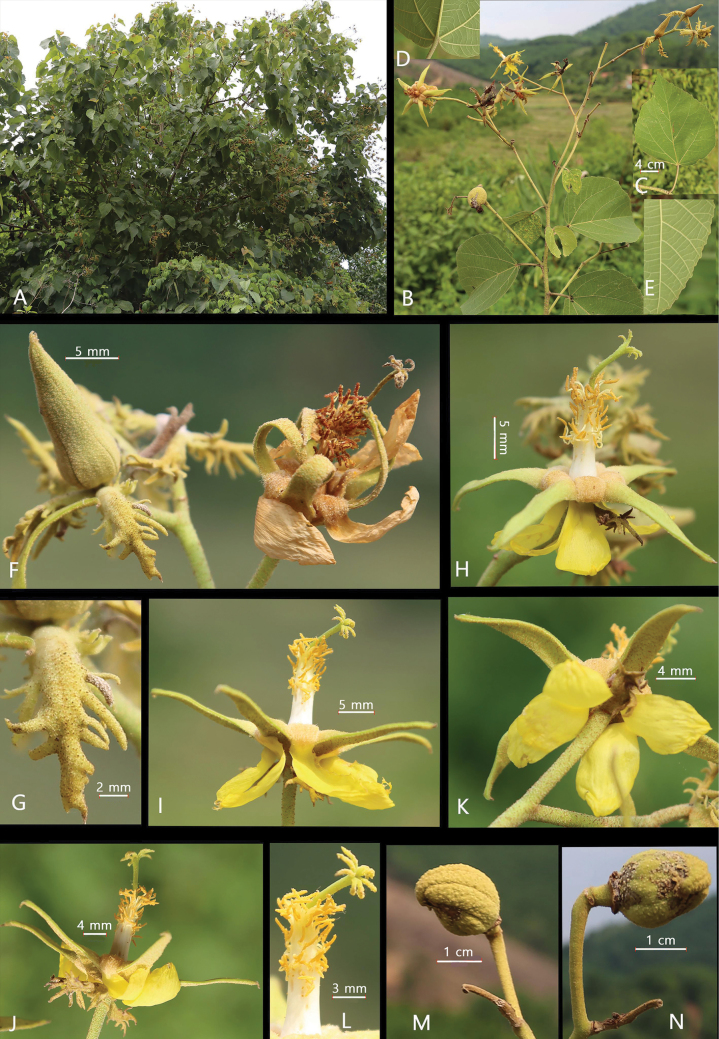 Figure 1
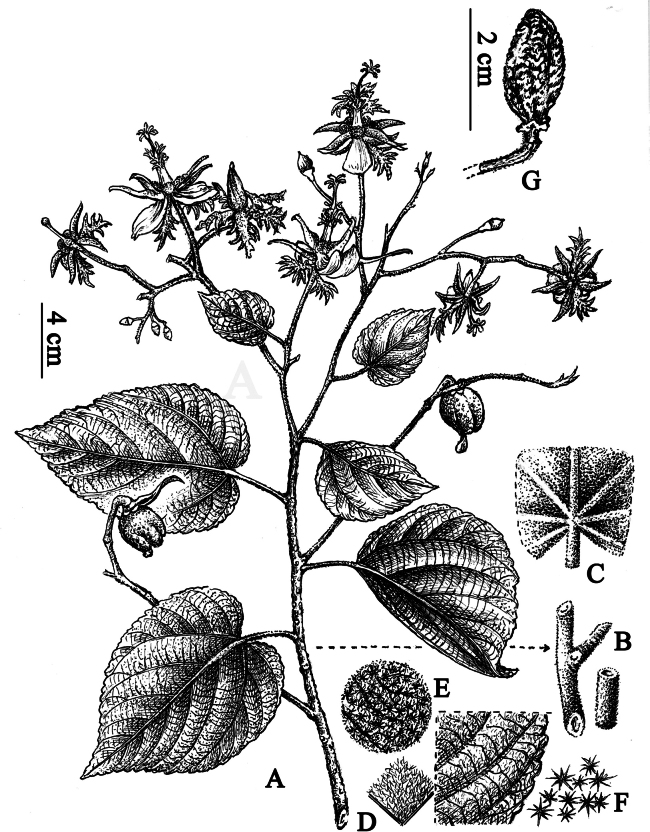 Figure 2
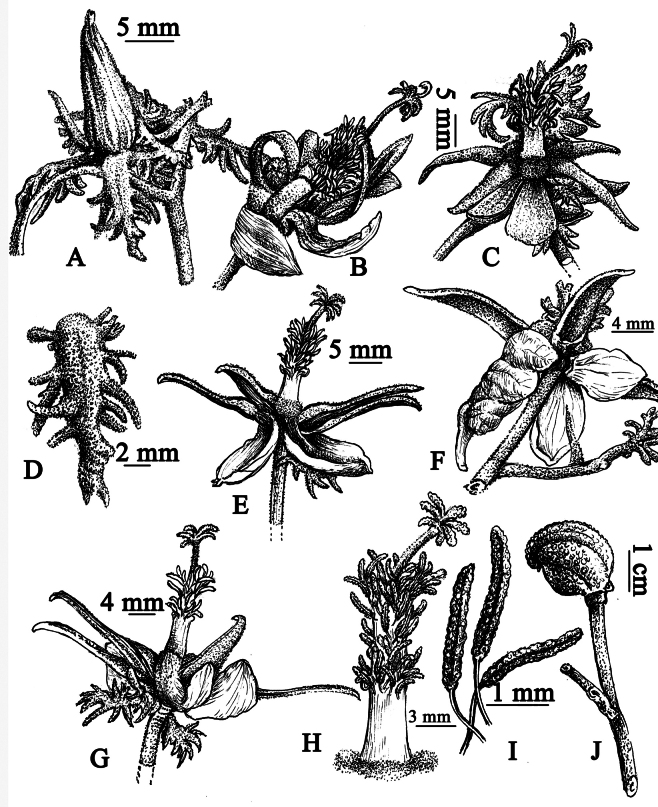 Figure 3
| Characters |
|
|
|
|---|---|---|---|
|
| small tree up to 8 m tall | tree up to 20 m tall | trees up to 6 m tall |
|
| lanceolate | lanceolate | globular |
|
| present | absent | present |
|
| deeply, densely fringed | sparsely fringed | deeply fimbriate |
|
| style significantly exceeds staminal tube length | style slightly longer than staminal tube | – |
|
| round | pointed and beaked | apex shortly beaked |
|
| 3.5–3.7 | 1.0–3.0 | ca. 1.5 |
| 1 | Inflorescences ≤ 6.0 cm long. Flower bud globular |
|
| – | Inflorescences ≥ 7.0 cm long. Flower bud lanceolate |
|
| 2 | Pedicel 3.0–4.0 cm long. Epicalyx lobes sparsely fringed, epicalyx absent after anthesis. Width of ovary 0.2–0.3 cm long, style slightly longer than staminal tube. Apex of fruit pointed and beaked, fruit stalk 1.0–3.0 cm long |
|
| – | Pedicel 1.4–2.3 cm long. Epicalyx lobes densely fringed, epicalyx present after anthesis. Width of ovary 0.5–0.6 cm long, style much longer than the staminal tube. Apex of fruit round, fruit stalk 3.5–3.7 cm long |
|
Peer Reviews
No public reviews on file for this paper yet. If you reviewed it on a platform where reviews are public (OpenReview, ICLR, NeurIPS, ICML), you can paste yours below so the community can read it here.
Videos
No videos yet. Explain this paper in a talk, walkthrough, or lecture? Add one.
Taxonomy
TopicsPlant and Fungal Species Descriptions · Plant and animal studies · Plant Diversity and Evolution
Introduction
Eriolaena DC. was established in 1823. This genus is now recognised as a genus in the subfamily Dombeyoideae, family Malvaceae (Colli-Silva et al. 2025). The genus comprises approximately 17 species (Ya et al. 2007), mainly distributed in tropical and subtropical Asia. In Vietnam, one species of Eriolaena (E.candollei) has been recorded so far (Gagnepain 1910; Nguyen et al. 1980; Pham 1999; Chamlong 2001; Nguyen 2003; Newman et al. 2007; Ya et al. 2007; Chandramohan et al. 2020; POWO 2025). E.candollei includes three synonyms such as E.affinis Pierre, E.glabrescens DC. and E.kwangsiensis Hand.-Mazz. (POWO 2025). The species is native to Bangladesh, Cambodia, south-central China, southeast China, East Himalaya, India, Laos, Myanmar, Thailand and Vietnam (POWO 2025). In 2025, during a botanical survey of Bac Giang Province, Vietnam, specimens of the genus Eriolaena were collected from this Province. After comparing with specimens in the Herbaria HN, K, KRIB, P and VNM and consulting the relevant literature, we determined that our specimens represent a new species. Here, we describe and illustrate this new species as Eriolaenabacgiangensis T.H.Bui.
Materials and methods
All morphological characters of the new species were observed from living and dried specimens. Material was stored at HN Herbarium of the Institute of Biology in Vietnam. The conservation status of the new species was assessed according to the guidelines of the International Union for Conservation of Nature (IUCN 2025). Other specimens of Eriolaena species are studied at HN, KRIB, VNM Herbaria that preserve many specimens of species distributed in Vietnam (acronyms follow Thiers (2025)).
Taxonomy
Eriolaena
bacgiangensis
Taxon classificationPlantae
T.H.Bui sp. nov.
B680676E-A003-5F1F-BA05-58D5CF7623EA
urn:lsid:ipni.org:names:77360921-1
Type.
Vietnam. • Bac Giang Province, Son Dong District, Huu San Commune, 21°23'26.1"N, 106°57'27.6"E, alt. 178 m, 18 July 2015, T.B. Tran, D.B. Tran, T.C. Vu, V.H. Do, H.Q. Bui, H.S. Doan, VK 6489 (holotype: HN80497!; isotypes: HN80498!, HN80499!, HN80500!, VNM00074095!).
Diagnosis.
Eriolaenabacgiangensis is most similar to E.candollei due to the shape of the leaf blade, number of basal and lateral veins, presence of epicalyx in the flower bud, lanceolate epicalyx; shape of sepal (linear–lanceolate) and yellow petals. E.bacgiangensis differs from E.candollei by the pedicel length (1.4–2.3 cm), presence of epicalyx after flowers at anthesis, densely fringed epicalyx, style significantly exceeds staminal tube length and fruit apex round.
Description.
Small tree up to 8 m tall; branchlets stellate puberulent. Stipules caducous. Petioles 1.1–6.0 cm long, densely pubescent. Leaf blades cordate, 7.0–23 × 3.6–18.0 cm; apex acute to caudate; base shallowly cordate; surfaces pubescent; veins densely pubescent; stellate hairy, denser abaxially; margin obtusely dentate; basal veins 5–7; secondary veins 3–5-paired. Inflorescence racemose, axillary to terminal, 3–10-flowered, 13.0–18.0 cm long. Flower pedicels 1.4–2.3 cm long, densely pubescent. Flower buds with epicalyx; epicalyx horizontal or pendulous; lanceolate, 1.5–1.6 × 0.6–0.7 cm, densely pubescent. Epicalyx present after flowers at anthesis, 1.3–1.5 × 0.2–0.4 cm; epicalyx lobe linear, margin pinnately partite, densely fringed, densely woolly stellate pilose. Calyx and corolla 5-merous. Sepals 5, valvate, linear–lanceolate, 2.0–2.9 × 0.47–0.53 cm; abaxially stellate hairy, adaxially villous. Petals 5, yellow to orange, oblong-rectangle; petals are turned backwards between the sepals; 1.3–1.5 × 0.6–0.7 cm, broader than sepals; above part glabrous; apex entire to emarginate; narrowed towards the base, claw broad, thick densely pubescent, deflexed between the sepals. Stamens many, connate into cylindrical tube; staminal tube covering the ovary and style, 1.1–1.3 cm long; anthers linear-oblong to rectangular, 0.21–0.31 × 0.04 cm, 2-celled, cells parallel. Ovary superior, ovate, 0.07–0.08 × 0.05–0.06 cm, pubescent; style linear, simple, 2.0–2.2 cm long, style significantly exceeds staminal tube length; stigma 5–7-lobed, lobes needle-like, horizontal to down-curved. Capsules ovate-elliptic, woody, 2.0–2.5 × 1.3–1.8 cm, longitudinally grooved, fruit apex round; fruit stalk 3.5–3.7 cm long; densely hairy.
Eriolaenabacgiangensis T.H.Bui A habit B flowering, fruiting branch C leaves D cordate base E dentate margin F flower bud and flower G epicalyx lobes H–J flower K flower from below L staminal tube, style, stigma M, N fruit (Photos by T.B. Tran).
Etymology.
The specific epithet refers to the type locality, Bac Giang Province in Vietnam.
Distribution and ecology.
E.bacgiangensis is found only in Vietnam, Bac Giang Province, Son Dong District, Huu San Commune, where it grows in well-lit places in shrubland and dry soil of secondary forest, in association with Acaciamangium Willd., Bidenspilosa L., Cayratiatrifolia (L.) Mabb. & J.Wen, Chromolaenaodorata (L.) R.M.King & H.Rob. and Stachytarphetajamaicensis (L.) Vahl. Flowering and fruiting specimens were collected in July 2015.
Eriolaenabacgiangensis T.H.Bui A flowering, fruiting branch B pubescent branch C pubescent leave D–F stellate hairs on leaves G fruit (Drawn by Le Kim Chi).
Conservation status.
Data Deficient (DD) (IUCN 2025). Eriolaenabacgiangensis is known only from the type locality. A comprehensive botanical survey of the Eriolaena has not been carried out to date. Potential threats from habitat fragmentation for road construction and land-use change for Acacia spp. plantations, therefore, require urgent and appropriate plans for ex situ species conservation.
Eriolaenabacgiangensis T.H.Bui A flower bud B, C bloom flower D epicalyx lobes E, G flower F flower from below H staminal tube, style, stigma I stamens J fruit (Drawn by Le Kim Chi).
Discussion
Diagnostic characters separating the allied species are listed in Table 1. Based on keys to species of Eriolaena mentioned in previous works (Ya et al. 2007; Chandramohan et al. 2020), we determined two species of Eriolaena (E.candollei, E.wallichii) with some similar features to the specimens we collected (branchlets stellate pubescent, stipules caducous, inflorescence axillary or terminal, pedicel with stellate hairy, flower bud with epicalyx, sepals 5, sepal linear–lanceolate, petals 5, fruit pubescent).
Two easily recognisable features of the epicalyx which we used to distinguish E.bacgiangensis from E.candollei include the presence of the epicalyx after flowers at anthesis and densely fringed epicalyx in E.bacgiangensis (vs. absence of epicalyx after flowers at anthesis and sparsely fringed epicalyx in E.candollei).
The shape of the epicalyx lobe can be used to distinguish E.bacgiangensis from E.wallichii (linear vs. ovate in E.wallichii). Therefore, the characteristics of the epicalyx are very important for the identification of E.bacgiangensis. In addition, the other differences in characteristics of the two species are: leaf blade (not thickly papery in E.bacgiangensis vs. thickly papery in E.wallichii); length of inflorescences (13.0–18.0 cm in E.bacgiangensis vs. ≤ 6.0 cm in E.wallichii); shape of flower bud (lanceolate in E.bacgiangensis vs. globular in E.wallichii); fruit apex (round in E.bacgiangensis vs. apex shortly beaked in E.wallichii).
Key to three species E.bacgiangensis, E.candollei and E.wallichii
**: **
Additional specimens examined
E.candollei: VIETNAM. Lang Son: Lang Met, 4/7/1944, Petelot, Petelot 6899 (VNM); Ninh Binh: Cuc Phuong, N.M Cuong, NMC 139 (HN); Thanh Hoa, 1921, Poilane, Poilane 1611 (VNM); Kon Tum: Sa Thay, Sa Son, 4/5/2009, T.T. Bach, V.T Chinh, D.V. Hai, B.H. Quang, VK 2630 (HN, KRIB); Dak Lak: Buon Ma Thuot, 17/1/1956, Pierre, Pierre 133 (VNM). LAOS: Xiangkhouang, 6/4/1949, Vidal, s.n. (VNM).
Supplementary Material
XML Treatment for Eriolaena bacgiangensis
The reference list from the paper itself. Each links out to its DOI / PubMed record.
- 1Chamlong P (2001) Sterculiaceae. Flora of Thailand.The Forest Herbarium, Royal Forest Department, Bangkok 7: 351–654.
- 2Chandramohan K Mahesh Y Rambabu K Kiran E (2020) A taxonomic revision of the genus Eriolaena (Malvaceae) in India.Annals of Plant Sciences 9(1): 3681–3692.
- 3Colli-Silva Pérez-Escobar OA Ferreira CDM Costa MTR Gerace S Coutinho TS Yoshikawa VN Antonio-Domingues H Hernández-Gutiérrez R Bovini MG Duarte MC Cheek M Chase MW Fay MF Christenhusz MJM Dorr LJ Schoeplein C Corcoran M Roy S Cable S Mc Lay T Maurin O Forest F Baker WJ Antonelli A (2025) Taxonomy in the light of incongruence: An updated classificationof Malvales and Malvaceae based on phylogenomic data.Taxon 74(2): 361–385. 10.1002/tax.13300 · doi ↗
- 4Gagnepain F (1910) Sterculiacées. In: Lecomte PH (Ed.) Flore Générale de l’Indo-Chine. Masson & Co., Paris,1: 454–481.
- 5IUCN (2025) The IUCN Red List of Threatened Species. Version 2025-1. https://www.iucnredlist.org [Accessed on 19 April 2025]
- 6Newman M Ketphanh S Svengsuksa B Thomas P Sendala K Lamxay V Amstrong K (2007) A checklist of the vascular plants of Lao PDR. Royal Botanic Garden Edinburgh.
- 7Nguyen TB (2003) Sterculiaceae. In: Nguyen TB (Ed.) A Checklist of plant species in Vietnam.Agricultural Publishing House 2: 548–552.
- 8Nguyen BQ Vu VD Nguyen NC Cao TC (1980) Vietnam Forest Trees.Agricultural Publishing House 3: 152–153.