Duodenal stricture in Crohn’s disease successfully managed with a fully covered metal stent-assisted with double pig-tail stents
Changqing Sun, Juan Wei, Yuping Qiu, Shupei Li, Juan Xu, Xiaoli Ren, Ji Xuan

Abstract
Genes, proteins, chemicals, diseases, species, mutations and cell lines named across the full text — each resolved to its canonical identifier and authoritative record.
Click any figure to enlarge with its caption.
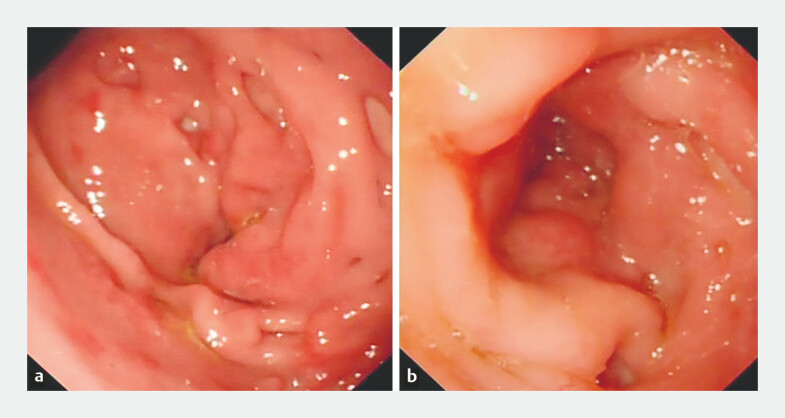 Fig. 1
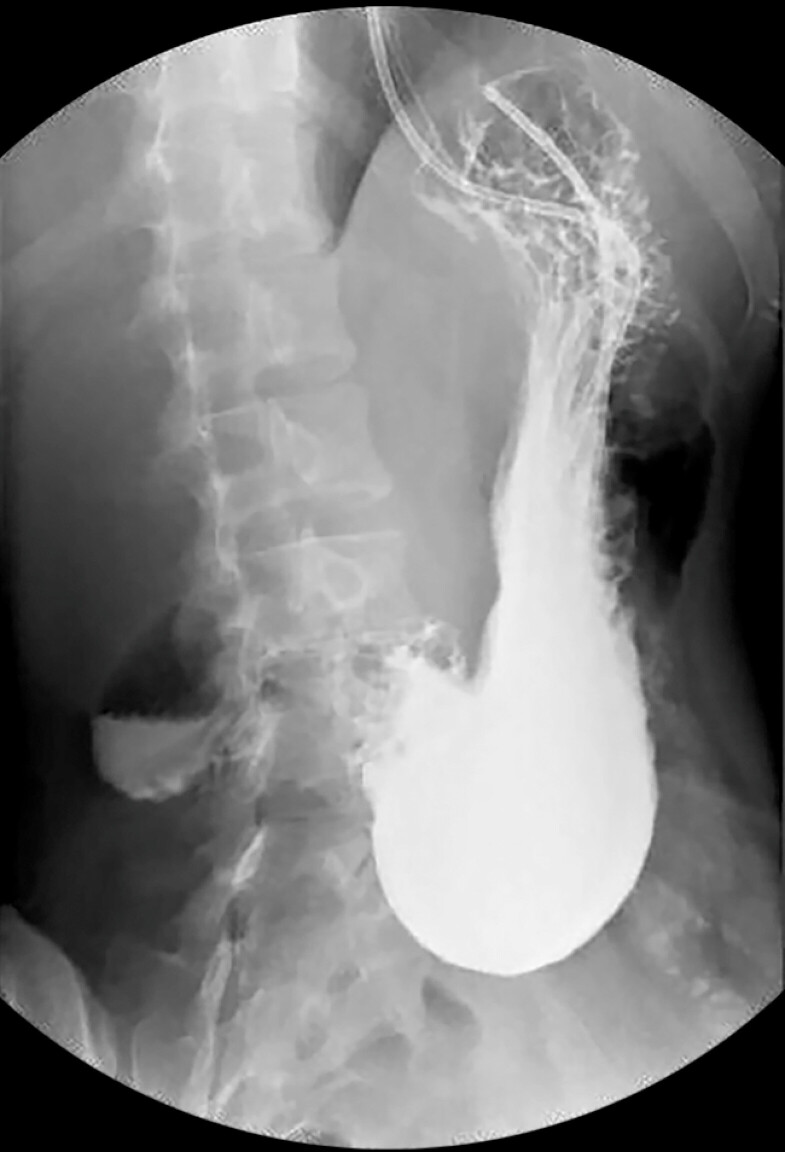 Fig. 2
Peer Reviews
No public reviews on file for this paper yet. If you reviewed it on a platform where reviews are public (OpenReview, ICLR, NeurIPS, ICML), you can paste yours below so the community can read it here.
Videos
No videos yet. Explain this paper in a talk, walkthrough, or lecture? Add one.
Taxonomy
TopicsEsophageal and GI Pathology · Abdominal vascular conditions and treatments · Biliary and Gastrointestinal Fistulas
A fully covered metal stent is a potentially feasible treatment option for refractory benign strictures, though stent migration limits its use 1 2 .
We present the case of a 21-year-old man diagnosed with Crohn’s disease (A2L3+4B2, CDAI: 59.14), who presented with a long-segment pyloroduodenal obstruction secondary to upper gastrointestinal Crohn’s disease. The patient presented with abdominal pain, vomiting, and significant weight loss, resulting in malnutrition. Endoscopy revealed pyloroduodenal stricture ( Fig. 1 ). Upper gastrointestinal radiography showed a delayed passage of contrast medium through the pyloroduodenal region ( Fig. 2 ). The patient received a 390 mg intravenous dose of ustekinumab. However, the obstruction persisted, and conservative anti-inflammatory treatment proved ineffective.
Endoscopy revealed pyloroduodenal stricture.
Upper gastrointestinal radiography showed a delayed passage of contrast medium through the pyloroduodenal region.
The patient declined surgery. The stricture is located in an anatomically curved and sharply angulated region. Endoscopic balloon dilation is suitable for short (<5 cm long) and straight strictures 3 ; however, in this case, the stricture was curved, and its length >5 cm. Consequently, we opted to place a fully covered metal stent.
A fully covered stent was deployed at the site of stricture. Subsequently, two double pig-tail plastic stents were inserted in a perpendicular configuration to form an “X” effectively fixing the fully covered stent. The patient had membrane damage by local granulation tissue infiltration into the stent 2 weeks after stent placement. To prevent mucosal injury, the stent was removed using an inverted technique via the anal route successfully ( Video 1 ). Postoperatively, the patient received symptomatic treatment, including acid suppression, gastric mucosal protection, and regular ustekinumab therapy for the underlying disease. Three months later, no evidence of recurrent strictures was observed.
Two double pig-tail stents in a perpendicular configuration, successfully fixed the fully covered stent.Video 1
This novel technique aims to reduce stent migration. Fully covered duodenal stent placement holds promise as a safe and effective treatment for refractory benign gastrointestinal strictures, offering the potential to delay or obviate the need for surgery.
Endoscopy_UCTN_Code_TTT_1AO_2AZ
CorrectionCorrection: Duodenal stricture in Crohn’s disease successfully managed with a fully covered metal stent-assisted with double pig-tail stents Changqing Sun, Juan Wei, Yuping Qiu et al. Duodenal stricture in Crohn’s disease successfully managed with a fully covered metal stent-assisted with double pig-tail stents. Endoscopy 2025; 57: E394–E395, doi:10.1055/a-2589-0790 In the above-mentioned article affiliation 1 has been corrected. This was corrected in the online version on March 13, 2026.
The reference list from the paper itself. Each links out to its DOI / PubMed record.
- 1Mohan BP Chandan S Garg R Lumen-apposing Metal Stents, Fully Covered Self-expanding Metal Stents, and Biodegradable Stents in the Management of Benign of GI Strictures A Systematic Review and Meta-Analysis J Clin Gastroenterol 20195356057310.1097/MCG.000000000000122831149932 · doi ↗ · pubmed ↗
- 2Hori Y Hayashi K Naitoh I Feasibility and safety of duodenal covered self-expandable metallic stent fixation: an experimental study Surg Endosc 2019334026403110.1007/s 00464-019-06694-130759276 · doi ↗ · pubmed ↗
- 3El Ouali S Click B Holubar SD Natural history, diagnosis and treatment approach to fibrostenosing Crohn’s disease United European Gastroenterol J 2020826327010.1177/2050640620901960 PMC 718466432213020 · doi ↗ · pubmed ↗