“Nothing Comes to Mind…”: Challenges With Identifying One’s Own Role in Preventable Adverse Outcomes in Interprofessional Birthing Unit Teams, and the Implications for Quality Improvement Initiatives
Lauren Columbus, Ayma Aqib, Rachael Pack, Harrison Banner, Taryn Taylor

TL;DR
This study explores how birthing unit staff struggle to recognize their own role in preventable adverse outcomes, which can hinder quality improvement efforts.
Contribution
The study introduces the concept of dissonant self-schemas in interprofessional teams and their impact on quality improvement initiatives.
Findings
Staff created more flattering self-schemas than the schemas their colleagues formed about them.
Participants easily identified others' errors but struggled to acknowledge their own role in poor outcomes.
Dissonant schemas may hinder accurate self-assessment and team competence.
Abstract
Preventable adverse perinatal outcomes have a devastating impact on patients and providers and form the basis of many quality improvement (QI) and patient safety initiatives in birthing unit teams, including fetal health surveillance (FHS) training programs. Birthing unit staff attitudes regarding the role of interprofessional relationships on FHS decisions remain largely unexplored with respect to preventable adverse outcomes. In this intervention-primed, constructivist grounded theory study, members across all five professions providing intrapartum care at one academic centre attended an interprofessional workshop on improving their FHS interpretation, response, communication, and teamwork skills. Twenty-three birthing unit team members across midwifery, obstetrics, family medicine, nursing, and obstetrical trainees were purposively sampled and completed semi-structured interviews.…
Genes, proteins, chemicals, diseases, species, mutations and cell lines named across the full text — each resolved to its canonical identifier and authoritative record.
Click any figure to enlarge with its caption.
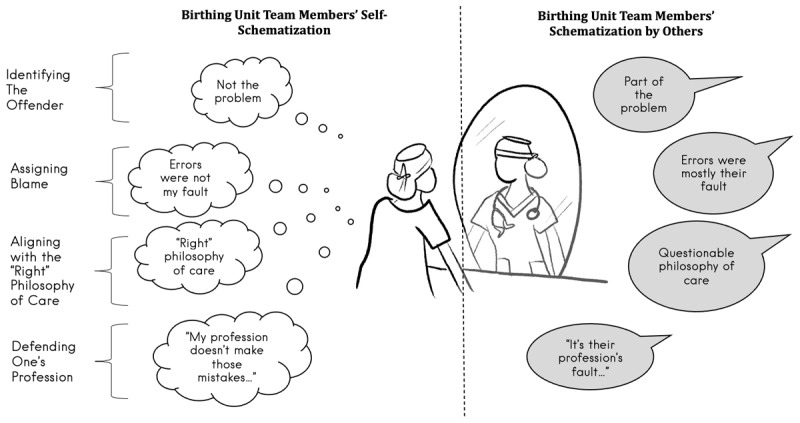 Figure 1
Peer Reviews
No public reviews on file for this paper yet. If you reviewed it on a platform where reviews are public (OpenReview, ICLR, NeurIPS, ICML), you can paste yours below so the community can read it here.
Videos
No videos yet. Explain this paper in a talk, walkthrough, or lecture? Add one.
Taxonomy
TopicsInterprofessional Education and Collaboration · Family and Patient Care in Intensive Care Units · Counseling, Therapy, and Family Dynamics