Sampling and metabarcoding of arthropod environmental DNA traces from flowers
David Wari, Yoshinobu Kusumoto, Toshio Kitamura

TL;DR
This paper shows how environmental DNA (eDNA) from flowers can reveal arthropod species, offering a faster alternative to traditional survey methods.
Contribution
Adapting aquatic eDNA methods to detect arthropod traces on flowers, revealing cryptic species.
Findings
eDNA traces on flowers reveal diverse arthropod species.
Modified aquatic eDNA methods work for floral sampling.
eDNA data complements traditional survey methods.
Abstract
Screening and selection of insectary plants that promote natural enemies has been mostly approached via conventional methods that employ mundane man-hours of manual surveys, sampling, sorting, and viewing under microscope. In this digital age, mundane man-hours in ecological surveys can be approached with revolutionary sequencing technology, i.e. the Next Generation Sequencing (NGS). Ecological scientist, especially marine biologists have been tracing environmental DNA (eDNA) by utilizing the NGS technology to study/monitor micro- and macro-organisms in aquatic conditions. The eDNA technology has now been adopted by applied entomologists and ecologists to survey and monitor arthropod biodiversity through space and time. Several advancements have been made in detecting arthropod eDNA traces cryopreserved in plant tissues such as stems, branches, leaves, and flowers. Using the techniques…
Genes, proteins, chemicals, diseases, species, mutations and cell lines named across the full text — each resolved to its canonical identifier and authoritative record.
Click any figure to enlarge with its caption.
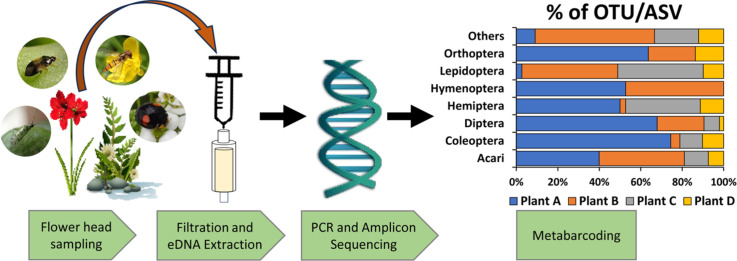 Figure 1
 Figure 2
 Figure 3
Peer Reviews
No public reviews on file for this paper yet. If you reviewed it on a platform where reviews are public (OpenReview, ICLR, NeurIPS, ICML), you can paste yours below so the community can read it here.
Videos
No videos yet. Explain this paper in a talk, walkthrough, or lecture? Add one.
Taxonomy
TopicsEnvironmental DNA in Biodiversity Studies · Identification and Quantification in Food · Species Distribution and Climate Change