The Dinuclear Zirconocene Complex [(Cp2Zr)2(μ‐Me)(μ‐C2Ph)] as a Platform for Small Molecule Activation
Hanan Al Hamwi, Mirko Rippke, Kevin Lindenau, Anke Spannenberg, Martin Lamac, Fabian Reiß, Torsten Beweries

TL;DR
A new zirconocene complex is shown to activate small molecules and form unique hydride complexes through various reactions.
Contribution
The study introduces a dinuclear zirconocene complex as a versatile platform for small molecule activation and hydride complex formation.
Findings
The complex catalyzes amine borane dehydrocoupling and forms a hydride-bridged alkynyl complex.
Reactions with hydrogen produce a trinuclear hydride-bridged complex with a unique carbon environment.
Reactions with nitriles involve coordination and reduction of substrates.
Abstract
The dinuclear title compound [(Cp2Zr)2(μ‐Me)(μ‐C2Ph)] 5 was prepared from a zirconocene alkynyl methyl complex and Rosenthal's zirconocene source [Cp2Zr(py)(η 2‐Me3SiC2SiMe3)] in a formal comproportionation reaction. This complex shows catalytic activity for the dehydrocoupling of amine boranes, with a dinuclear hydride‐bridged alkynyl complex 6 being formed as a catalytically relevant species. The structure of this complex was confirmed for the first time by single‐crystal X‐ray analysis. The reaction of complex 5 with hydrogen results in hydrogenation of the alkynyl ligand, yielding a highly labile trinuclear hydride‐bridged complex as a possible intermediate of zirconocene dihydride/ethylbenzene formation. This complex shows an unusual distorted planar tetracoordinate environment at the central carbon atom positioned between the three Zr centers. The reaction of complex 5 with…
Genes, proteins, chemicals, diseases, species, mutations and cell lines named across the full text — each resolved to its canonical identifier and authoritative record.
Click any figure to enlarge with its caption.
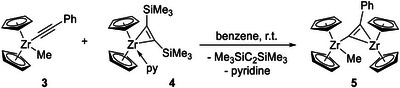 Figure 1
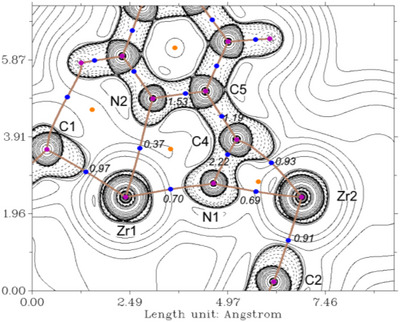 Figure 2
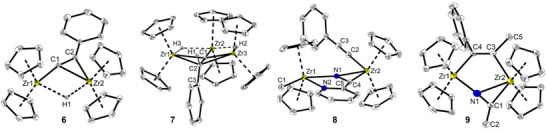 Figure 3
 Figure 4
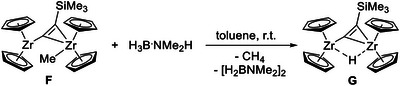 Figure 5
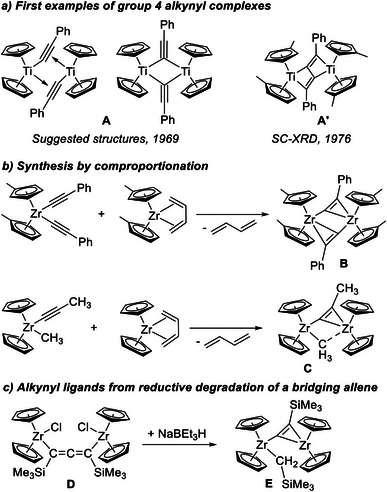 Figure 6
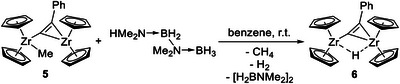 Figure 7
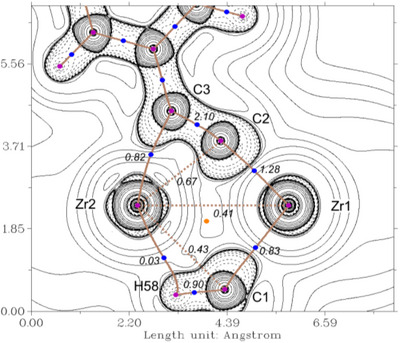 Figure 8
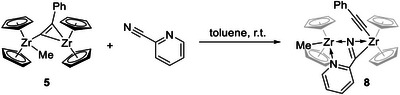 Figure 9
 Figure 10
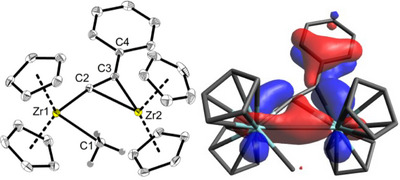 Figure 11
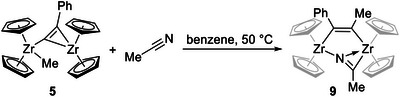 Figure 12
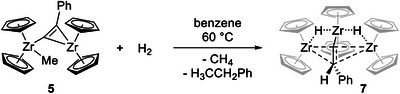 Figure 13
Peer Reviews
No public reviews on file for this paper yet. If you reviewed it on a platform where reviews are public (OpenReview, ICLR, NeurIPS, ICML), you can paste yours below so the community can read it here.
Videos
No videos yet. Explain this paper in a talk, walkthrough, or lecture? Add one.
Taxonomy
TopicsOrganometallic Complex Synthesis and Catalysis · Synthetic Organic Chemistry Methods · Organoboron and organosilicon chemistry