A linamarase transgene controlled by heatshock creates a pro-toxin activation system in Drosophila melanogaster
Lauren Carey, Osnat Malka, Shai Morin, Charles Robin

TL;DR
Scientists made fruit fly larvae sensitive to a plant toxin by inserting a plant enzyme gene controlled by heat shock.
Contribution
A novel pro-toxin activation system in Drosophila using a heat-shock-controlled linamarase transgene.
Findings
Drosophila larvae with the transgene become sensitive to linamarin after heat-shock.
Exposure to gaseous hydrogen cyanide is suggested as the cause of larval death.
Control larvae in sealed containers with transgenic larvae also show sensitivity.
Abstract
Linamarase is a plant β-glucosidase enzyme involved in the activation of plant protoxins. It thereby plays a key role in plant defense mechanisms against herbivory. We have taken the linamarase gene sequence from cassava and placed it into the genome of Drosophila melanogaster under the control of non-leaky heat-shock promoter. We show that Drosophila larvae carrying the transgene become sensitive to the pro-toxin linamarin after heat-shock. Furthermore, the sensitivity is elevated in sealed containers and control-larvae sharing such containers with linamarase-larvae are also sensitive, suggesting that the larvae are dying from poisoning with gaseous hydrogen cyanide.
Genes, proteins, chemicals, diseases, species, mutations and cell lines named across the full text — each resolved to its canonical identifier and authoritative record.
Click any figure to enlarge with its caption.
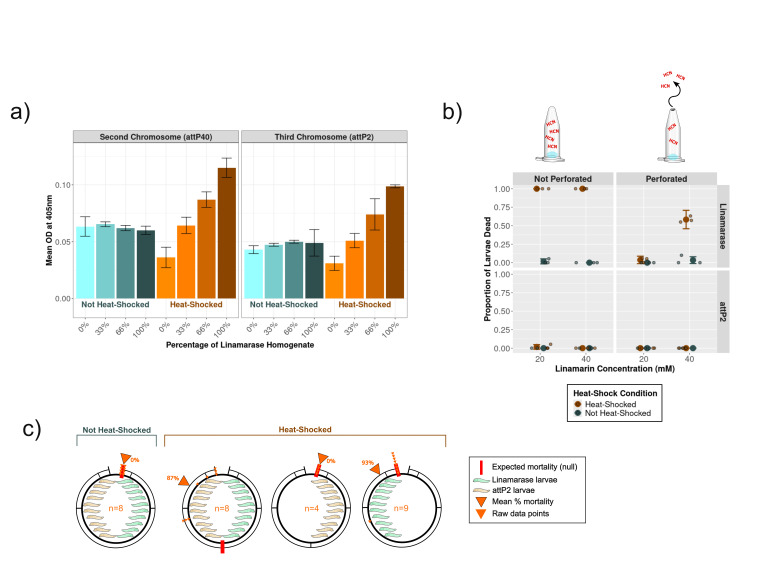 Figure 1
Peer Reviews
No public reviews on file for this paper yet. If you reviewed it on a platform where reviews are public (OpenReview, ICLR, NeurIPS, ICML), you can paste yours below so the community can read it here.
Videos
No videos yet. Explain this paper in a talk, walkthrough, or lecture? Add one.
Taxonomy
TopicsInsect and Pesticide Research · Toxin Mechanisms and Immunotoxins