Aryl Hydrocarbon Receptor (AHR) is required for repopulation of decellularized intestinal colon scaffolds
Lizbeth Perez-Castro, Busola Alabi, Afshan Nawas, M.Carmen Lafita-Navarro, Jerry Shay, Maralice Conacci-Sorrell

TL;DR
This study shows that the AHR protein is essential for regrowing the intestinal lining using decellularized scaffolds.
Contribution
The study reveals a novel role for AHR in intestinal regeneration using decellularized scaffolds.
Findings
Silencing AHR prevents colonic cells from repopulating decellularized colons.
AHR's ligand-dependent activity could be targeted to treat intestinal disorders.
AHR is critical for regulating intestinal tissue renewal.
Abstract
This study investigates the role of the ligand-activated transcription factor AHR in repopulating the intestinal lining. Using organoid-derived cells and decellularized mouse intestinal scaffolds to investigate the importance of AHR in regulating intestinal regeneration, we found that silencing AHR expression hinders the capacity of colonic cells to repopulate decellularized colons. We therefore propose that AHR may play an important role in regulating intestinal regeneration. The ligand-dependent nature of AHR activity may provide an opportunity to interfere with disorders such as cancer and inflammatory bowel diseases which are caused by dysregulation in intestinal tissue renewal.
Genes, proteins, chemicals, diseases, species, mutations and cell lines named across the full text — each resolved to its canonical identifier and authoritative record.
Click any figure to enlarge with its caption.
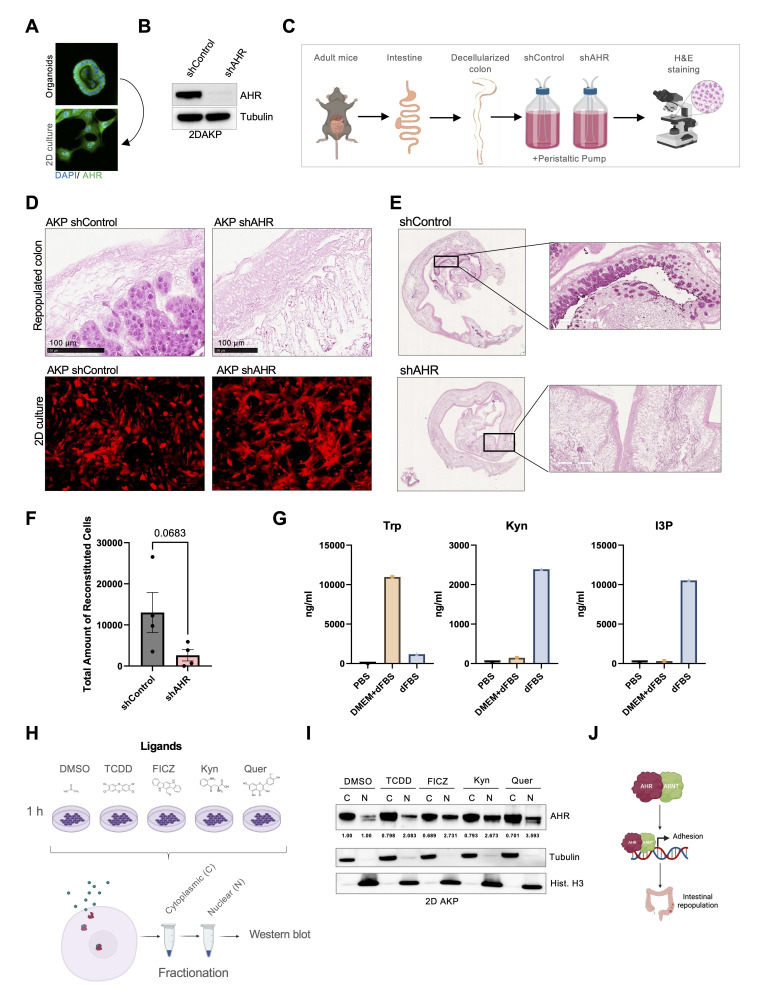 Figure 1
Peer Reviews
No public reviews on file for this paper yet. If you reviewed it on a platform where reviews are public (OpenReview, ICLR, NeurIPS, ICML), you can paste yours below so the community can read it here.
Videos
No videos yet. Explain this paper in a talk, walkthrough, or lecture? Add one.
Taxonomy
TopicsTissue Engineering and Regenerative Medicine