Shifting the substrate scope of dimeric pyranose oxidase from monosaccharide to glycoside preference through oligomeric state modification
Anja Kostelac, Enikő Hermann, Clemens Peterbauer, Chris Oostenbrink, Dietmar Haltrich

TL;DR
Researchers modified a dimeric pyranose oxidase to prefer glycosides over monosaccharides by altering its oligomeric state.
Contribution
The study demonstrates that modifying the oligomeric state of pyranose oxidase can shift its substrate preference from monosaccharides to glycosides.
Findings
Deleting domains in KaPOx led to monomeric variants that preferred glycosides like phlorizin over monosaccharides.
Monomeric KaPOx variants showed 24 × 10⁶ higher catalytic efficiency for phlorizin compared to d-xylose.
Dimeric KaPOx had no activity towards glycosides due to steric hindrance and active site inaccessibility.
Abstract
Pyranose oxidase (POx) and C‐glycoside oxidase (CGOx) are FAD‐dependent oxidoreductases belonging to the glucose‐methanol‐choline oxidoreductase superfamily and share the same sequence space. Despite a shared structural fold, these two members possess homologous domains that enable (arm and head domain) or disable (insertion‐1 domain and barrel‐shaped bottom) oligomerization. POxs with a higher oligomerization state (dimeric or tetrameric) exclusively catalyze the oxidation of monosaccharides (d‐glucose, d‐xylose). In contrast, the monomeric state of POxs/CGOxs is observed to prefer glycosides (homoorientin, phlorizin) and has low activity with free monosaccharides. We aimed to engineer dimeric POx from Kitasatospora aureofaciens (KaPOx) to form a functional monomer, and monomeric POx/CGOx from Streptomyces canus (ScPOx) to a dimeric structure. Deletion of the head and arm domains of…
Genes, proteins, chemicals, diseases, species, mutations and cell lines named across the full text — each resolved to its canonical identifier and authoritative record.
Click any figure to enlarge with its caption.
 Figure 1
 Figure 2
 Figure 3
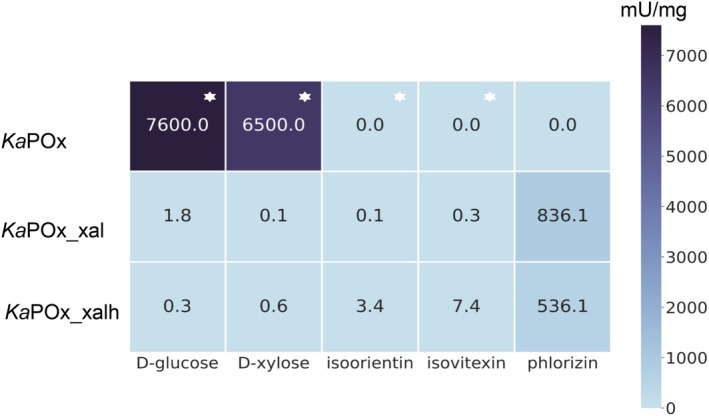 Figure 4
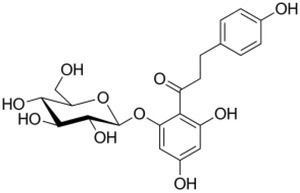 Figure 5
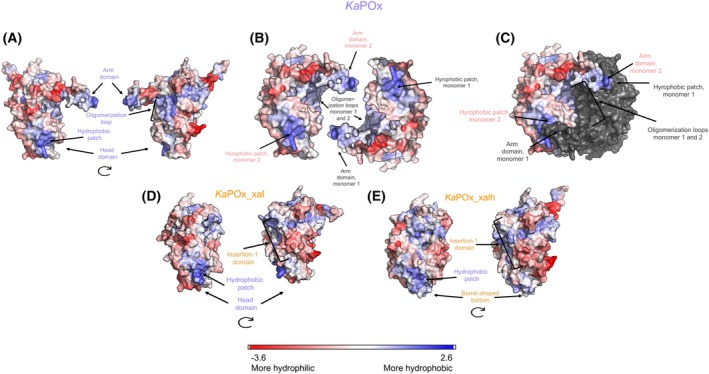 Figure 6
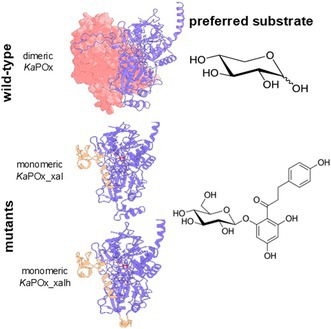 Figure 7
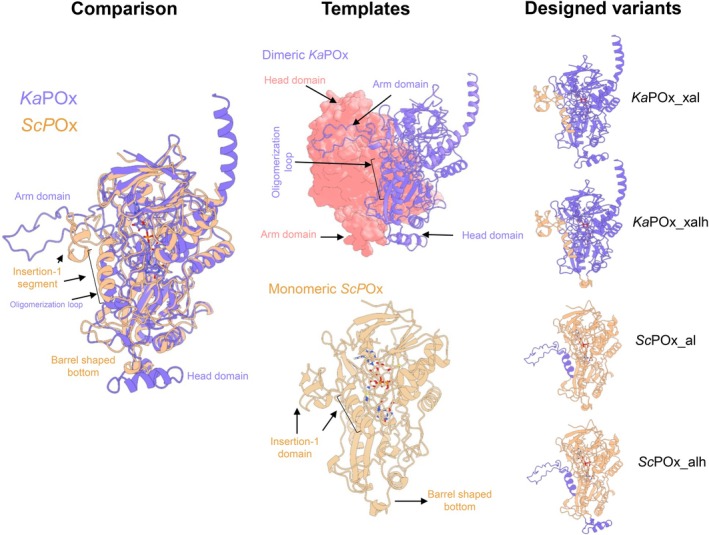 Figure 8
Peer Reviews
No public reviews on file for this paper yet. If you reviewed it on a platform where reviews are public (OpenReview, ICLR, NeurIPS, ICML), you can paste yours below so the community can read it here.
Videos
No videos yet. Explain this paper in a talk, walkthrough, or lecture? Add one.
Taxonomy
TopicsEnzyme-mediated dye degradation · Microbial Metabolism and Applications · Enzyme Catalysis and Immobilization