How long can you hold on? Physical self-efficacy predicts performance estimation accuracy independent of leisure-time physical activity
Friedrich Meixner, Sophia Wölfle, Nizar Hawat

TL;DR
This study shows that a person's belief in their physical abilities helps them better estimate their performance in exercises, regardless of how active they are in their free time.
Contribution
The study demonstrates that physical self-efficacy, not leisure-time physical activity, predicts performance estimation accuracy.
Findings
Participants underestimated their performance in physical exercises regardless of their activity levels.
Physical self-efficacy was strongly linked to more accurate performance estimation across all exercises.
The relationship between self-efficacy and estimation accuracy was not influenced by leisure-time physical activity.
Abstract
Accurately estimating future performance is crucial for optimizing performance in sports and exercise. In our study, we aimed to explore the relationship between physical self-efficacy and the accuracy of performance estimation in various physical exercises. Data were collected from N = 31 students (M = 23.5 years, n = 23 female, BMI 17–30, not engaged in any competitive sports). Measurements included questionnaires on physical activity and physical self-efficacy. Participants estimate their performance in five exercises, prior to performing them: (a) dumbbell hold, (b) plank, (c) vertical jump, (d) grip strength and (e) flamingo balance test. Independently of leisure-time physical activity, participants underestimated their performance in these exercises. Physical self-efficacy was neither associated with levels of intense, leisure-time physical activity (r = 0.243, p > 0.05), nor…
Genes, proteins, chemicals, diseases, species, mutations and cell lines named across the full text — each resolved to its canonical identifier and authoritative record.
Click any figure to enlarge with its caption.
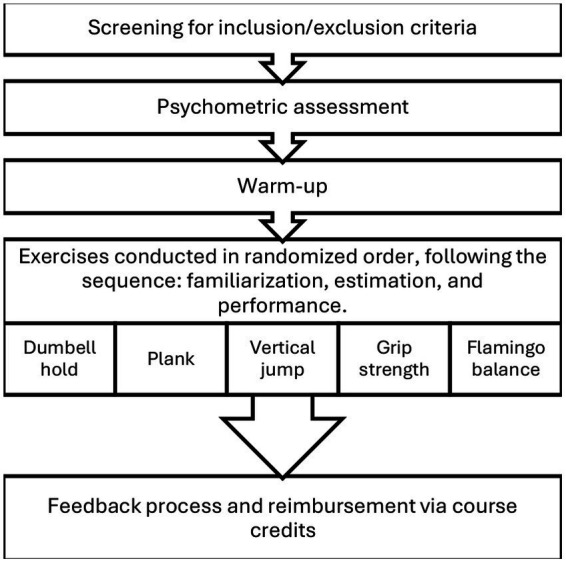 Figure 1
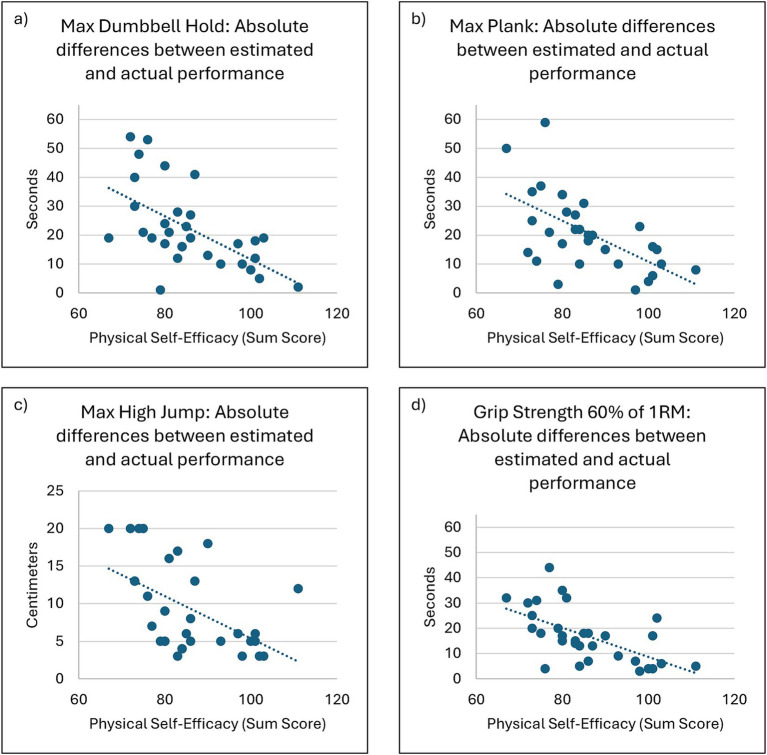 Figure 2
Peer Reviews
No public reviews on file for this paper yet. If you reviewed it on a platform where reviews are public (OpenReview, ICLR, NeurIPS, ICML), you can paste yours below so the community can read it here.
Videos
No videos yet. Explain this paper in a talk, walkthrough, or lecture? Add one.
Taxonomy
TopicsMotivation and Self-Concept in Sports · Behavioral Health and Interventions · Physical Activity and Health