Draft genome sequences of Salmonella enterica subsp. enterica serovar Give sequence type 516 isolated from blood and brain abscess of a child from North India
Paulami Dutta, Subhasree Roy, Gourab Halder, Manisha Ghosh, Arindam Ganai, Archana Angrup, Shanta Dutta

TL;DR
This paper presents draft genome sequences of a Salmonella strain isolated from a child's blood and brain abscess in North India.
Contribution
The study provides new genomic data for Salmonella Give sequence type 516, including its antibiotic resistance gene aac(6′)-Iaa.
Findings
The draft genomes are 4,690,901 bp and 4,703,054 bp in size.
The genomes were assembled into 64 and 67 contigs respectively.
The genomes contain the antibiotic resistance gene aac(6′)-Iaa.
Abstract
Invasive non-typhoidal Salmonellae remains a substantial cause of morbidity and mortality. Here, we present the draft genome sequences of Salmonella Give ST516, isolated from blood and brain abscess of a child. The genome sizes are 4,690,901 bp and 4,703,054 bp, assembled in 64 and 67 contigs respectively, and possess aac(6′)-Iaa.
Genes, proteins, chemicals, diseases, species, mutations and cell lines named across the full text — each resolved to its canonical identifier and authoritative record.
Click any figure to enlarge with its caption.
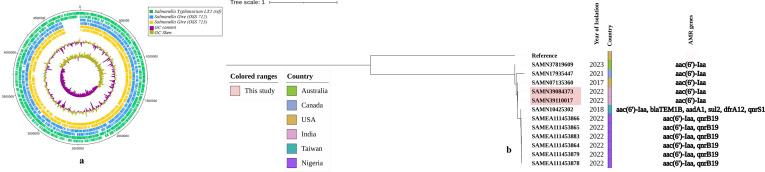 Fig 1
Fig 1| AST and genome characteristic | Result for sample ID: | |
|---|---|---|
| OSS-712 | OSS-713 | |
| Source of isolation | Blood | Brain abscess |
| AST profile | Amp (S), C (S), T (S), Q (S), Nal (S), Cip (S), 3Cs (S), St (S), G (S), Ak (S), Az (S), AmC (S) | Amp (s), C (s), T (s), Q (S), Nal (S), Cip (S), 3Cs (S), St (S), G (S), Ak (S), Az (S), AmC (S) |
| Genome size (bp) | 4,690,901 | 4,703,054 |
| No. of reads | 983,448 | 1,118,588 |
| Mean read length (bp) | 268 | 261 |
| No. of contigs | 64 | 67 |
| G+C content (%) | 52.22 | 52.21 |
|
| 94,979 | 79,869 |
|
| 283,930 | 283,928 |
| Genes (total) | 4,589 | 4,592 |
| CDSs (total) | 4,479 | 4,485 |
| Genes (coding) | 4,298 | 4,311 |
| CDSs (with protein) | 4,298 | 4,311 |
| rRNA (5S, 16S, 23S) | 8, 11, 10 | 8, 9, 10 |
| tRNA | 72 | 71 |
| ncRNAs | 9 | 9 |
| Virulence genes | ||
| AMR gene |
|
|
| ST type (MLST) | 516 ( | 516 ( |
| GenBank accession number |
|
|
| SRA accession number |
|
|
- —Indian Council of Medical Research (ICMR)
- —Indian Council of Medical Research (ICMR)
Peer Reviews
No public reviews on file for this paper yet. If you reviewed it on a platform where reviews are public (OpenReview, ICLR, NeurIPS, ICML), you can paste yours below so the community can read it here.
Videos
No videos yet. Explain this paper in a talk, walkthrough, or lecture? Add one.
Taxonomy
TopicsSalmonella and Campylobacter epidemiology · Bacteriophages and microbial interactions · Genomics and Phylogenetic Studies
ANNOUNCEMENT
Invasive non-typhoidal salmonellosis can be fatal, particularly in children and elderly adults (1). Salmonella enterica subsp. enterica serovar Give was previously reported from ruminants and pigs in Quebec (2, 3). Human infection through consumption of contaminated meat products was reported in the US and Europe (4). Here, we report the draft genome sequences of Salmonella Give ST516, isolated from a child.
A 3-year-old female child with acute encephalopathy syndrome was admitted to the paediatric ward of PGIMER, Chandigarh, India, in December 2022. The patient’s paired peripheral blood samples were collected before starting antibiotic treatment. A brain abscess specimen was taken from the left-sided subdural abscess in operation theater under general anesthesia. The specimens were collected with parental consent and as a part of the treatment protocol. Samples were inoculated in sheep blood agar (BD BBL) and MacConkey agar (BD, Difco) followed by 16 hours of incubation at 37°C. The isolates were identified as Salmonella in MALDI-TOF (Biomerieux) and were sent to ICMR-NIRBI, where they were confirmed as S. Give by serotyping (5, 6). The isolates were susceptible to the tested antibiotics as detected by the Kirby-Bauer disk-diffusion method (Table 1). For the isolation of gDNA, bacterial colonies were inoculated into tryptic soy broth (BD, Bacto) and incubated at 37°C for 16 hours. gDNA was extracted using DNeasy blood and tissue kit (Qiagen), quantified in Qubit 3.0 fluorometer. DNA libraries were prepared for single-end sequencing (400 bp chemistry) using Ion Xpress Plus Fragment Library Kit as per the user manual (Thermo Fisher Scientific, TFS). First, the gDNA was sheared using Ion Shear Plus 10× Reaction Buffer and Enzyme Mix II (TFS) followed by adapter ligation and nick repairing. The DNA was size selected using E-Gel Size Select II Agarose Gel as per the NGS library size selection reference (400 bp) and sequenced on the IonTorrent-S5 platform using Ion530 chip (TFS). Read filtering and trimming were performed by BaseCaller module, inbuilt into Torrent-Suite Software (version 5.16.1) (7). Reads were assembled in contigs using the de novo assembler SPAdes (version 13.3.0) (8). Contigs were annotated by Prokaryotic Genome Annotation Pipeline (version 6.6) of NCBI (9). The annotated assemblies were investigated for the presence of antimicrobial resistance genes (ARGs), plasmids, and sequence types using ResFinder (4.6.0) (10), PlasmidFinder (2.1) (11), and MLST (2.0) (11), respectively, available at Centre for Genomic Epidemiology (11). The virulence genes were determined using Virulence Factor Database (4.0) (12). Default parameters were used for all the analyses.
The genome sizes of OSS-712 and OSS-713 were 4,690,901 bp and 4,703,054 bp, respectively, with an average G+C content of 52%. The genomic features and circular genome plot of the isolates are presented in Table 1; Fig. 1a, respectively. The isolates were pan-susceptible with no notable ARGs, except aac(6′)-Iaa, which is a chromosomal, cryptic gene present in most Salmonella serovars (13).
(a) Circular genome of S. Give ST516 study strains (OSS 712 and OSS 713), compared with S. Typhimurium LT2 (reference strain) plotted from the Artemis tool (version 1.8.0.0) using DNA plotter, with default parameter (14). The outer scale is marked in megabases. The tracks from the outside represent (1) Salmonella Typhimurium LT2 forward CDS; (2) Salmonella Typhimurium LT2 reverse CDS; (3) Salmonella Give (OSS-712) forward CDS; (4) Salmonella Give (OSS-712) reverse CDS; (5) Salmonella Give (OSS-713) forward CDS; (6) Salmonella Give (OSS-713) reverse CDS; (7) %GC plot; and (8) GC skew. (b) WGS-based SNP phylogenetic tree of S. Give ST516 study strains (OSS-712 and OSS-713) were compared with S. Typhimurium LT2 (reference strain) and global blood isolates (n = 10) available at EnteroBase (version 1.2.0). The SNP analysis was done using CSI phylogeny (version 1.4) tool, and the phylogenetic tree was visualized in iTOL (version 6.0).
The phylogenetic relationship of the study strains was compared by WGS-based SNP analysis with only the available blood isolates (n = 10) of S. Give ST516 available at EnteroBase (version 1.2.0) (15) in CSI phylogeny (version 1.4) (16). The phylogenetic tree (Fig. 1b) revealed that the Indian isolates were closely related to the USA isolate (SAMN07135360), which was also pan-susceptible. These sequences will serve as references from this region for comparative global genome analysis.
The reference list from the paper itself. Each links out to its DOI / PubMed record.
- 1Feasey NA, Dougan G, Kingsley RA, Heyderman RS, Gordon MA. 2012. Invasive non-typhoidal Salmonella disease: an emerging and neglected tropical disease in Africa. Lancet 379:2489–2499. doi:10.1016/S 0140-6736(11)61752-222587967 PMC 3402672 · doi ↗ · pubmed ↗
- 2Higgins R, Désilets A, Cantin M, Messier S, Khakhria R, Ismaïl J, Mulvey MR, Daignault D, Caron H. 1997. Outbreak of Salmonella give in the province of Quebec. Can Vet J 38:780–781.9426945 PMC 1576797 · pubmed ↗
- 3Girardin F, Mezger N, Hächler H, Bovier PA. 2006. Salmonella serovar Give: an unusual pathogen causing splenic abscess. Eur J Clin Microbiol Infect Dis 25:272–274. doi:10.1007/s 10096-006-0122-216565825 · doi ↗ · pubmed ↗
- 4Afreen S, Ray P, Muthuvel R, Agarwal A, Angrup A. 2024. Salmonella enterica serovar Give causing brain abscess and bacteremia: a case report. Indian J Med Microbiol 48:100526. doi:10.1016/j.ijmmb.2024.10052638176586 · doi ↗ · pubmed ↗
- 5Winn WC Jr, Allen SD, Janda WM, Koneman E, Procop G, Schreckenberger PC, Woods GL. 2006. Koneman’s colour atlas and textbook of diagnostic microbiology. 6th ed, p 93–107. Lippincott, Philadelphia, PA.
- 6Jain P, Chowdhury G, Samajpati S, Basak S, Ganai A, Samanta S, Okamoto K, Mukhopadhyay AK, Dutta S. 2020. Characterization of non-typhoidal Salmonella isolates from children with acute gastroenteritis, Kolkata, India, during 2000-2016. Braz J Microbiol 51:613–627. doi:10.1007/s 42770-019-00213-z 31898246 PMC 7203375 · doi ↗ · pubmed ↗
- 7Sola-Landa A, Rodríguez-García A, Barreiro C, Pérez-Redondo R. 2017. Genome sequencing of steroid producing bacteria using ion torrent technology and a reference genome. Methods Mol Biol 1645:45–58. doi:10.1007/978-1-4939-7183-1_428710620 · doi ↗ · pubmed ↗
- 8Alexyuk M, Bogoyavlenskiy A, Moldakhanov Y, Akanova K, Manakbayeva A, Alexyuk P. 2024. Draft genome sequence data of methicillin-resistant Staphylococcus aureus, strain 4233. Data Brief 54:110492. doi:10.1016/j.dib.2024.11049238799713 PMC 11127097 · doi ↗ · pubmed ↗