Complete genome sequence of Photobacterium piscicola strain WVL24019 isolated from a freshwater hatchery-raised rainbow trout (Oncorhynchus mykiss)
Pacharapong Khrongsee, Apryle Panyi, Kuttichantran Subramaniam, Joseph M. Groff

TL;DR
This paper presents the full genome sequence of a marine bacterium found in a freshwater-raised trout.
Contribution
The study provides the first complete genome sequence of Photobacterium piscicola strain WVL24019.
Findings
The genome was sequenced using Oxford Nanopore and Illumina NovaSeq technologies.
The sequencing resulted in two complete circular chromosomes.
Abstract
This report describes the complete genome sequence of the non-bioluminescent marine bacterium Photobacterium piscicola strain WVL24019, isolated from a one-year freshwater hatchery-raised rainbow trout in a non-recirculating system supplied by aquiferous water. The genome was sequenced using Oxford Nanopore and Illumina NovaSeq technologies, resulting in two complete circular chromosomes.
Genes, proteins, chemicals, diseases, species, mutations and cell lines named across the full text — each resolved to its canonical identifier and authoritative record.
Click any figure to enlarge with its caption.
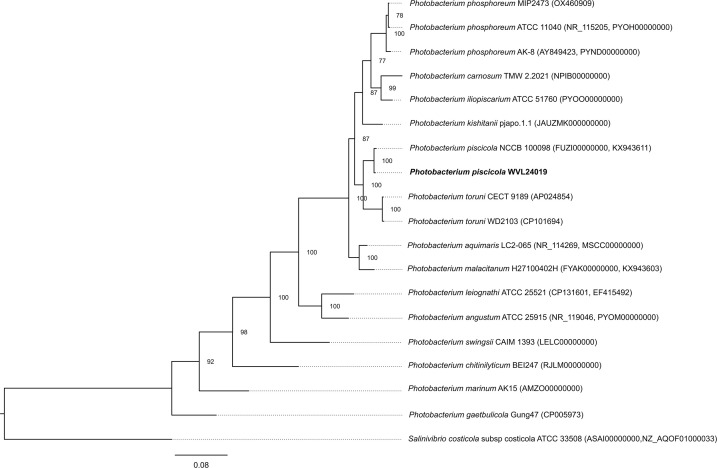 Fig 1
Fig 1| Genome feature | Value |
|---|---|
| ONT sequencing | |
| No. of reads | 6,996,684 |
| No. of reads after 2,000 bp filter | 1,324,265 |
| Avg. coverage | 198.75× |
| Illumina sequencing | |
| No. of reads | 3,081,796 |
| No. of base | 454,949,884 |
| No. of base change after Pilon-corrected draft assemblies | 229 nt |
| Avg. coverage | 99.99× |
| Assembly | |
| Genome structure | Two chromosomes |
| Chromosome 1 size (bp) | 3,141,886 |
| Chromosome 2 size (bp) | 1,332,937 |
| GC content (Chromosome 1) | 40.41% |
| GC content (Chromosome 2) | 37.64% |
| No. of coding sequences (CDSs) | 3,800 |
| No. of tRNA | 232 |
| No. of rRNA | 77 |
- —U.S. Fish and Wildlife Servicehttp://dx.doi.org/10.13039/100000202
Peer Reviews
No public reviews on file for this paper yet. If you reviewed it on a platform where reviews are public (OpenReview, ICLR, NeurIPS, ICML), you can paste yours below so the community can read it here.
Videos
No videos yet. Explain this paper in a talk, walkthrough, or lecture? Add one.
Taxonomy
TopicsAquaculture disease management and microbiota · Microbial Community Ecology and Physiology · Biosensors and Analytical Detection
ANNOUNCEMENT
Members of the genus Photobacterium (family Vibrionaceae) are primarily marine bacteria with roles as luminescent symbionts, pathogens, or saprotrophs (1–4). Photobacterium piscicola was first isolated from marine fish, but its complete genome has not been documented (5). Herein is the complete genome sequence of P. piscicola strain WVL24019, which was isolated from a freshwater fish expanding the known habitat range of this species.
Strain WVL24019 was isolated from the kidney of an apparently healthy, 1-year freshwater hatchery-raised rainbow trout (Oncorhynchus mykiss) housed in a non-recirculating aquifer-fed system maintained at 12℃–13°C in northwestern New Jersey, USA. The kidney was cultured with an inoculating loop prior to streaking on TSA and incubation at 15°C. The isolate was initially identified as Vibrio anguillarum using the Sensititre Aris 2X ID/AST Diagnostic System (Thermo Fisher). The isolate was subcultured on TSA at 15°C for DNA extraction and subsequent genetic sequencing.
The sample was obtained during routine health monitoring following the fish health policy for state hatcheries: https://dep.nj.gov/njfw/fishing/freshwater/health-of-hatchery-fish/.
Genomic DNA was extracted using the NucleoSpin Microbial DNA MiniKit (Macherey-Nagel) according to the manufacturer’s instructions and was subsequently used to prepare both Oxford Nanopore Technology (ONT) and Illumina libraries. ONT sequencing was conducted on a GridION sequencer with R10.4.1 flow cell using the PCR-free ONT Ligation Sequencing Kit (SQK-NBD114.24) and NEBNext® Companion Module (E7180L) protocols. No additional DNA fragmentation or size selection was performed. Basecalling, demultiplexing, and adapter trimming were performed with Guppy v6.5.7 in superaccurate mode (SUP). ONT sequencing generated 6,996,684 reads with an average read length of 1,549 bp. After filtering for a minimum length of 2,000 bp using CLC Genomics Workbench v20.0.4, the final count of reads is 1,324,265, with an average length of 4,524 bp. Genome assembly was performed using Canu v2.2, generating two circular chromosome scaffolds at an average coverage of 198.75× (6). All software was used with default parameters unless otherwise specified.
Short-read sequencing was performed on the Illumina NovaSeqX Plus platform using libraries prepared with the Illumina DNA Prep Kit and IDT 10 bp unique dual indices, targeting an insert size of 280 bp. Paired-end sequencing (2 × 151 bp) generated 3,081,796 reads. Quality control and adapter trimming were performed with bcl-convert v4.2.4, and the reads were aligned with the genome scaffolds using Bowtie2 v2.4.2 (7). Pilon v1.23 was used to correct the draft assembly, achieving an average coverage of 99.99× (8). Genome annotation was performed using the NCBI prokaryotic genome annotation pipeline v6.9 (9). The final genome assembly was manually scrutinized, and the overlapping ends were trimmed in CLC Genomics Workbench v20.0.4 to confirm completeness.
The assembled genome consists of two circular chromosomes: 3,141,886 bp (G+C content, 40.41%) and 1,332,937 bp (G+C content, 37.64%); 3,800 coding sequences, 232 tRNA genes, and 77 rRNA genes were annotated (Table 1). No lux genes responsible for bioluminescence were detected. Species identification was confirmed using the Type Strain Genome Server (10) and phylogenetic analysis based on concatenated housekeeping genes (16S rRNA, gyrB, gapA, topA, ftsZ, mreB; Fig. 1) as previously described for Photobacterium spp. (11, 12). Both analyses confirmed strain WVL24019 as P. piscicola.
Maximum likelihood phylogram depicting the relationship of the Photobacterium piscicola strain WVL24019 to 17 members in the genus Photobacterium and Salinivibrio costicola subsp. costicola (outgroup) based on concatenated sequences of the 16S rRNA, gyrB, gapA, topA, ftsZ, and mreB housekeeping genes. Bootstrap values (n = 1000) are shown at the branch nodes to indicate support for each clade.
The reference list from the paper itself. Each links out to its DOI / PubMed record.
- 1Dryselius R, Kurokawa K, Iida T. 2007. Vibrionaceae, a versatile bacterial family with evolutionarily conserved variability. Res Microbiol 158:479–486. doi:10.1016/j.resmic.2007.04.00717590316 · doi ↗ · pubmed ↗
- 2Takemura AF, Chien DM, Polz MF. 2014. Associations and dynamics of Vibrionaceae in the environment, from the genus to the population level. Front Microbiol 5:38. doi:10.3389/fmicb.2014.0003824575082 PMC 3920100 · doi ↗ · pubmed ↗
- 3Labella AM, Arahal DR, Castro D, Lemos ML, Borrego JJ. 2017. Revisiting the genus Photobacterium: taxonomy, ecology and pathogenesis. Int Microbiol 20:1–10. doi:10.2436/20.1501.01.28028581017 · doi ↗ · pubmed ↗
- 4Moi IM, Roslan NN, Leow ATC, Ali MSM, Rahman R, Rahimpour A, Sabri S. 2017. The biology and the importance of Photobacterium species. Appl Microbiol Biotechnol 101:4371–4385. doi:10.1007/s 00253-017-8300-y 28497204 · doi ↗ · pubmed ↗
- 5Figge MJ, Cleenwerck I, van Uijen A, De Vos P, Huys G, Robertson L. 2014. Photobacterium piscicola sp. nov., isolated from marine fish and spoiled packed cod. Syst Appl Microbiol 37:329–335. doi:10.1016/j.syapm.2014.05.00324951451 · doi ↗ · pubmed ↗
- 6Koren S, Walenz BP, Berlin K, Miller JR, Bergman NH, Phillippy AM. 2017. Canu: scalable and accurate long-read assembly via adaptive k-mer weighting and repeat separation. Genome Res 27:722–736. doi:10.1101/gr.215087.11628298431 PMC 5411767 · doi ↗ · pubmed ↗
- 7Langmead B, Salzberg SL. 2012. Fast gapped-read alignment with Bowtie 2. Nat Methods 9:357–359. doi:10.1038/nmeth.192322388286 PMC 3322381 · doi ↗ · pubmed ↗
- 8Walker BJ, Abeel T, Shea T, Priest M, Abouelliel A, Sakthikumar S, Cuomo CA, Zeng Q, Wortman J, Young SK, Earl AM. 2014. Pilon: an integrated tool for comprehensive microbial variant detection and genome assembly improvement. P Lo S One 9:e 112963. doi:10.1371/journal.pone.011296325409509 PMC 4237348 · doi ↗ · pubmed ↗