Draft genome sequences of six bacterial strains degrading the biodegradable plastic polyhydroxybutyrate (PHB)
Rino Isshiki, Kyohei Kuroda, Riho Tokizawa, Chisato Shiiba, Shodai Hino, Naoko Yamano, Hideyuki Tamaki, Atsuyoshi Nakayama, Takashi Narihiro, Kyosuke Yamamoto

TL;DR
This paper presents the draft genomes of six new bacteria that can break down the biodegradable plastic PHB, isolated from marine environments.
Contribution
The novelty lies in identifying and sequencing six phylogenetically distinct PHB-degrading bacterial strains.
Findings
The six bacterial strains have genome sizes ranging from 4.5 to 6.6 Mb.
These strains are phylogenetically distinct from previously known PHB-degrading bacteria.
They were isolated from marine samples undergoing PHB biodegradation tests.
Abstract
The draft genome sequences of six strains of bacteria degrading polyhydroxybutyrate (PHB), a biodegradable plastic, have been sequenced. These strains were isolated from marine biodegradation test samples of PHB. The genome sizes range from 4.5 to 6.6 Mb, and they are phylogenetically distinct from known PHB-degrading bacteria.
Genes, proteins, chemicals, diseases, species, mutations and cell lines named across the full text — each resolved to its canonical identifier and authoritative record.
Click any figure to enlarge with its caption.
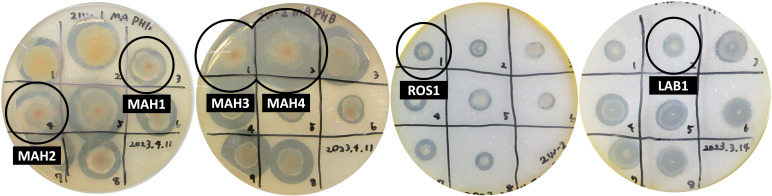 Fig 1
Fig 1| Strain | ||||||
|---|---|---|---|---|---|---|
| Total contig length (bp) | 4,539,058 | 4,542,034 | 4,494,785 | 4,494,868 | 6,187,225 | 6,646,216 |
| Number of contigs | 38 | 41 | 67 | 73 | 18 | 35 |
| Longest contigs (bp) | 442,042 | 411,077 | 405,843 | 405,843 | 2,164,360 | 1,792,396 |
| Sequencing coverage (×) | 450 | 324 | 361 | 320 | 303 | 275 |
| N50 (bp) | 208,135 | 184,078 | 139,811 | 118,930 | 1,719,597 | 1,781,916 |
| Gap ratio (%) | 0.019299 | 0.019198 | 0.010768 | 0.01079 | 0.001568 | 0.004409 |
| GC content (%) | 42.3 | 42.3 | 42.7 | 42.7 | 59.3 | 59 |
| Number of CDSs | 3,712 | 3,711 | 3,685 | 3,683 | 5,703 | 6,074 |
| Average Protein Length (aa) | 323.2 | 323.2 | 323.7 | 323.9 | 317.5 | 318.1 |
| Coding ratio (%) | 79.3 | 79.2 | 79.6 | 79.6 | 87.8 | 87.2 |
| Number of rRNAs | 3 | 3 | 3 | 3 | 3 | 3 |
| Number of tRNAs | 38 | 38 | 38 | 38 | 48 | 51 |
| Number of CRISPRs | 2 | 2 | 2 | 3 | 0 | 0 |
| Completeness (%) | 100 | 100 | 100 | 100 | 100 | 100 |
| Contamination (%) | 0 | 0 | 0 | 0 | 0 | 0 |
| ANI-based taxonomy (FastANI) |
|
|
|
|
|
|
| ANI (%) | 77.6086 | 77.7527 | 77.9442 | 77.9386 | 87.8181 | 88.0352 |
| SRA accession no. |
|
|
|
|
|
|
| Assembly accession no. |
|
|
|
|
|
|
- —New Energy and Industrial Technology Development Organizationhttp://dx.doi.org/10.13039/501100003051
Peer Reviews
No public reviews on file for this paper yet. If you reviewed it on a platform where reviews are public (OpenReview, ICLR, NeurIPS, ICML), you can paste yours below so the community can read it here.
Videos
No videos yet. Explain this paper in a talk, walkthrough, or lecture? Add one.
Taxonomy
Topicsbiodegradable polymer synthesis and properties · Microplastics and Plastic Pollution · Biofuel production and bioconversion
ANNOUNCEMENT
Polyhydroxybutyrate (PHB) is known as a raw material for biodegradable plastics, which are being studied as an alternative to petroleum-derived plastics from environmental perspectives (1). To date, PHB-degrading bacteria have been found in diverse environments (2–7), while the culture-independent metagenomic analysis suggests the existence of many uncultivated PHB-degrading bacteria (8).
Here, the PHB-degrading bacteria were isolated from the biodegradability test samples using seawater (9) as the source, and their genomes were sequenced. The seawater was collected from the sea surface at a coastal area in Japan (34°37′03.2″N 135°25′42.1″E). Then, 30 mg of PHB powder (Merck, Germany) and 200 mL of seawater were added to testing bottles without adding any sources of nutrients and incubated at 27°C under stirring. The PHB degradation was evaluated from determination of O_2_ consumption using laboratory-scale BOD testers (BOD200F, TAITEC, Japan/OxiTop IDS, WTW, Germany) (10). Next, the culture was spread on a double-layered 1.5% agar plate containing artificial seawater DAIGO (SHIOTANI M.S., Japan) and yeast extract or marine agar in the bottom layer and 1.2% PHB fine powder in the top layer. After 2 weeks of incubation at 25°C, colonies forming a clear zone, which indicated PHB degradation activity, were selectively isolated (Fig. 1). The isolation process was repeated three times for purification. Cells for genome analysis were obtained by centrifuging and pelleting liquid culture samples or collecting colonies on agar plates cultured at 25°C in DAIGO containing yeast extract.
Clear zone formed by the degradation of PHB.
The genomic DNA was extracted using a NucleoSpin Microbial DNA kit (Macherey-Nagel, Germany) following the manufacturer’s instructions. Whole-genome shotgun sequencing was conducted using the Illumina NovaSeq6000 platform (Illumina Inc., USA) at the NovoGene Co., Ltd. (Beijing, China). A short-read library was prepared using DNA fragmented by Covaris ultrasonic shearing system (Covaris Inc., USA) and NEBNext Ultra II DNA Library Prep Kit for Illumina (New England Biolabs Inc., USA). Illumina paired-end sequences (2 × 150 bp) were determined using a NovaSeq 6000 S4 Reagent Kit v1.5 (Illumina). Read QC and adapter trimming were performed using Fastp v0.23.1 (11). The genomes were assembled using SPAdes v3.15.3 (12). Structural annotation of the genomes was performed using the DDBJ Fast Annotation and Submission Tool (DFAST) pipeline version 1.2.20 (13) with the following programs: GAPannotator version 1.0 (14) for assembly gap, MetaGeneAnnotator version 2008/08/19 (15) for CDS, CRT version 1.2(16) for CRISPR, Aragorn version 1.2.38 (17) for tRNA, and Barrnap version 0.8 (18) for rRNA. Default parameters were used for all software unless otherwise specified.
The six genomes ranged in length from 4.49 to 6.65 Mbp and in GC content from 42.3% to 59.0% (Table 1). The average nucleotide identity (ANI)-based phylogeny calculated by the DFAST_QC pipeline version 0.5.7 (19) indicated that four strains were closely related to the genus Sessilibacter, and the other two strains were closely related to Roseibium with an ANI of 78% and 88%, respectively. The PHB depolymerase gene [EC 3.1.1.75] was annotated on all six genomes. As any PHB-degrading strains belonging to these two genera have not been reported, further investigation is needed to clarify PHB degradation mechanisms and ecological role in the marine ecosystem.
The reference list from the paper itself. Each links out to its DOI / PubMed record.
- 1Romen F, Reinhardt S, Jendrossek D. 2004. Thermotolerant poly(3-hydroxybutyrate)-degrading bacteria from hot compost and characterization of the PHB depolymerase of Schlegelella sp. KB 1a. Arch Microbiol 182:157–164. doi:10.1007/s 00203-004-0684-215340791 · doi ↗ · pubmed ↗
- 2Tanio T, Fukui T, Shirakura Y, Saito T, Tomita K, Kaiho T, Masamune S. 1982. An extracellular poly(3-hydroxybutyrate) depolymerase from Alcaligenes faecalis. Eur J Biochem 124:71–77. doi:10.1111/j.1432-1033.1982.tb 05907.x 7084231 · doi ↗ · pubmed ↗
- 3Mukai K, Yamada K, Doi Y. 1993. Enzymatic degradation of poly(hydroxyalkanoates) by a marine bacterium. Polym Degrad Stab 41:85–91. doi:10.1016/0141-3910(93)90066-R · doi ↗
- 4Mukai K, Yamada K, Doi Y. 1994. Efficient hydrolysis of polyhydroxyalkanoates by Pseudomonas stutzeri YM 1414 isolated from lake water. Polym Degrad Stab 43:319–327. doi:10.1016/0141-3910(94)90002-7 · doi ↗
- 5Mas-Castellà J, Urmeneta J, Lafuente R, Navarrete A, Guerrero R. 1995. Biodegradation of Poly-β-hydroxyalkanoates in anaerobic sediments. Int Biodeterior Biodegradation 35:155–174. doi:10.1016/0964-8305(95)00066-E · doi ↗
- 6Focarete ML, Ceccorulli G, Scandola M, Kowalczuk M. 1998. Further evidence of crystallinity-induced biodegradation of synthetic atactic poly(3-hydroxybutyrate) by PHB-depolymerase a from Pseudomonas l emoignei. blends of atactic Poly(3-hydroxybutyrate) with crystalline polyesters. Macromolecules 31:8485–8492. doi:10.1021/ma 981115 e · doi ↗
- 7Allen AD, Anderson WA, Ayorinde F, Eribo BE. 2011. Isolation and characterization of an extracellular thermoalkanophilic P(3HB-co-3HV) depolymerase from Streptomyces sp. IN 1. Int Biodeterior Biodegradation 65:777–785. doi:10.1016/j.ibiod.2011.02.010 · doi ↗
- 8Omura T, Isobe N, Miura T, Ishii SI, Mori M, Ishitani Y, Kimura S, Hidaka K, Komiyama K, Suzuki M, Kasuya K-I, Nomaki H, Nakajima R, Tsuchiya M, Kawagucci S, Mori H, Nakayama A, Kunioka M, Kamino K, Iwata T. 2024. Microbial decomposition of 99 biodegradable plastics on the deep-sea floor. Nat Commun 15:568. doi:10.1038/s 41467-023-44368-838278791 PMC 10817984 · doi ↗ · pubmed ↗