Metagenome-assembled genome of a novel Pseudoalteromonas species from South Mid-Atlantic Ridge deep-sea water suggests potential for chitin degradation
Zhiyi Wang, Yan Sun, Hongliang Wang, Juanli Yun, Wenbin Du

TL;DR
A new Pseudoalteromonas species from deep-sea water may help break down chitin, contributing to organic matter recycling.
Contribution
A novel Pseudoalteromonas species with potential chitin-degrading abilities is identified through a high-quality metagenome-assembled genome.
Findings
The MAG contains genes related to chitin degradation.
The species was recovered from deep-sea water at the South Mid-Atlantic Ridge.
Abstract
We report a high-quality metagenome-assembled genome (MAG) of a novel Pseudoalteromonas species recovered from deep-sea water of the South Mid-Atlantic Ridge. This MAG encodes key chitinase-related genes, suggesting potential involvement in chitin degradation and organic matter remineralization in the deep sea.
Genes, proteins, chemicals, diseases, species, mutations and cell lines named across the full text — each resolved to its canonical identifier and authoritative record.
Click any figure to enlarge with its caption.
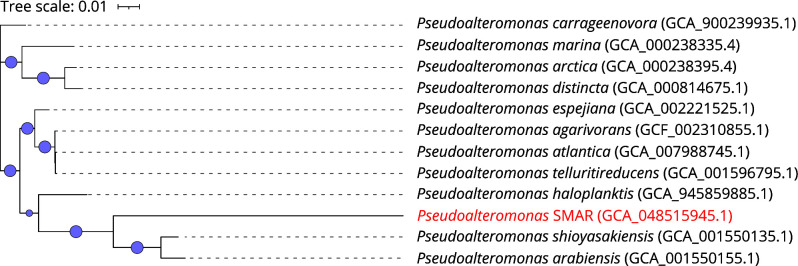 Fig 1
Fig 1| Parameter | Data |
|---|---|
| Sequence read archive accession number | |
| BioSample accession number | |
| MAG accession number | |
| No. of reads for assembly | 228553006 |
| Completion (%) | 98.13 |
| Contamination (%) | 0.168 |
| G + C content (%) | 45.54 |
| N50 (bp) | 88369 |
| No. of contigs | 60 |
| Genome size (bp) | 3947538 |
| No. of CDSs | 3467 |
| No. of tRNA | 37 |
| No. of tmRNA | 1 |
| Encoded rRNA | Not detected |
- —Chinese Academy of Scienceshttp://dx.doi.org/10.13039/501100002367
Peer Reviews
No public reviews on file for this paper yet. If you reviewed it on a platform where reviews are public (OpenReview, ICLR, NeurIPS, ICML), you can paste yours below so the community can read it here.
Videos
No videos yet. Explain this paper in a talk, walkthrough, or lecture? Add one.
Taxonomy
TopicsStudies on Chitinases and Chitosanases · Genomics and Phylogenetic Studies · Legume Nitrogen Fixing Symbiosis
ANNOUNCEMENT
Chitin is one of the most abundant biopolymers in marine ecosystems (1). Chitin-degrading bacteria play a crucial role in marine carbon and nitrogen cycling by breaking down chitin into bioavailable oligosaccharides and monomers, contributing to deep-sea biogeochemical cycles (2). Here, we report the draft MAG of a novel Pseudoalteromonas species from deep-sea water encoding chitinase genes, suggesting its potential role in chitin degradation and nutrient cycling in deep-sea ecosystems.
Deep-sea water was collected in February 2024 at 5,500 m depth from the South Mid-Atlantic Ridge (SMAR, 13°28′ W, 27°10′ S) using a CTD Rosette Sampler aboard the research vessel Deep Sea No. 1. Twenty liters of seawater was concentrated to 10 mL using a Large Volume Concentration Kit (Cat. No. CC01116, InnovaPrep, USA). The concentrated sample was diluted to approximately 1 × 10⁷ cells/mL in 2216E medium using a cell counting chamber (Cat. No. 177–112C, Watson, Japan) and then encapsulated as single cells into 30-pL droplets using a custom-built microfluidic device following laboratory-established protocols (3). Droplets were pooled and incubated at 25°C for 7 days and then demulsified with perfluorooctanol to collect enriched microbial cells.
Genomic DNA was extracted from 3 mL of demulsified droplet solution using the Bacterial DNA Extraction Kit (Cat. No. DZ314-03, FINDROP, China) following the manufacturer’s protocol. Sequencing libraries were prepared using the ALFA-SEQ DNA Library Prep Kit (Cat. No. NDI001E, FINDROP, China), and paired-end 150 bp reads were generated on the Illumina NovaSeq X Plus platform, yielding 37.59 Gbp of raw metagenomic data. Sequencing quality was assessed using Fastp (v0.23.2, default parameters) (4), and clean reads were assembled using SPAdes (v3.15.5) with the “--meta” option (5). MAGs were recovered using MetaWRAP (v1.3.2, default parameters) (6), and CheckM (v1.1.2) (7) identified eight high-quality MAGs (completeness >90%, contamination <5%). Taxonomic classification was performed via GTDB-Tk (v2.4.0, r220, default parameters) (8), and protein-coding sequences were predicted by PROKKA (v1.14.6, default parameters) (9). Predicted proteins were annotated against the KEGG database using DIAMOND BLASTp (v2.1.8, coverage >80%, identity >80%, e-value <1e-5) (10). Average nucleotide identity (ANI) was calculated using fastANI (v1.34) (11).
A MAG, designated Pseudoalteromonas SMAR (GCA_048515945.1), was identified, exhibiting high genome novelty and encoding genes associated with chitin degradation. GTDB-Tk classified it as an uncharacterized species within the genus Pseudoalteromonas, and its genomic features are summarized in Table 1. ANI analysis confirmed its novelty, with the highest similarity (78.37%) to Pseudoalteromonas shioyasakiensis. A phylogenetic tree illustrating its relationship to closely related species is presented in Fig. 1.
Maximum likelihood phylogenetic tree showing the relationship between Pseudoalteromonas SMAR (GCA_048515945.1) and closely related Pseudoalteromonas genomes. The tree was constructed using FastTree (v2.1.11) with the GTR model and 1,000 bootstrap replicates, based on the alignment of 120 conserved bacterial marker genes via GTDB-Tk. Node sizes correspond to bootstrap support values, with larger nodes indicating >75% support. Pseudoalteromonas SMAR is highlighted in red.
Functional annotation of the Pseudoalteromonas SMAR suggests a putative role in chitin degradation. The genome encodes key enzymes, including chitinase (chiA) and N-acetylglucosaminidase (nagZ), which may facilitate the conversion of chitin into oligomers and subsequently into monomeric N-acetylglucosamine (GlcNAc) (2), a bioavailable source of carbon and nitrogen. A nearly complete chitin degradation pathway suggests potential involvement in organic matter remineralization within deep-sea environments.
The reference list from the paper itself. Each links out to its DOI / PubMed record.
- 1Souza CP, Almeida BC, Colwell RR, Rivera ING. 2011. The importance of chitin in the marine environment. Mar Biotechnol 13:823–830. doi:10.1007/s 10126-011-9388-121607543 · doi ↗ · pubmed ↗
- 2Beier S, Bertilsson S. 2013. Bacterial chitin degradation-mechanisms and ecophysiological strategies. Front Microbiol 4:149. doi:10.3389/fmicb.2013.0014923785358 PMC 3682446 · doi ↗ · pubmed ↗
- 3Qiao Y, Hu R, Chen D, Wang L, Wang Z, Yu H, Fu Y, Li C, Dong Z, Weng Y-X, Du W. 2022. Fluorescence-activated droplet sorting of PET degrading microorganisms. J Hazard Mater 424:127417. doi:10.1016/j.jhazmat.2021.12741734673397 · doi ↗ · pubmed ↗
- 4Chen S, Zhou Y, Chen Y, Gu J. 2018. fastp: an ultra-fast all-in-one FASTQ preprocessor. Bioinformatics 34:i 884–i 890. doi:10.1093/bioinformatics/bty 56030423086 PMC 6129281 · doi ↗ · pubmed ↗
- 5Nurk S, Meleshko D, Korobeynikov A, Pevzner PA. 2017. meta SP Ades: a new versatile metagenomic assembler. Genome Res 27:824–834. doi:10.1101/gr.213959.11628298430 PMC 5411777 · doi ↗ · pubmed ↗
- 6Uritskiy GV, Di Ruggiero J, Taylor J. 2018. Meta WRAP-a flexible pipeline for genome-resolved metagenomic data analysis. Microbiome 6:158. doi:10.1186/s 40168-018-0541-130219103 PMC 6138922 · doi ↗ · pubmed ↗
- 7Parks DH, Imelfort M, Skennerton CT, Hugenholtz P, Tyson GW. 2015. Check M: assessing the quality of microbial genomes recovered from isolates, single cells, and metagenomes. Genome Res 25:1043–1055. doi:10.1101/gr.186072.11425977477 PMC 4484387 · doi ↗ · pubmed ↗
- 8Chaumeil P-A, Mussig AJ, Hugenholtz P, Parks DH. 2019. GTDB-Tk: a toolkit to classify genomes with the Genome Taxonomy Database. Bioinformatics 36:1925–1927. doi:10.1093/bioinformatics/btz 84831730192 PMC 7703759 · doi ↗ · pubmed ↗