Genome sequence of a lytic phage phi1_092060 targeting ST2 KL104-type Acinetobacter baumannii
Li Wei, Jiayuan Qin, Yu Feng, Zhiyong Zong

TL;DR
This paper reports the genome sequence of a phage that can kill a drug-resistant strain of Acinetobacter baumannii.
Contribution
The study provides a new lytic phage genome targeting a specific carbapenem-resistant strain of A. baumannii.
Findings
The phage genome is 167,208 bp long with a 37% GC content.
It contains 266 protein-coding sequences and five tRNAs.
Abstract
We describe the genome of a lytic phage isolated from sewage, which is capable of lysing ST2 KL104-type carbapenem-resistant Acinetobacter baumannii strains. The genome is 167,208 bp in length, has a guanine-cytosine (GC) content of 37%, and includes 266 protein-coding sequences and five tRNAs.
Genes, proteins, chemicals, diseases, species, mutations and cell lines named across the full text — each resolved to its canonical identifier and authoritative record.
Click any figure to enlarge with its caption.
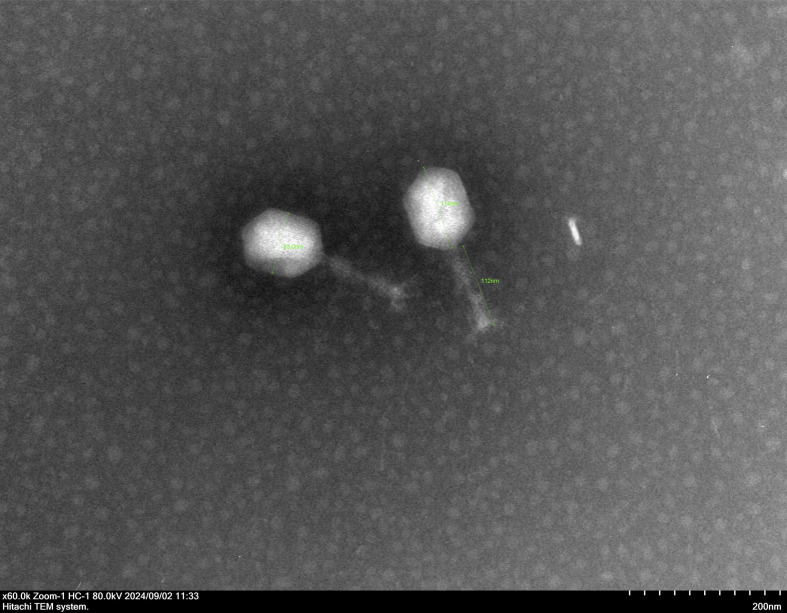 Fig 1
Fig 1- —National Key Research and Development Program of Chinahttp://dx.doi.org/10.13039/501100012166
Peer Reviews
No public reviews on file for this paper yet. If you reviewed it on a platform where reviews are public (OpenReview, ICLR, NeurIPS, ICML), you can paste yours below so the community can read it here.
Videos
No videos yet. Explain this paper in a talk, walkthrough, or lecture? Add one.
Taxonomy
TopicsBacteriophages and microbial interactions · Genomics and Phylogenetic Studies · Antibiotic Resistance in Bacteria
ANNOUNCEMENT
Carbapenem-resistant Acinetobacter baumannii (CRAb) has been designated by the World Health Organization as a critical pathogen of concern (1). Treatment options for CRAb are severely limited (2, 3), making phage therapy a promising alternative (4). While phages targeting sequence type 2 (ST2) and capsular type KL2 CRAb have been reported (5–7), no phages specific to ST2 KL104 CRAb have been described. Expanding the library of lytic phages for precise targeting of specific strain types is of significant clinical and practical importance. Here, we present the genome of phi1_092060, a phage capable of effectively lysing ST2 KL104 CRAb clinical isolates.
In July 2024, phi1_092060 was isolated from untreated sewage at the wastewater treatment plant of West China Hospital using the CRAb clinical strain 091006 (accession no. JBLLSI000000000), following the methodology described in previous studies (8). Strain 091006 belongs to sequence type 2 and capsular type KL104. Individual phage plaques were purified three times to ensure phage purity. Genomic DNA of phi1_092060 was extracted from purified phage particles using the Phage DNA Isolation Kit (Norgen Biotek, Thorold, Canada) according to the manufacturer’s instructions. Sequencing libraries were prepared using the NEBNext Ultra II DNA Library Prep Kit (New England Biolabs, Ipswich, MA, USA), and sequencing was performed on the HiSeq X10 platform. Raw sequencing reads underwent quality control with Trimmomatic v0.39 (9) to remove adapter sequences and discard reads shorter than 130 bases. Genome assembly was performed using Unicycler v0.5.0 (10). Contamination was assessed using CheckV, and non-phage contigs were discarded (11). Genome annotation was conducted using Pharokka v1.7.2 (12), and BLAST was used to identify the phage with the highest overall DNA similarity (identity × coverage) (13). Unless specified otherwise, the software was run with default parameters.
The genome sequencing of phi1_092060 produced 4,217,862 pairs of 150 bp reads, totaling 1.27 Gb (accession no. SRR32014619). The genome of phi1_092060 is 167,208 bp in length, with a GC content of 37%, 266 predicted coding sequences (CDSs), and five tRNAs. BLAST analysis showed that phi1_092060 shares the highest DNA similarity (96.38%, identity × coverage) with Acinetobacter phage AB-Navy97 (accession no. OL770261.1), which belongs to the genus Lazarusvirus of the family Straboviridae within the class Caudoviricetes.
Negative staining of the phi1_092060 phage particles was performed using 2.0% (wt/vol) uranyl acetate. The morphology of phi1_092060 was observed under a Hitachi transmission electron microscope (Hitachi, Japan) at an accelerating voltage of 80 kV. phi1_092060 features a polyhedral head structure, approximately 83 nm in diameter, and a long, rod-shaped, contractile tail approximately 112 nm in length (Fig. 1). The host range of phi1_092060 was determined as described previously (14). phi1_092060 was able to lyse ST2-KL52, ST2-KL104, and ST195-KL45 CRAb isolates. No known antimicrobial resistance or virulence genes were identified in the phi1_092060 genome using the CARD v4.0.0 (15) and VFDB 2025 (16) databases. The high BACPHLIP (17) score (83.7%) suggested a virulent lifestyle for phi1_092060. As such, phi1_092060 meets the standards for clinical phage therapy applications, thereby expanding the phage arsenal against difficult-to-treat CRAb pathogens.
The morphology of phage phi1_092060 under transmission electron microscopy. The scale was 200 nm.
The reference list from the paper itself. Each links out to its DOI / PubMed record.
- 1World Health Organization. 2024. WHO bacterial priority pathogens list, 2024: bacterial pathogens of public health importance, to guide research, development, and strategies to prevent and control antimicrobial resistance. https://www.who.int/news/item/27-02-2017-who-publishes-list-of-bacteria-for-which-new-antibiotics-are-urgently-needed.
- 2Shields RK, Paterson DL, Tamma PD. 2023. Navigating available treatment options for carbapenem-resistant Acinetobacter baumannii-calcoaceticus complex infections. Clin Infect Dis 76:S 179–S 193. doi:10.1093/cid/ciad 09437125467 PMC 10150276 · doi ↗ · pubmed ↗
- 3Iovleva A, Fowler VG, Doi Y. 2025. Treatment approaches for carbapenem-resistant Acinetobacter baumannii infections. Drugs (Abingdon Engl) 85:21–40. doi:10.1007/s 40265-024-02104-6PMC 1195013139607595 · doi ↗ · pubmed ↗
- 4Koncz M, Stirling T, Hadj Mehdi H, Méhi O, Eszenyi B, Asbóth A, Apjok G, Tóth Á, Orosz L, Vásárhelyi BM, et al.. 2024. Genomic surveillance as a scalable framework for precision phage therapy against antibiotic-resistant pathogens. Cell 187:5901–5918. doi:10.1016/j.cell.2024.09.00939332413 · doi ↗ · pubmed ↗
- 5Evseev PV, Sukhova AS, Tkachenko NA, Skryabin YP, Popova AV. 2024. Lytic capsule-specific Acinetobacter bacteriophages encoding polysaccharide-degrading enzymes. Viruses 16:771. doi:10.3390/v 1605077138793652 PMC 11126041 · doi ↗ · pubmed ↗
- 6Soontarach R, Srimanote P, Arechanajan B, Nakkaew A, Voravuthikunchai SP, Chusri S. 2024. Characterization of a novel bacteriophage endolysin (Lys AB 1245) with extended lytic activity against distinct capsular types associated with Acinetobacter baumannii resistance. P Lo S One 19:e 0296453. doi:10.1371/journal.pone.029645338165983 PMC 10760713 · doi ↗ · pubmed ↗
- 7Soontarach R, Srimanote P, Enright MC, Blundell-Hunter G, Dorman MJ, Thomson NR, Taylor PW, Voravuthikunchai SP. 2022. Isolation and characterisation of bacteriophage selective for key Acinetobacter baumannii capsule chemotypes. Pharmaceuticals (Basel) 15:443. doi:10.3390/ph 1504044335455440 PMC 9027227 · doi ↗ · pubmed ↗
- 8Li J, Fang Q, Luo H, Feng Y, Feng Y, Zong Z. 2025. “Sichuanvirus”, a novel bacteriophage viral genus, able to lyse carbapenem-resistant Klebsiella pneumoniae. BMC Microbiol 25:17. doi:10.1186/s 12866-024-03736-039806322 PMC 11726925 · doi ↗ · pubmed ↗