Complete genome sequence of dengue virus serotype 2 obtained from Chattogram, Bangladesh
Mohabbat Hossain, Md. Abdur Rob, M. A. Sattar, Abul Faisal Md. Nuruddin Chowdhury, Noor Mohammed, Istiaq Uddin Ahmed, Mohammed Maruf ul Quader, H. M. Hamidullah Mehedi, Md. Zakir Hossain, Md. Mobarok Hossain, Md. Mustafizur Rahman, Md. Shaheen Alam, Mohammad Jubair, Anjasu Paul

TL;DR
This paper reports the full genome sequence of a dengue virus strain from Bangladesh and identifies genetic changes in its proteins.
Contribution
The study provides a new genome sequence of dengue virus serotype 2 from Bangladesh and identifies its cosmopolitan genotype V classification.
Findings
The genome sequence of a dengue virus serotype 2 strain was obtained from a patient in Bangladesh.
The strain belongs to the cosmopolitan genotype V and shows genetic alterations in structural proteins.
Oxford Nanopore sequencing technology was used to generate the genomic data.
Abstract
The whole genome sequence of a dengue virus serotype 2 strain (GenBank accession number PQ657766) obtained from a dengue-infected hospitalized patient in Chittagong, Bangladesh, is classified as the cosmopolitan genotype V, with genetic alterations observed in several structural proteins. The genomic data were generated using Oxford Nanopore sequencing technology.
Genes, proteins, chemicals, diseases, species, mutations and cell lines named across the full text — each resolved to its canonical identifier and authoritative record.
Click any figure to enlarge with its caption.
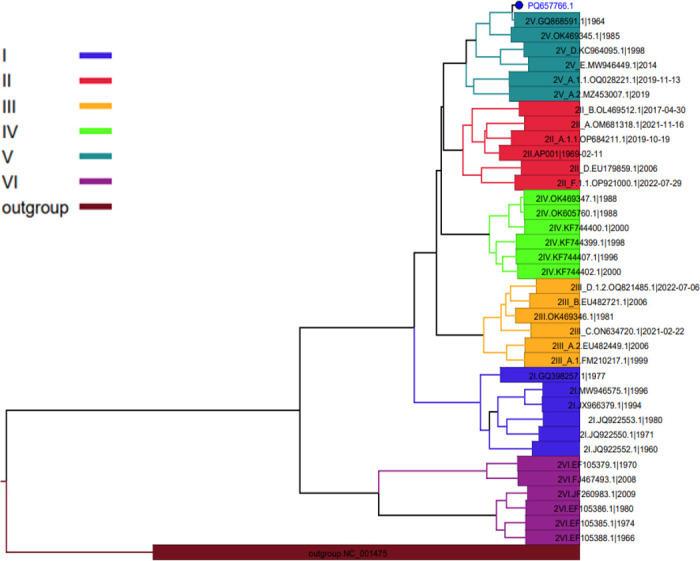 Fig 1
Fig 1| Protein name | Gene name | Amino acid changes | List of alterations in the protein sequence |
|---|---|---|---|
| Structural protein | Polyprotein (POLY) | 12 | K9R (122A > G), S101T (397T > A 399T > C), M104I (408G > A), L108M (418C > A), D143N (523G > A), V234A (797T > C 798C > A), I241V (817A > G), M249I (843G > A), H262Y (880C > T), A266I (892G > A 893C > T), T276A (922A > G), M286I (954G > A) |
| Anchored capsid protein (ancC) | 4 | K9R (122A > G), S101T (397T > A 399T > C), M104I (408G > A), L108M (418C > A) | |
| Capsid protein (C) | 1 | K9R (122A > G) | |
| Membrane glycoprotein precursor (prM) | 7 | D29N (523G > A), V120A (797T > C 798C > A), I127V (817A > G), M135I (843G > A), H148Y (880C > T), A152I (892G > A 893C > T), T162A (922A > G) | |
| Protein (pr) | 1 | D29N (523G > A) | |
| Membrane glycoprotein (M) | 6 | V29A (797T > C 798C > A), I36V (817A > G), M44I (843G > A), H57Y (880C > T), A61I (892G > A 893C > T), T71A (922A > G) | |
| Envelope protein (E) | 1 | M6I (954G > A) |
- —Beximco
Peer Reviews
No public reviews on file for this paper yet. If you reviewed it on a platform where reviews are public (OpenReview, ICLR, NeurIPS, ICML), you can paste yours below so the community can read it here.
Videos
No videos yet. Explain this paper in a talk, walkthrough, or lecture? Add one.
Taxonomy
TopicsMosquito-borne diseases and control · Viral Infections and Vectors · Vector-borne infectious diseases
ANNOUNCEMENT
Dengue virus (DENV), an Orthoflavivirus in the Flaviviridae family*,* is a mosquito-borne virus that causes dengue fever and has an ~10.7 kb positive-sense RNA genome. In rare cases, infection progresses to dengue hemorrhagic fever or fatal dengue shock syndrome (1–3). Bangladesh’s 2023 dengue outbreak was the deadliest, with 1,705 deaths (4), while over 14 million dengue cases and more than 10,000 deaths have been recorded globally in 2024 (5). Enhanced genomic surveillance is crucial to track DENV lineages (6) and aid preventive measures (7).
Blood serum samples were collected from dengue patients in government tertiary hospitals in Chittagong during the 2023 outbreak. Viral RNA was extracted using Chemagic Viral NA/gDNA H96 Kit (CMG-1049) on the Chemagic 360 system (PerkinElmer, USA) following the manufacturer’s instructions. A real-time RT-PCR assay using the TaqPath 1-Step Multiplex Master Mix (No ROX) Kit (Thermo Fisher Scientific, USA) was performed on the Bio-Rad CFX96 Touch real-time PCR system (Bio-Rad, USA) to determine the DENV serotypes. DENV serotyping primers and probes were sourced from a published article (8). Among the identified DENV serotypes, a DENV-2 positive (severe, hospitalized) case with a Ct value < 25 underwent whole-genome sequencing. cDNA was prepared from the isolated viral RNA using the PrimeScript cDNA Synthesis Kit (Takara Bio Inc., Japan) as per the manufacturer’s protocol, followed by a multiplex PCR that was performed with GoTaq G2 Hot Start Polymerase (Promega Corporation, USA) and specific primer pools (9). Oxford Nanopore sequencing technology was utilized for the whole genome sequencing of the DENV-2 serotype. Sequencing libraries were prepared according to the manufacturer’s V14 Ligation Sequencing protocol (Native Barcoding Kit V14 96, SQK-NBD114.96). The barcoded library (50 fmol) was loaded onto a MinION R10.4.1 Flowcell (FLO-MIN114) and sequenced on the MinION MK 1C platform. Base calling was performed using bcl2fastq, yielding 19.1M bases, with an average read length of 1.1 Kb, assessed by FastQC. Adapters/primers were removed using Trimmomatic software. Minimap2 version 2.28 (https://github.com/lh3/minimap2) was used for genome mapping against the reference genome NC_001474. The number of reads that were mapped to the reference genome was 10,723 bp, with a coverage depth of 82.5×. The completeness of the sequenced genome was determined by comparing it with the reference genome (NC_001474). The coverage breadth of our sequence was around 99%.
The Kraken2 viral database was utilized to obtain a taxonomic identification. Analysis with BLASTn showed that the viral genome exhibited 99.57% similarity with the genomic sequence of the DENV-2 strain from Thailand (GQ868591). Phylogenetic analysis of whole genome sequences placed the Chittagong isolate PQ657766 within DENV-2 genotype-V (Fig. 1), linking it to a Southeast Asian/American lineage found in Southeast Asia and Central/South America. Notable genetic alterations were found in the DENV-2 serostructural proteins, including polyprotein, anchored capsid protein, membrane glycoprotein precursor, and membrane glycoprotein (Table 1).
The randomly selected reference sequences were aligned with the study sequence using the Augur pipeline (https://github.com/nextstrain/augur). The tree was built using IQ-TREE 2 (https://github.com/iqtree/iqtree2) with 1,000 bootstraps (maximum likelihood). The analyzed sequence clusters within the DENV-2 serotype were classified into genotype V (cosmopolitan genotype) after comparison with representative global sequences.
The reference list from the paper itself. Each links out to its DOI / PubMed record.
- 1Songjaeng A, Chin-Inmanu K, Proykhunthod P, Poraha R, Sayboonruan P, Prayongkul D, Mairiang D, Suputtamongkol Y, Angkasekwinai N, Punyadee N, Avirutnan P. 2024. Genome sequences of dengue virus serotypes 2, 3, and 4 isolated from adult patients in Thailand. Microbiol Resour Announc 13:e 0052224. doi:10.1128/mra.00522-2439470230 PMC 11636373 · doi ↗ · pubmed ↗
- 2Guzman MG, Harris E. 2015. Dengue. Lancet 385:453–465. doi:10.1016/S 0140-6736(14)60572-925230594 · doi ↗ · pubmed ↗
- 3Mustafa MS, Rasotgi V, Jain S, Gupta V. 2015. Discovery of fifth serotype of dengue virus (DENV-5): a new public health dilemma in dengue control. Med J Armed Forces India 71:67–70. doi:10.1016/j.mjafi.2014.09.01125609867 PMC 4297835 · doi ↗ · pubmed ↗
- 4Rob MA, Hossain M, Sattar MA, Ahmed IU, Chowdhury AFMN, Mehedi HMH, Mohammed N, Maruf Ul Quader M, Hossain MZ, Rahman M, Chakma K, Barua S, Naznin Etu S, Sikder U, Tanni AA, Mannan A. 2024. Circulating dengue virus serotypes, demographics, and epidemiology in the 2023 dengue outbreak in Chittagong, Bangladesh. Eur J Microbiol Immunol (Bp) 14:272–279. doi:10.1556/1886.2024.0006939172528 PMC 11393644 · doi ↗ · pubmed ↗
- 5European Centre for Disease Prevention and Control (ECDC). 2025. Dengue Worldwide Overview (Situation update). Available from: https://www.ecdc.europa.eu/en/dengue-monthly
- 6World Health Organization (WHO). 2023. Disease Outbreak News: Dengue – the Region of the Americas. Available from: https://www.who.int/emergencies/disease-outbreak-news/item/2023-DON 475
- 7Vogels CBF, Hill V, Breban MI, Chaguza C, Paul LM, Sodeinde A, Taylor-Salmon E, Ott IM, Petrone ME, Dijk D, et al.. 2024. Dengue Seq: a pan-serotype whole genome amplicon sequencing protocol for dengue virus. BMC Genomics 25:433. doi:10.1186/s 12864-024-10350-x 38693476 PMC 11062901 · doi ↗ · pubmed ↗
- 8Santiago GA, Vergne E, Quiles Y, Cosme J, Vazquez J, Medina JF, Medina F, Colón C, Margolis H, Muñoz-Jordán JL. 2013. Analytical and clinical performance of the CDC real time RT-PCR assay for detection and typing of dengue virus. P Lo S. doi:10.1371/journal.pntd.0002311 PMC 370887623875046 · doi ↗ · pubmed ↗