Complete mitochondrial genome sequence of giant tiger prawn, Penaeus monodon, of Bangladesh
Dipta Chandra Pal, Shakila Nargis Khan, Muhammad Manjurul Karim

TL;DR
This paper presents the full mitochondrial genome of the giant tiger prawn from Bangladesh, including its size, composition, and genetic features.
Contribution
The study provides the first complete mitochondrial genome sequence of Penaeus monodon from Bangladesh.
Findings
The mitochondrial genome is 15,979 base pairs long with a GC content of 29.04%.
It encodes 13 protein-coding genes, 22 tRNAs, 2 rRNAs, and 1 control region.
Abstract
We report the complete mitochondrial genome sequence of the giant tiger prawn (Penaeus monodon) from Bangladesh. The circular genome spans 15,979 base pairs, with a GC content of 29.04%, and encodes 13 protein-coding genes, 22 tRNAs, 2 rRNAs, and 1 control region.
Genes, proteins, chemicals, diseases, species, mutations and cell lines named across the full text — each resolved to its canonical identifier and authoritative record.
Click any figure to enlarge with its caption.
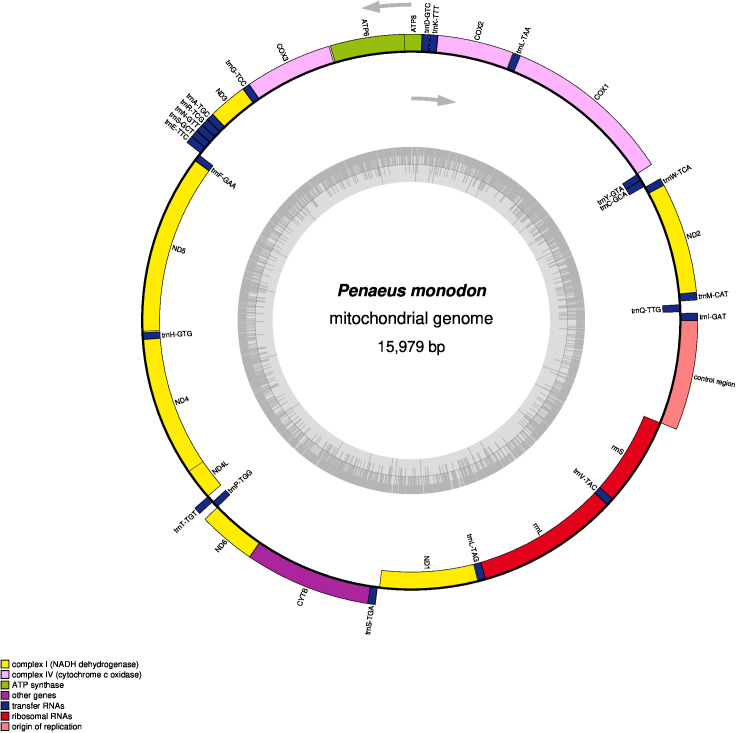 Fig 1
Fig 1| Gene | Location | Gene length (bp) | Start codon | Stop codon | Anti-codon | H/L strand | Intergenic region length (bp) |
|---|---|---|---|---|---|---|---|
| trnI | 1–68 | 68 | GAT | + | 0 | ||
| trnQ | 81–151 | 71 | TTG | − | 12 | ||
| trnM | 182–250 | 69 | CAT | + | 30 | ||
| ND2 | 251–1252 | 1,002 | ATT | TAA | + | 0 | |
| trnW | 1251–1319 | 69 | TCA | + | −2 | ||
| trnC | 1328–1395 | 68 | GCA | − | 8 | ||
| trnY | 1397–1462 | 66 | GTA | − | 1 | ||
| COX1 | 1465–3003 | 1,539 | ACG | TAA | + | 2 | |
| trnL | 2999–3065 | 67 | TAA | + | −5 | ||
| COX2 | 3071–3758 | 688 | ATG | Ta | + | 5 | |
| trnK | 3759–3827 | 69 | TTT | + | 0 | ||
| trnD | 3831–3898 | 68 | GTC | + | 3 | ||
| ATP8 | 3899–4057 | 159 | ATT | TAA | + | 0 | |
| ATP6 | 4051–4725 | 675 | ATG | TAA | + | −7 | |
| COX3 | 4736–5525 | 790 | ATG | Ta | + | 10 | |
| trnG | 5526–5592 | 67 | TCC | + | 0 | ||
| ND3 | 5593–5944 | 352 | ATG | Ta | + | 0 | |
| trnA | 5945–6009 | 65 | TGC | + | 0 | ||
| trnR | 6012–6076 | 65 | TCG | + | 2 | ||
| trnN | 6078–6144 | 67 | GTT | + | 1 | ||
| trnS | 6148–6214 | 67 | GCT | + | 3 | ||
| trnE | 6215–6283 | 69 | TTC | + | 0 | ||
| trnF | 6303–6369 | 67 | GAA | − | 19 | ||
| ND5 | 6370–8092 | 1,723 | ATA | Ta | − | 0 | |
| trnH | 8102–8168 | 67 | GTG | − | 9 | ||
| ND4 | 8169–9509 | 1,341 | ATG | TAA | − | 0 | |
| ND4L | 9503–9802 | 300 | ATG | TAA | − | −7 | |
| trnT | 9805–9871 | 67 | TGT | + | 2 | ||
| trnP | 9872–9937 | 66 | TGG | − | 0 | ||
| ND6 | 9939–10460 | 522 | ATC | TAA | + | 1 | |
| COB/ CYTB | 10460–11596 | 1,137 | ATG | TAG | + | −1 | |
| trnS | 11595–11664 | 70 | TGA | + | −2 | ||
| ND1 | 11682–12620 | 939 | ATA | TAG | − | 17 | |
| trnL | 12626–12694 | 69 | TAG | − | 5 | ||
| rrnL | 12695–14059 | 1,365 | − | 0 | |||
| trnV | 14063–14134 | 72 | TAC | − | 3 | ||
| rrnS | 14135–14987 | 853 | − | 0 | |||
| D-loop | 14988–15979 | 992 | + | 0 |
- —Biotechnology Research Centre, University of Dhaka
Peer Reviews
No public reviews on file for this paper yet. If you reviewed it on a platform where reviews are public (OpenReview, ICLR, NeurIPS, ICML), you can paste yours below so the community can read it here.
Videos
No videos yet. Explain this paper in a talk, walkthrough, or lecture? Add one.
Taxonomy
TopicsGenomics and Phylogenetic Studies · Crustacean biology and ecology · Genetic diversity and population structure
ANNOUNCEMENT
The giant tiger prawn (Penaeus monodon), locally known as Bagda shrimp in Bangladesh, is a brackish water species of economic significance. Belonging to the family Penaeidae, it contributes approximately USD 407.25 million annually to Bangladesh’s revenue, accounting for 1.76% of global shrimp exports in 2021–2022 (1). However, disease outbreaks caused by viral and bacterial pathogens severely impact production, posing challenges to farmers and the economy (2, 3).
Understanding the genetic variation and population structure of P. monodon is crucial for biodiversity conservation and sustainable aquaculture (4). Molecular genetic studies in Bangladeshi populations remain limited, necessitating efforts to fill this gap. This study presents the complete mitochondrial genome of P. monodon from Bangladesh.
A specimen was collected from the Bhola River (22°40′44.66″N, 90°36′22.92″E) and immediately preserved at −26°C until DNA extraction. Mitochondria were isolated from telson tissue (0.1 g) following the Wieckowski protocol with modifications (5, 6). Telson tissue was homogenized using a precooled mortar and pestle. The homogenate was differentially centrifuged at 4°C to obtain the mitochondrial pellet. DNA was extracted using proteinase K digestion, phenol-chloroform purification, and ethanol precipitation (7). The quality of the extracted DNA was evaluated by gel electrophoresis on a 0.8% agarose followed by spectrophotometric analysis using a Colibri-Model LB 915 microvolume spectrophotometer (Berthold Technologies GmbH & Co. KG, Germany) to measure DNA purity and concentration. The presence of mt-DNA was confirmed via COI gene-specific PCR. NGS library preparation was performed using the Illumina DNA Prep kit (Illumina, San Diego, CA, USA). Sequencing was carried out on the Illumina NextSeq 550 platform, generating paired-end reads of 151 bp in length. A total of 107,508 raw reads were generated, corresponding to 23.9 Mbp of sequencing data with an average coverage depth of 45×. The raw data quality was checked using FastQC v0.12.1 (8). Quality filtering (Q <20) was performed with Trimmomatic v0.39 (9), and de novo assembly was conducted using SPAdes v3.15.5 (10), yielding a 15,979 bp contig mitochondrial genome.
Gene annotation was performed using MITOS v1.1.7 with the Invertebrate Mitochondrial Code (transl_table = 5) (11). Manual curation refined gene boundaries through NCBI BLAST comparisons with reference mitochondrial genomes of P. monodon (NC_002184.1, MN057663.1). The assembled genome showed 92.97% and 93.13% identity to these previously identified circular mitochondrial genomes, respectively.
The mitochondrial genome comprises a D-loop control region, 2 rRNA genes (12S and 16S), 22 tRNA genes, and 13 protein-coding genes. Of these, 23 genes are encoded on the heavy strand, and 14 on the light strand (Table 1). The nucleotide composition of the heavy strand includes 5,661 A (35.43%), 5,677 T (35.53%), 2,663 C (16.67%), and 1,978 G (12.38%). The ATP6, ATP8, COI-III, CYTB, ND2, ND3, and ND6 genes are encoded by the heavy strand, while the light strand encodes ND1, ND4, ND4L, and ND5. Visualization using OGDRAW generated a genome map (Fig. 1), showing transcription directions, gene locations, and GC content (12).
The mitochondrial genome map of Penaeus monodon. It shows GC content in the innermost ring (ash grey), transcription directions as arrows, with clockwise-transcribed genes on the inner side and counterclockwise-transcribed genes on the outer side, color-coded gene groups (key in the bottom left corner) including 13 protein-coding genes (PCGs), 2 ribosomal RNA genes (rrnS for 12S and rrnL for 16S rRNA), 22 transfer RNA (tRNA) genes, and the putative control region.
This study provides the first complete mitochondrial genome of P. monodon from Bangladesh, contributing valuable data for genetic and evolutionary studies of this economically important species.
The reference list from the paper itself. Each links out to its DOI / PubMed record.
- 1Alam SMN. 2024. Portraying the Bangladesh shrimp industry: a SWOT analysis. Sustainability 16:1290. doi:10.3390/su 16031290 · doi ↗
- 2Hasan MM, Hoque MN, Ahmed F, Haque MIM, Sultana M, Hossain MA. 2022. Circulating phylotypes of white spot syndrome virus in Bangladesh and their virulence. Microorganisms 10:191. doi:10.3390/microorganisms 1001019135056639 PMC 8780693 · doi ↗ · pubmed ↗
- 3Hossain MMM, Farjana N, Afroz R, Saha PK, Roy HS, Rahman MA, Farid MA. 2023. Genes expression in Penaeus monodon of Bangladesh; challenged with AHPND-causing Vibrio parahaemolyticus. Fish Shellfish Immunol Rep 4:100092. doi:10.1016/j.fsirep.2023.10009237091065 PMC 10114510 · doi ↗ · pubmed ↗
- 4Vu NTT, Zenger KR, Silva CNS, Guppy JL, Jerry DR. 2021. Population structure, genetic connectivity, and signatures of local adaptation of the giant black tiger shrimp (Penaeus monodon) throughout the Indo-Pacific Region. Genome Biol Evol 13:evab 214. doi:10.1093/gbe/evab 21434529049 PMC 8495139 · doi ↗ · pubmed ↗
- 5Wieckowski M, Giorgi C, Lebiedzinska M, Duszynski J, Pinton P. 2009. Isolation of mitochondria-associated membranes and mitochondria from animal tissues and cells. Nat Protoc 4:1582–1590. doi:10.1038/nprot.2009.15119816421 · doi ↗ · pubmed ↗
- 6Pal DC, Hasan MM, Khan SN, Karim MM. 2025. Complete mitochondrial genome sequence of giant freshwater prawn, Macrobrachium rosenbergii of Bangladesh. Microbiol Resour Announc 14:e 0092424. doi:10.1128/mra.00924-2439601589 PMC 11737144 · doi ↗ · pubmed ↗
- 7Green RM, Sambrook J. 2012. Molecular cloning: a laboratory manual. 4th edition. Vol. 33. Cold Spring Harbor Laboratory Press.
- 8Andrews S. 2020. Babraham bioinformatics - Fast QC a quality control tool for high throughput sequence data. https://www.bioinformatics.babraham.ac.uk/projects/fastqc/.