A comparison of TURP, HoLEP, and RFA for nonneurogenic LUTS in men
Turgay EBİLOĞLU, Özgür ÇINAR, Selçuk SARIKAYA, Adem Emrah COĞUPLUGİL, Bahadır TOPUZ, Cengiz KARA, Selahattin BEDİR

TL;DR
This study compares three prostate treatments for urinary symptoms and finds that TURP and HoLEP are equally effective, while RFA is less effective but has fewer incontinence issues.
Contribution
The study provides a direct comparison of TURP, HoLEP, and RFA for nonneurogenic LUTS in men over a 36-month period.
Findings
TURP and HoLEP showed similar improvement in IPSS, but HoLEP had higher incontinence rates.
RFA had lower IPSS improvement but the lowest incontinence rates, making it suitable for older patients.
None of the techniques improved OAB-V8 scores over time.
Abstract
The effect of transurethral resection of the prostate (TURP) for nonneurogenic male lower urinary tract symptoms (LUTS) is well known. However, recent advancements have come into use, so studies have been done to compare these new techniques to the gold standard TURP technique. The aim of this study was to compare the results of TURP, holmium laser enucleation of the prostate (HoLEP), and radiofrequency ablation (RFA) in men. The patients who had the TURP procedure were defined as group 1 (G1), those who had HoLEP were in group 2 (G2), and those who had RFA were in group 3 (G3). Preoperative and postoperative results were compared, with postoperative checks done at 1, 12, 24, and 36 months. There were 41, 40, and 40 patients in G1, G2, and G3, respectively. The mean ages for G1, G2, and G3 were 68.21 ± 8.19, 65.44 ± 10.48, and 77.32 ± 10.58, respectively. The decrease in international…
Genes, proteins, chemicals, diseases, species, mutations and cell lines named across the full text — each resolved to its canonical identifier and authoritative record.
Click any figure to enlarge with its caption.
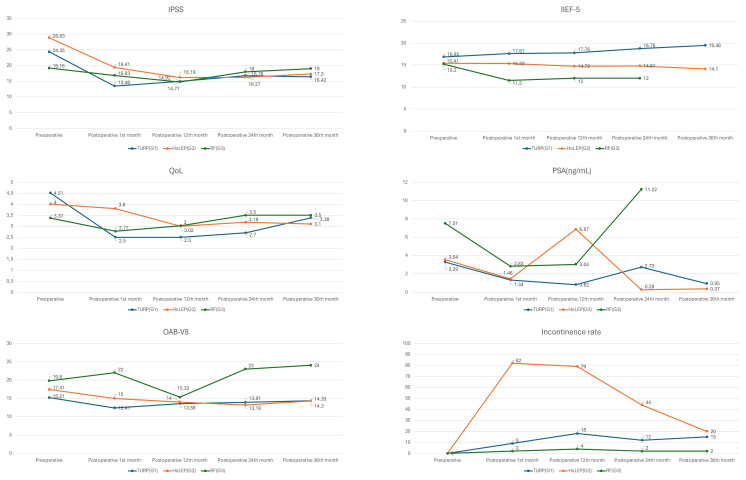 Figure 1
Peer Reviews
No public reviews on file for this paper yet. If you reviewed it on a platform where reviews are public (OpenReview, ICLR, NeurIPS, ICML), you can paste yours below so the community can read it here.
Videos
No videos yet. Explain this paper in a talk, walkthrough, or lecture? Add one.
Taxonomy
TopicsCardiovascular Disease and Adiposity