The long-term effects of parental marriage age on children’s educational human capital
Bohui Yuan, Yanping Pu

TL;DR
The paper examines how the age at which parents marry affects their children's education in Chinese households.
Contribution
It reveals that marrying later has a positive impact on children's education up to age 30, after which it becomes negative.
Findings
Parents who marry later are better prepared, leading to longer education periods for their children.
The positive effect of later marriage turns negative when parents marry beyond age 30.
Mothers have a more significant impact on children's educational outcomes than fathers.
Abstract
This paper focuses on micro-level Chinese households and studies the impact of parental marriage age on the education outcomes of their children, utilizing data from the China Family Panel Studies (2020). Through OLS model regression, it is found that parents who get married later are better prepared to have children, marital stability is also stronger, and their children have a longer education period. But this positive effect will turn negative after the age of marriage exceeds 30. Further analysis reveals that parental age at marriage has a heterogeneous effect on their children’s educational attainment, which means mothers have a more significant impact on their children’s education outcomes than fathers.
Genes, proteins, chemicals, diseases, species, mutations and cell lines named across the full text — each resolved to its canonical identifier and authoritative record.
Click any figure to enlarge with its caption.
 Figure 1
 Figure 2
 Figure 3
 Figure 4
 Figure 5
 Figure 6
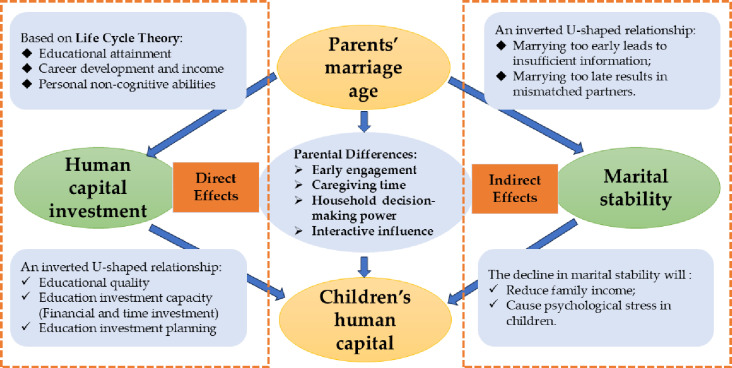 Figure 7
 Figure 8
 Figure 9
 Figure 10
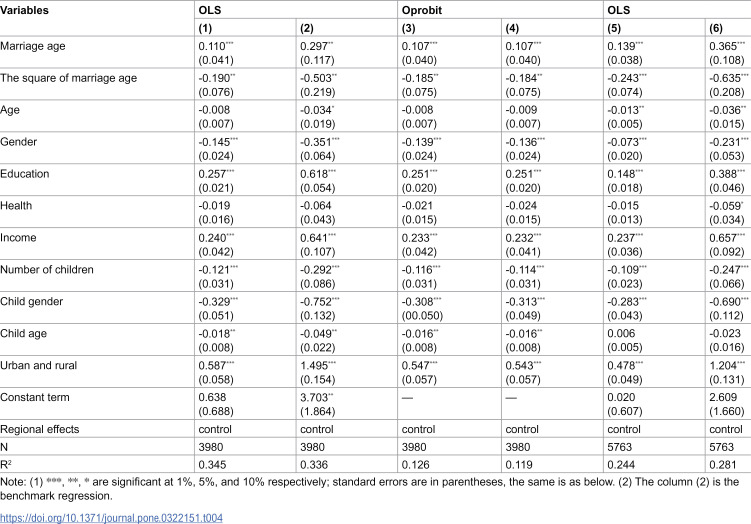 Figure 11
 Figure 12
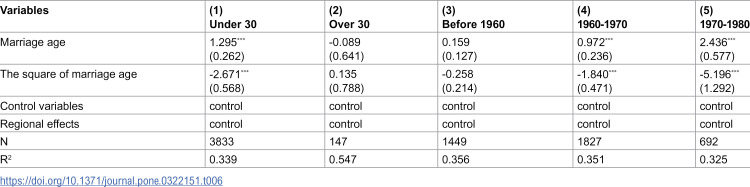 Figure 13
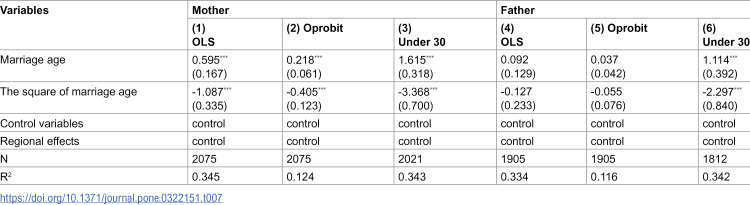 Figure 14
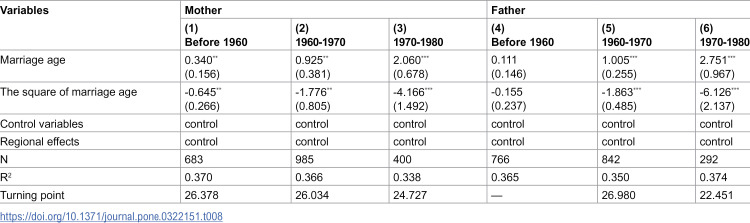 Figure 15
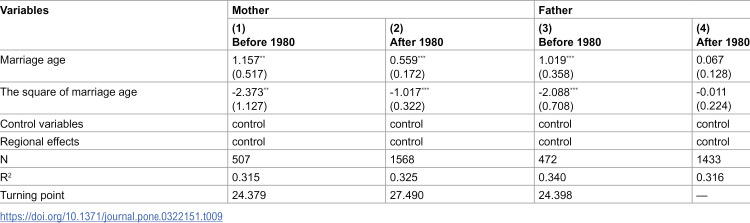 Figure 16
Peer Reviews
No public reviews on file for this paper yet. If you reviewed it on a platform where reviews are public (OpenReview, ICLR, NeurIPS, ICML), you can paste yours below so the community can read it here.
Videos
No videos yet. Explain this paper in a talk, walkthrough, or lecture? Add one.
Taxonomy
TopicsIntergenerational Family Dynamics and Caregiving · Family Dynamics and Relationships · Gender, Labor, and Family Dynamics