Unveiling the mechanism of dodecylphosphorylcholine as an extremely promising drug delivery system: From self-assembly clusters to drug encapsulation pathways
Qijiang Shu, Linjing Yang, Li Li, Zedong Lin, Pengru Huang

TL;DR
This study explores how dodecylphosphorylcholine can help deliver doxorubicin more effectively by forming molecular clusters that encapsulate the drug.
Contribution
The first combined quantum and molecular simulation study of DPC-DOX interactions reveals molecular-level drug encapsulation mechanisms.
Findings
DPC molecules self-assemble into clusters via van der Waals attraction, forming drug-loading conformations.
DPC-DOX interactions occur at ~0.5 nm distances, driven by electrostatic and van der Waals forces.
DPC-DOX clusters dynamically stabilize within 70 ns simulations, suggesting effective drug encapsulation.
Abstract
Significant progress has been achieved in cancer treatment with Doxorubicin (DOX), yet its low toxicity and poor bioavailability have long troubled scientists. Dodecylphosphorylcholine (DPC), as a candidate material for drug delivery systems (DDS), holds promise in assisting DOX to overcome its application bottleneck. In this study, employing a combination of quantum chemical calculations and molecular simulations, we delve into the dynamic processes of the interaction between DPC and DOX molecules for the first time. The results indicate that, under the synergistic effect where electrostatic repulsion plays a minor role and van der Waals attraction predominates, the end (containing choline group) of DPC molecules aggregate, self-assembling into multiple molecular clusters. There is a notable presence of electrostatic attraction and van der Waals attraction between DPC and DOX, which…
Genes, proteins, chemicals, diseases, species, mutations and cell lines named across the full text — each resolved to its canonical identifier and authoritative record.
Click any figure to enlarge with its caption.
 Figure 1
 Figure 2
 Figure 3
 Figure 4
 Figure 5
 Figure 6
 Figure 7
 Figure 8
 Figure 9
 Figure 10
 Figure 11
 Figure 12
 Figure 13
 Figure 14
 Figure 15
 Figure 16
 Figure 17
 Figure 18
 Figure 19
 Figure 20
 Figure 21
 Figure 22
 Figure 23
 Figure 24
 Figure 25
 Figure 26
 Figure 27
 Figure 28
 Figure 29
 Figure 30
 Figure 31
 Figure 32
 Figure 33
 Figure 34
 Figure 35
 Figure 36
 Figure 37
 Figure 38
 Figure 39
 Figure 40
 Figure 41
 Figure 42
 Figure 43
 Figure 44
 Figure 45
 Figure 46
 Figure 47
 Figure 48
 Figure 49
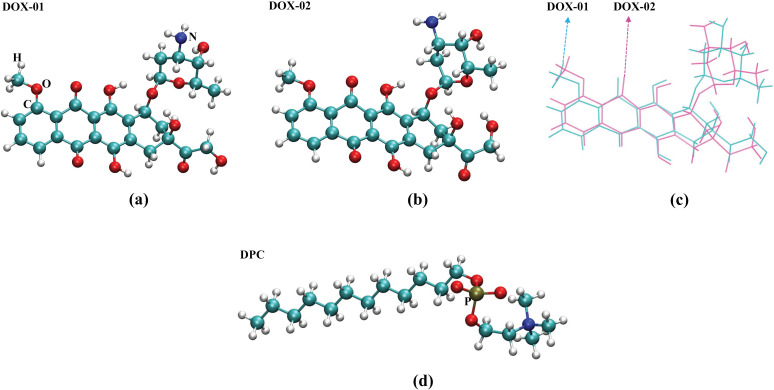 Figure 50
Peer Reviews
No public reviews on file for this paper yet. If you reviewed it on a platform where reviews are public (OpenReview, ICLR, NeurIPS, ICML), you can paste yours below so the community can read it here.
Videos
No videos yet. Explain this paper in a talk, walkthrough, or lecture? Add one.
Taxonomy
TopicsSupramolecular Chemistry and Complexes · Crystallography and molecular interactions · Molecular spectroscopy and chirality