Resilience to abrupt global catastrophic risks disrupting trade: Combining urban and near-urban agriculture in a quantified case study of a globally median-sized city
Matt Boyd, Nick Wilson, Susmita Lahiri (Ganguly), Susmita Lahiri (Ganguly), Susmita Lahiri (Ganguly)

TL;DR
This study explores how combining urban and near-urban agriculture can help a median-sized city withstand global catastrophic risks by reducing reliance on trade for food and fuel.
Contribution
The paper introduces a quantified case study combining urban and near-urban agriculture to assess resilience against abrupt global catastrophic risks.
Findings
Urban agriculture could feed 20% of the city's population under normal and nuclear winter conditions.
Near-urban industrial agriculture would require at least 1140 hectares to supplement urban food production.
An additional 110 hectares of canola cultivation could provide biodiesel for local agricultural machinery.
Abstract
Abrupt global catastrophic risks (GCRs) are not improbable and could massively disrupt global trade leading to shortages of critical commodities, such as liquid fuels, upon which industrial food production, processing and distribution depends. Previous studies have suggested urban agriculture as a resilience measure in the context of climate change and other natural hazards. To estimate the contribution a radical pivot to urban agriculture could have in building resilience to GCRs and the near-urban industrial agriculture needed to supplement urban food production. We determined optimum crops through mathematical optimization for food calorie and protein supply per land area for both urban and near-urban (industrial) agriculture. We calculated the land area available for food production within a temperate globally median-sized city using Google Earth image analysis of residential lots…
Genes, proteins, chemicals, diseases, species, mutations and cell lines named across the full text — each resolved to its canonical identifier and authoritative record.
Click any figure to enlarge with its caption.
 Figure 1
 Figure 2
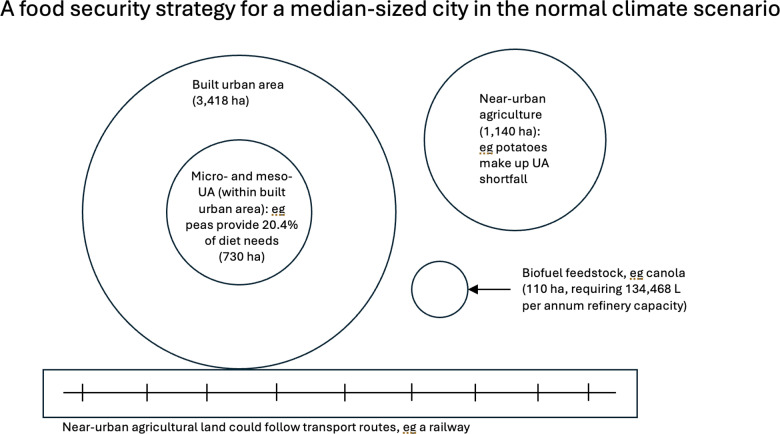 Figure 3
 Figure 4
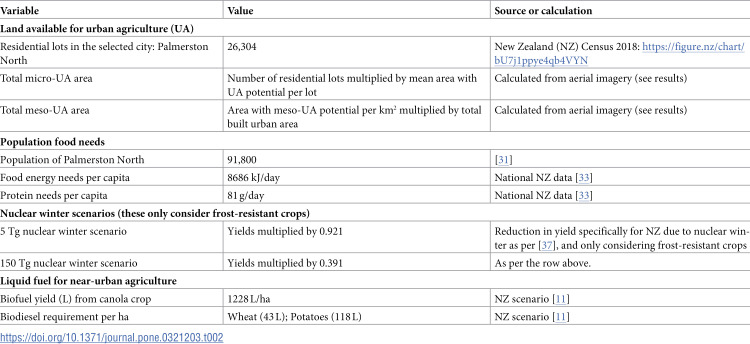 Figure 5
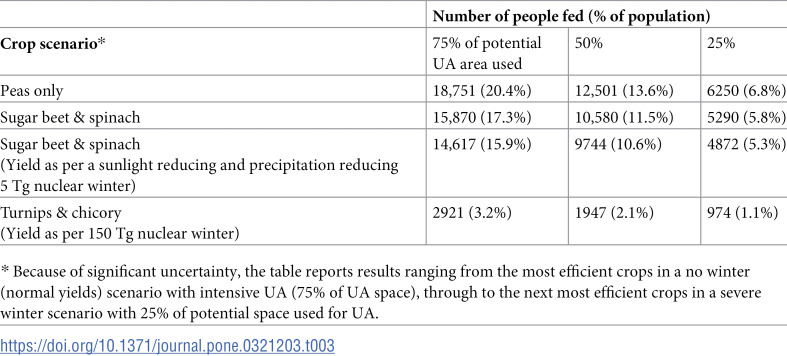 Figure 6
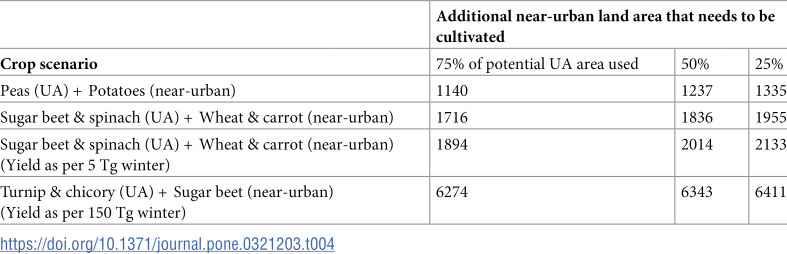 Figure 7
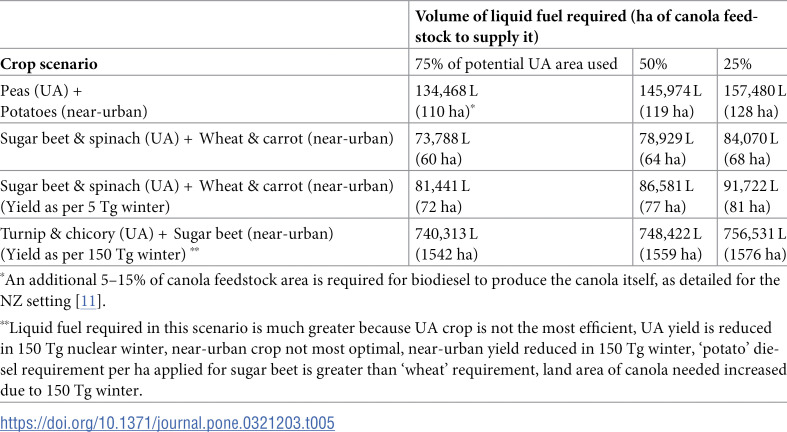 Figure 8
Peer Reviews
No public reviews on file for this paper yet. If you reviewed it on a platform where reviews are public (OpenReview, ICLR, NeurIPS, ICML), you can paste yours below so the community can read it here.
Videos
No videos yet. Explain this paper in a talk, walkthrough, or lecture? Add one.
Taxonomy
TopicsUrban Agriculture and Sustainability · Urban Green Space and Health