Models for the Anionic Polymerization of P═C Bonds: Cyclization of n‐BuLi‐Initiated MesP═CPh2 and Related Phosphaalkenes with H2C═CPh2
Tian Zhang, Kurt F. Hoffmann, Brian O. Patrick, Derek P. Gates

TL;DR
This paper explores the polymerization mechanism of phosphaalkenes by studying the reaction of MesP═CPh2 with n-BuLi and H2C═CPh2, revealing new insights into cyclization and bond cleavage.
Contribution
The study identifies a novel cyclization mechanism and a long-lived intermediate in phosphaalkene reactions, offering new clues to their polymerization.
Findings
Addition of Li[MesP(Bu)–CPh2] to H2C═CPh2 leads to cyclization and release of Li[CHPh2].
A long-lived intermediate was observed in two phosphaalkene reactions.
The chiral cyclophosphane products may be useful as ligands for catalytic applications.
Abstract
To model the first propagation step in the anionic polymerization of MesP═CPh2 we studied the addition of Li[MesP(Bu)–CPh2] (and related species) to nonpolymerizable H2C═CPh2. Addition proceeds via the o‐CH3 of the P‐Mes followed by unprecedented cyclization to C5P‐rings with release of Li[CHPh2]. Further investigation of the aforementioned reaction using phosphaalkenes, RP═CAr2 (R ═ Mes, m‐Xyl; R′ ═ Ph, 4‐FC6H4, 4‐MeC6H4, 4‐MeOC6H4), resulted in the observation of a relatively long‐lived intermediate in two instances (R ═ Mes, R’ = 4‐MeC6H4, 4‐MeOC6H4). For the latter, the intermediate was identified as n‐BuP(CH(4‐MeOC6H4)2)[C6(4,6‐Me2)H2–(2‐CH2CH2CPh2Li) by isolation of the oxidized, H+‐quenched product. These observations provide intriguing clues into the complex mechanism of polymerization of P‐Mes phosphaalkenes and the chiral cyclophosphane products are of interest as ligands for…
Genes, proteins, chemicals, diseases, species, mutations and cell lines named across the full text — each resolved to its canonical identifier and authoritative record.
Click any figure to enlarge with its caption.
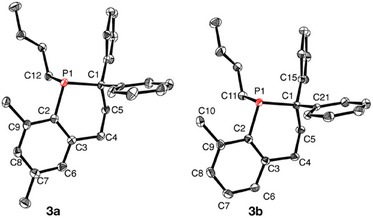 Figure 1
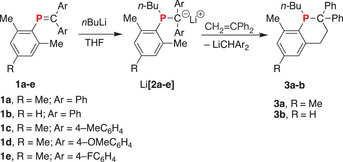 Figure 2
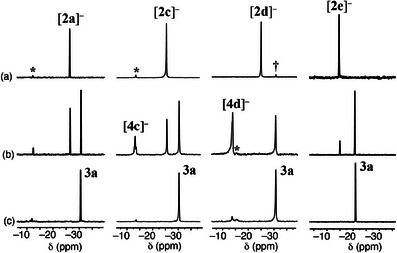 Figure 3
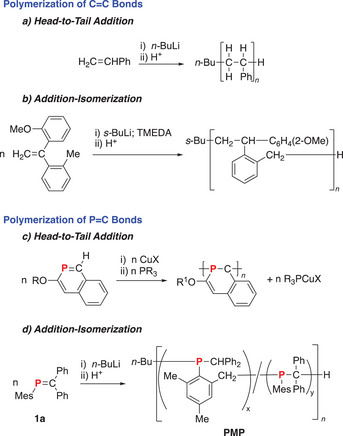 Figure 4
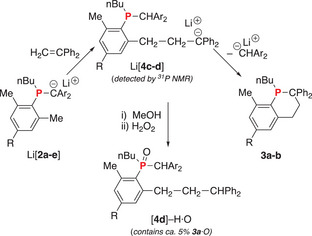 Figure 5
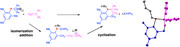 Figure 6
Peer Reviews
No public reviews on file for this paper yet. If you reviewed it on a platform where reviews are public (OpenReview, ICLR, NeurIPS, ICML), you can paste yours below so the community can read it here.
Videos
No videos yet. Explain this paper in a talk, walkthrough, or lecture? Add one.
Taxonomy
TopicsOrganometallic Complex Synthesis and Catalysis · Synthesis and characterization of novel inorganic/organometallic compounds · Coordination Chemistry and Organometallics