A Foldaxane‐Based Supramolecular Muscle‐Like Switch
Philip Waelès, Frédéric Coutrot

TL;DR
Scientists created a molecular muscle-like switch using foldaxane structures that can contract and stretch in response to chemical stimuli.
Contribution
The first supramolecular muscle-like switch based on foldaxane was developed, showing controlled contraction and stretching.
Findings
The foldaxane-based switch can transition between contracted and degenerate-like states using a bulky Fmoc group.
The assembly is kinetically stable, with disassembly slower than the gliding of helixes along molecular rods.
Abstract
[cn]daisy chain molecular muscle architectures are self‐assemblies of hermaphrodite monomers, which usually contain a macrocycle unit linked to a molecular thread that contains sites of interactions – i. e. molecular stations – for the macrocycle. In these multiply threaded structures, altering with control the affinity between macrocycles and stations allows for contraction and extension of the molecule, which is reminiscent of the operation of a muscle. Besides, the field that consists of combining helix and template‐containing rods to design foldaxane supramolecular assemblies is still underexplored. By using foldamer units as surrogates for macrocycles, Gan et al. reported the first supramolecular muscle‐like foldamer‐containing switch that can adopt, after chemical stimulus, either a contracted co‐conformational state or a degenerate‐like state for which a slow exchange occurred…
Genes, proteins, chemicals, diseases, species, mutations and cell lines named across the full text — each resolved to its canonical identifier and authoritative record.
Click any figure to enlarge with its caption.
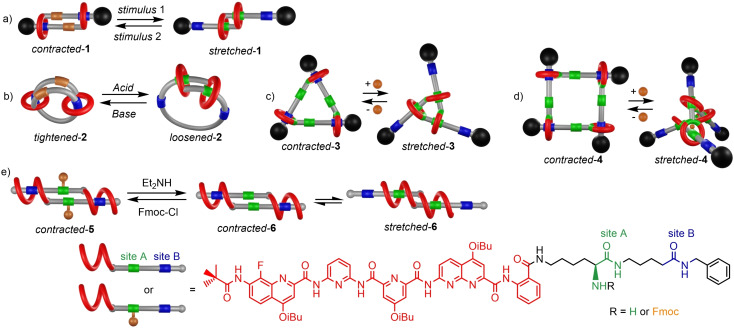 Figure 1
 Figure 2
Peer Reviews
No public reviews on file for this paper yet. If you reviewed it on a platform where reviews are public (OpenReview, ICLR, NeurIPS, ICML), you can paste yours below so the community can read it here.
Videos
No videos yet. Explain this paper in a talk, walkthrough, or lecture? Add one.
Taxonomy
TopicsSupramolecular Chemistry and Complexes · Chemical Synthesis and Analysis · Supramolecular Self-Assembly in Materials