In silico study of the potential of curcumin and its derivatives for increasing wild-type p53 expression and improving the function of p53 mutant R273H
Sarah Ika Nainggolan, Rajuddin Rajuddin, Reno Keumalazia Kamarlis, Muhammad Hambal, Frengki Frengki

TL;DR
This study uses computer simulations to find curcumin derivatives that can boost wild-type p53 activity and restore function in a cancer-linked p53 mutant.
Contribution
The novel contribution is identifying curcumin derivatives as dual p53 enhancers and reactivators using in silico methods.
Findings
Hexahydrocurcumin and tetrahydrocurcumin showed the highest potential as p53 enhancers based on QSAR analysis.
Curcumin derivatives stabilized the R273H p53 mutant through strong binding and hydrogen bonds.
Most derivatives had favorable pharmacokinetic profiles and low toxicity predictions.
Abstract
p53 is a critical tumor suppressor protein responsible for regulating the cell cycle and inducing apoptosis. Mutations in the p53 gene, particularly in the DNA-binding domain, are frequently associated with various cancers due to the loss of transcriptional activity. Curcumin and its derivatives have demonstrated potential as p53 enhancers and reactivators of mutant p53. This study employs in silico methods to evaluate the potential of curcumin derivatives to enhance wild-type p53 expression and restore the function of the p53 mutant R273H. Curcumin and 20 derivatives were selected from PubChem for computational analysis. Their potential as p53 enhancers was assessed using Quantitative Structure-Activity Relationship (QSAR) analysis. Molecular docking was conducted to determine their binding affinities with wild-type and mutant p53 proteins, followed by molecular dynamics (MD)…
Genes, proteins, chemicals, diseases, species, mutations and cell lines named across the full text — each resolved to its canonical identifier and authoritative record.
Click any figure to enlarge with its caption.
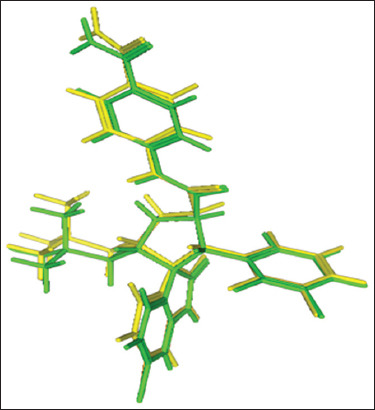 Figure 1
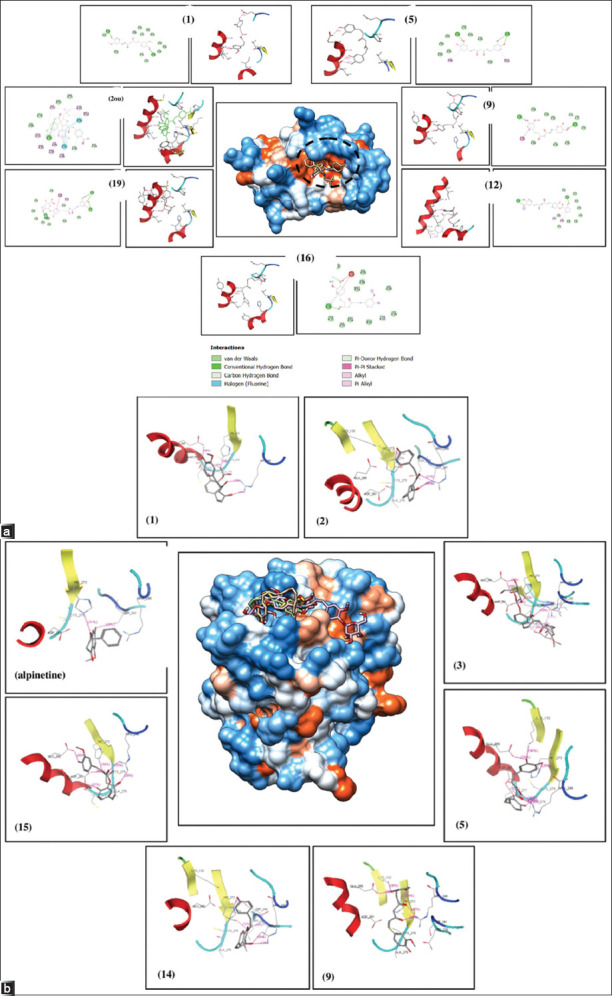 Figure 2
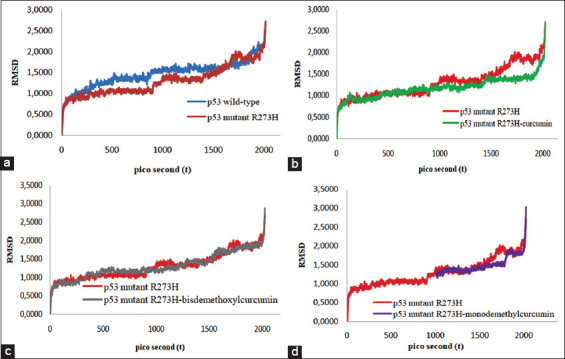 Figure 3
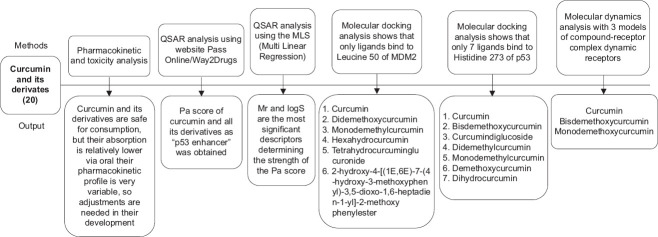 Figure 4
Peer Reviews
No public reviews on file for this paper yet. If you reviewed it on a platform where reviews are public (OpenReview, ICLR, NeurIPS, ICML), you can paste yours below so the community can read it here.
Videos
No videos yet. Explain this paper in a talk, walkthrough, or lecture? Add one.
Taxonomy
TopicsCurcumin's Biomedical Applications · Computational Drug Discovery Methods · Cancer-related Molecular Pathways