Predictive Factors for Procedure Time for Closure of Mucosal Defect Following Colorectal Endoscopic Submucosal Dissection
Hideaki Kazumori, Rurika Masatsugu, Kousuke Fukuda, Koji Onishi, Yasuhiko Ohno

TL;DR
This study identifies factors affecting the time needed to close mucosal defects after colorectal endoscopic submucosal dissection.
Contribution
The study provides validated predictive factors for closure procedure time after colorectal ESD.
Findings
Resected specimen size significantly influences closure procedure time.
Colon site also affects the time required for mucosal defect closure.
Abstract
The present study was conducted to clarify predictive factors related to procedure time for closure of a mucosal defect following colorectal endoscopic submucosal dissection. To prevent complications following a colorectal endoscopic submucosal dissection (ESD) procedure, closure of the resultant mucosal defect is considered to be most effective. However, closure after colorectal ESD is challenging, and technical difficulties can lead to a longer procedure time. Although it is important to clarify predictive factors related to the time needed for effective treatment planning, no such validated data obtained prior to the present study have been reported. Overall, 61 consecutive patients who underwent colorectal ESD for a colorectal neoplasm sized greater than 20 mm were enrolled. Immediately after performing colorectal ESD, closure of the mucosal defect was implemented using a loop…
Genes, proteins, chemicals, diseases, species, mutations and cell lines named across the full text — each resolved to its canonical identifier and authoritative record.
Click any figure to enlarge with its caption.
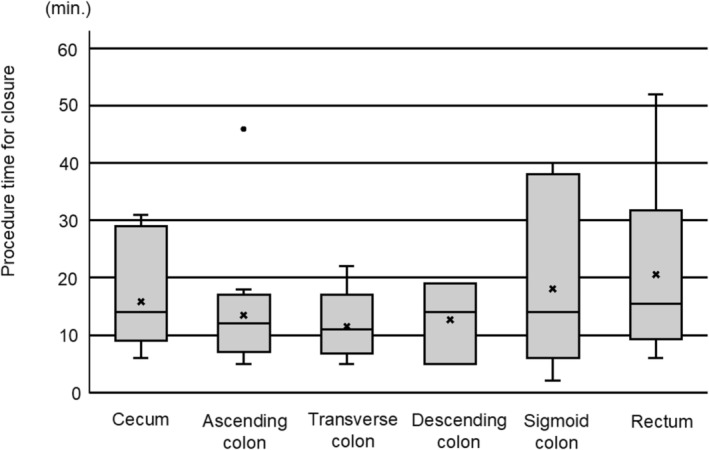 Figure 1
Peer Reviews
No public reviews on file for this paper yet. If you reviewed it on a platform where reviews are public (OpenReview, ICLR, NeurIPS, ICML), you can paste yours below so the community can read it here.
Videos
No videos yet. Explain this paper in a talk, walkthrough, or lecture? Add one.
Taxonomy
TopicsGastric Cancer Management and Outcomes · Esophageal and GI Pathology · Esophageal Cancer Research and Treatment