Mucosal carcinoma arising in a colon diverticulum: endoscopic submucosal dissection using the novel “clip-band-tent” traction method
Felipe Ramos-Zabala, Marian García-Mayor, Alejandra Alzina-Pérez, Raúl José Díaz-Molina, Luis Moreno-Almazán

Abstract
Genes, proteins, chemicals, diseases, species, mutations and cell lines named across the full text — each resolved to its canonical identifier and authoritative record.
Click any figure to enlarge with its caption.
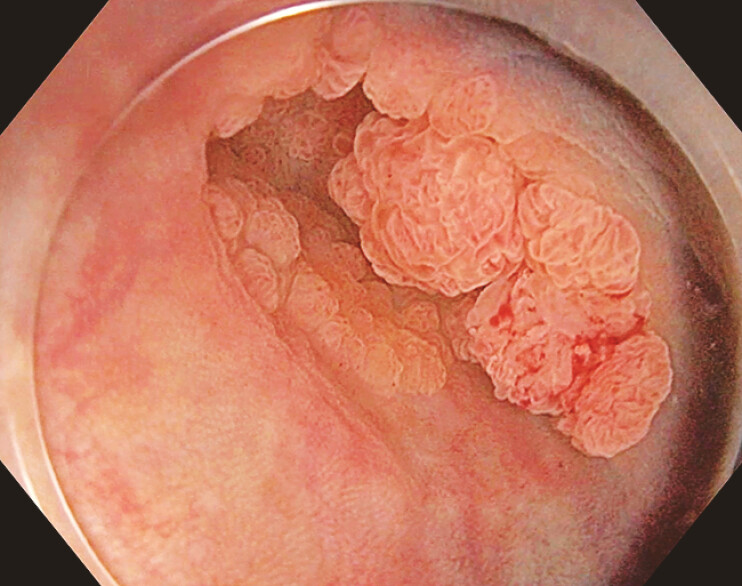 Fig. 1
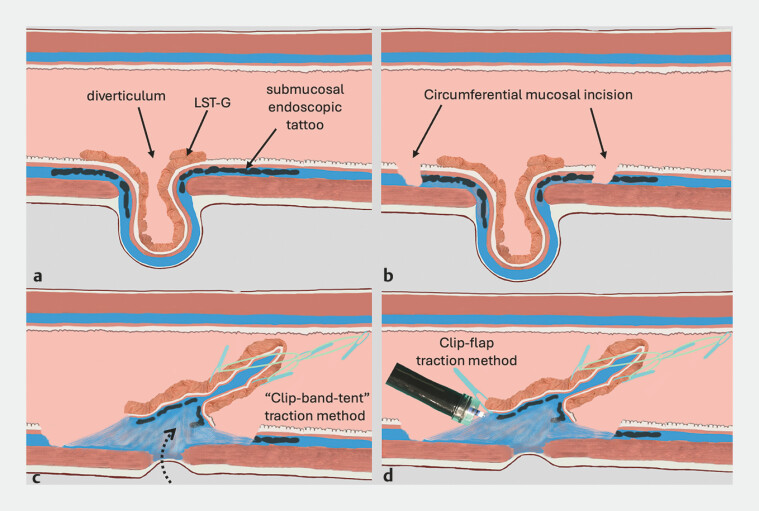 Fig. 2
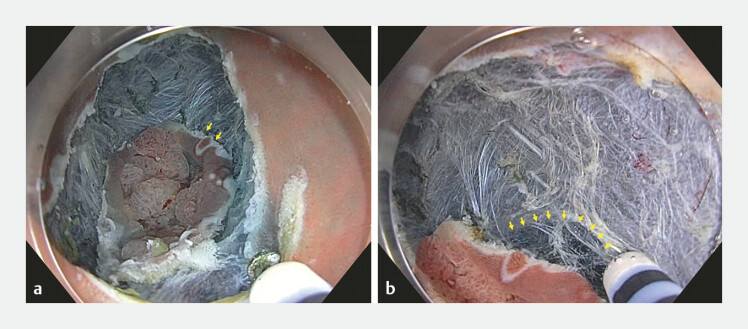 Fig. 3
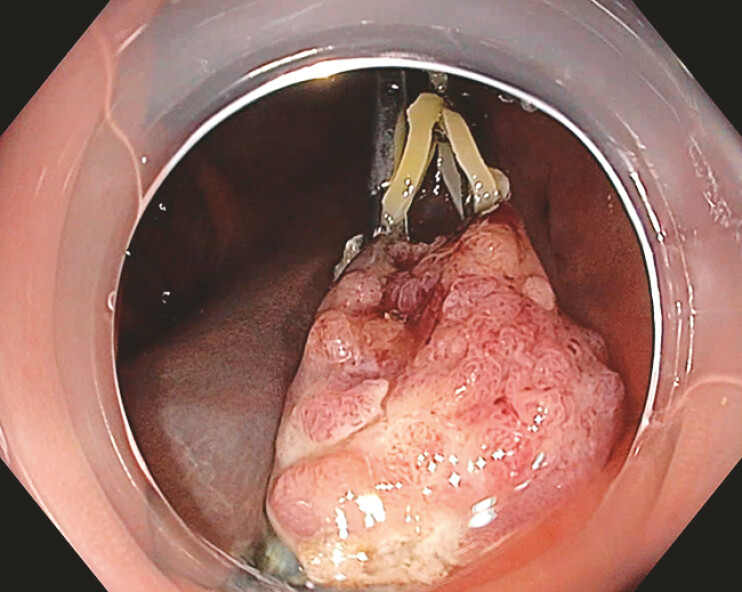 Fig. 4
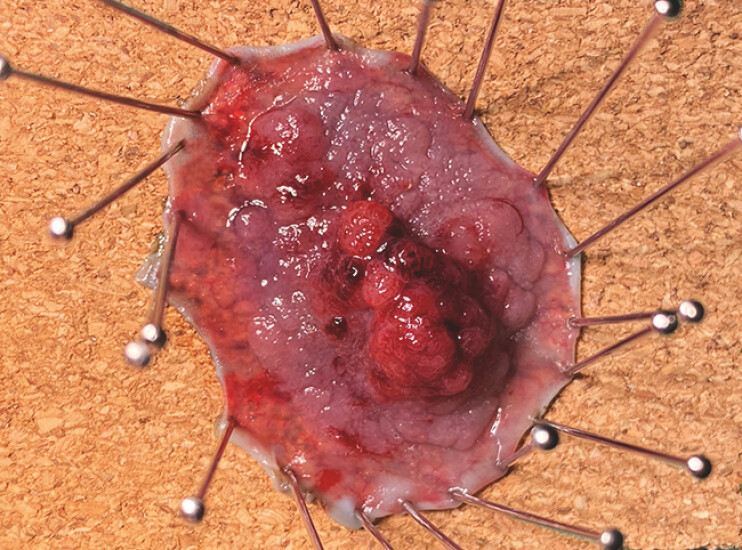 Fig. 5
Peer Reviews
No public reviews on file for this paper yet. If you reviewed it on a platform where reviews are public (OpenReview, ICLR, NeurIPS, ICML), you can paste yours below so the community can read it here.
Videos
No videos yet. Explain this paper in a talk, walkthrough, or lecture? Add one.
Taxonomy
TopicsGastric Cancer Management and Outcomes · Metastasis and carcinoma case studies · Gastrointestinal Tumor Research and Treatment
Endoscopic submucosal dissection (ESD) may be considered challenging for treating a colonic tumor involving a diverticulum 1 or having tattoo-induced fibrotic submucosal 2 . Here, we report a case of a laterally spreading tumor (LST) tattooed arising from a colonic diverticulum resected by saline immersion ESD ( Video 1 ). A 83-year-old woman with a previous left hemicolectomy for sigmoid adenocarcinoma was referred to our hospital for an organ-sparing approach. On endoscopic examination, in the ascending colon, a lesion with granular nodular mixed LST morphology was detected inside of a diverticulum which was completely involved ( Fig. 1 ). Surface pattern evaluation classified this lesion as JNET2A according to the Japan NBI Expert Team classification. We performed the technique with the following steps ( Fig. 2 ): circumferential mucosal incision using the ERBEJET hydrodissection system (Erbe), which allowed the diverticulum to be released from the tattoo-induced fibrotic wall ( Fig. 3 ); the “clip-band-tent” traction method was used as a variant of the clip-band technique 3 for the eversion of the diverticulum, stabilizing the submucosal layer view and providing adequate tension, which allowed better recognition of the dissection line ( Fig. 4 ); we easily identified the fibrotic submucosal layer using immersion in saline solution and the clip-flap traction method 4 , which enabled precise dissection using the T-type HybridKnife in probe mode 5 and a VIO 3 unit set at preciseSECT mode (Erbe) with a narrow safety margin. En bloc resection was achieved without any adverse events ( Fig. 5 ) and the diverticular orifice and mucosal defect were closed using resolution clips (Boston Scientific). The patient was discharged 24 hours after ESD. Histopathological examination showed a well-differentiated adenocarcinoma confined to the mucosal layer and free lateral and vertical resection margins.
Endoscopic image showing a laterally spreading granular-type tumor in the ascending colon arising from the base of the diverticulum with evidence of a previous endoscopic tattoo around it. Surface pattern evaluation classified this lesion as JNET2A according to the Japan NBI Expert Team classification.
Graphical representation of endoscopic submucosal dissection with the “clip-band-tent” traction method for eversion of the diverticulum: a illustration of the laterally spreading granular-type tumor arising from the base of the diverticulum and endoscopic tattoo around it; b circumferential mucosal incision; c the “clip-band-tent” traction method is used as a variant of the clip-band technique for the eversion of diverticulum; d the clip-flap traction method is used facilitating submucosal layer visualization during saline immersion dissection.
a Endoscopic image showing a circumferential mucosal incision T-type Hybridknife using an ERBEJET hydrodissection system, which allowed the diverticulum to be released from the tattoo-induced fibrotic wall. b The defect of the muscularis propria at the diverticulum is indicated with yellow arrows.
Endoscopic image showing an optimal eversion of the diverticulum by the “clip-band-tent” traction method.
Macroscopic appearance of the resected specimen.
Large superficial tumor of the colon involving a diverticulum removed by endoscopic submucosal dissection using the novel “clip-band-tent” traction method and T-type Hybridknife used in probe mode.Video 1
The “clip-band-tent” traction method could be a promising variant of traction-assisted ESD for lesions involving a diverticulum as it significantly facilitates the precision of the technique.
Endoscopy_UCTN_Code_TTT_1AQ_2AD_3AD
The reference list from the paper itself. Each links out to its DOI / PubMed record.
- 1Jimenez-Garcia VA Yamada M Ikematsu H Endoscopic submucosal dissection in management of colorectal tumors near or involving a diverticulum: a retrospective case series Endosc Int Open 20197 E 664E 67110.1055/a-0848-804831061878 PMC 6499619 · doi ↗ · pubmed ↗
- 2Ramos-Zabala F Gil-Páez C Alzina-Pérez A“Trans-tattoo in immersion” method for the removal of a recurrent, previously tattooed adenoma using endoscopic submucosal hydrodissection Endoscopy 202052 E 408E 41032330953 10.1055/a-1147-1206 · doi ↗ · pubmed ↗
- 3Parra-Blanco A Nicolas D Arnau MR Gastric endoscopic submucosal dissection assisted by a new traction method: the clip-band technique. A feasibility study in a porcine model (with video)Gastrointest Endosc 2011741137114122032320 10.1016/j.gie.2011.07.037 · doi ↗ · pubmed ↗
- 4Yamamoto K Hayashi S Nakabori T Endoscopic submucosal dissection using endoclips to assist in mucosal flap formation (novel technique: “clip flap method”)Endoscopy 201244 E 334E 33523012008 10.1055/s-0032-1309860 · doi ↗ · pubmed ↗
- 5Ramos-Zabala F García-Mayor M Domínguez-Pino A Combination of immersion in saline solution, pocket-creation method, water-jet hydrodissection, and hybrid knife “probe mode” simplifies endoscopic submucosal dissection in giant rectal polyp Video GIE 2019447848031709336 10.1016/j.vgie.2019.05.009PMC 6831841 · doi ↗ · pubmed ↗