Endoscopic management of colonic diverticulitis with fecalith impaction: a novel suction technique
Shihe Hu, Jiyu Zhang, Deliang Li, Huige Wang, Dan Liu

Abstract
Genes, proteins, chemicals, diseases, species, mutations and cell lines named across the full text — each resolved to its canonical identifier and authoritative record.
Click any figure to enlarge with its caption.
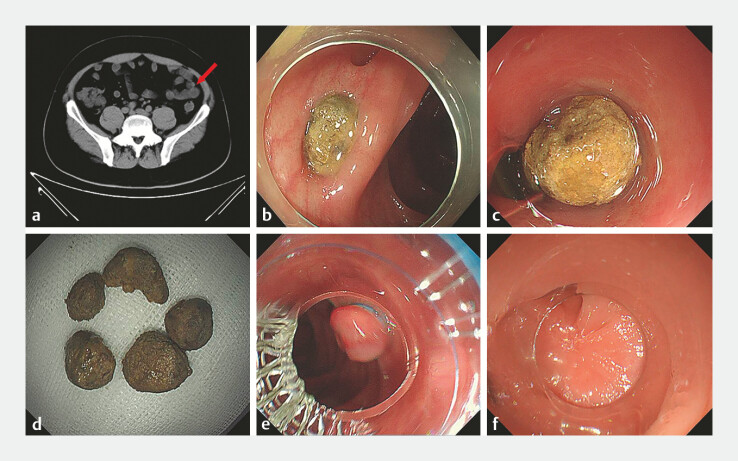 Fig. 1
- —Henan key medical laboratory: innovative technology for minimally invasive treatment of digestive endoscope
- —Application and Promotion of Endoscopic Retrograde Appendicitis Therapy, Key Research Project of Henan Province Higher Education Institutions
- —The Key R&D Program of Henan Province
- —Natural Science Foundation of Henan Province10.13039/501100006407
Peer Reviews
No public reviews on file for this paper yet. If you reviewed it on a platform where reviews are public (OpenReview, ICLR, NeurIPS, ICML), you can paste yours below so the community can read it here.
Videos
No videos yet. Explain this paper in a talk, walkthrough, or lecture? Add one.
Taxonomy
TopicsDiverticular Disease and Complications · Gastrointestinal disorders and treatments · Esophageal and GI Pathology
A 40-year-old man presented to our hospital with a 1-year history of recurrent left lower abdominal pain. A computed tomography (CT) scan revealed multiple colonic diverticulitis ( Fig. 1 a , Video 1 ). Colonoscopy confirmed the presence of fecalith impaction within the diverticula. Initially, we attempted to extract the fecaliths using a short transparent cap for suction ( Fig. 1 b ). However, this approach proved challenging due to the narrow openings of the diverticula. Therefore, we switched to a long transparent cap, which allowed better visualization of the diverticulum openings and facilitated alignment of the fecaliths with the axis of the endoscope’s working channel for effective suction ( Fig. 1 c ). The long cap enhanced suction power and provided sufficient internal space for efficient fecalith removal. Complete extraction from all diverticula was achieved without complications ( Fig. 1 d ). Subsequently, endoscopic band ligation (EBL) was performed on the inverted colonic diverticulum ( Fig. 1 e ). The patient reported significant improvement in abdominal pain with no adverse reactions. Follow-up colonoscopy at 1 month demonstrated complete mucosal healing at the treatment site ( Fig. 1 f ).
a CT scan revealed multiple colonic diverticulitis caused by calcified fecaliths. b Using a short transparent cap for suction. c Using a long transparent cap for suction. d The impacted fecaliths aspirated from diverticula. e The inverted diverticulum was exposed by suction with the transparent cap and ligated by EBL. f The colonic mucosa at the treatment site had healed completely. Abbreviation: EBL, endoscopic band ligation.
Endoscopic management of colonic diverticulitis with fecalith impaction: a novel suction technique.Video 1
Fecalith impaction is a leading cause of complicated colonic diverticulitis, often resulting in perforation or bleeding 1 . In cases where the diverticulum has a narrow opening, traditional methods such as biopsy forceps are often ineffective for fecalith removal. Based on our experience, the use of a long transparent cap significantly improves suction efficiency by exerting greater pressure and facilitating better expansion of the diverticulum opening. Furthermore, EBL is a simple, safe, and effective technique for the curative treatment of diverticula 2 3 . No abnormalities were observed during follow-up. In conclusion, long cap-assisted suction represents a promising and minimally invasive option for managing fecalith impaction in colonic diverticula, offering a safe and effective alternative to conventional techniques.
Endoscopy_UCTN_Code_TTT_1AQ_2AH
The reference list from the paper itself. Each links out to its DOI / PubMed record.
- 1Tursi A Scarpignato C Strate LL Colonic diverticular disease Nat Rev Dis Primers 202062010.1038/s 41572-020-0153-532218442 PMC 7486966 · doi ↗ · pubmed ↗
- 2Kobayashi K Nagata N Furumoto Y Effectiveness and adverse events of endoscopic clipping versus band ligation for colonic diverticular hemorrhage: a large-scale multicenter cohort study Endoscopy 20225473574410.1055/a-1705-092134820792 PMC 9329063 · doi ↗ · pubmed ↗
- 3Li J Zhou Y Liu D Endoscopic band ligation: a simple, safe, and effective method for refractory diverticular bleeding (with video)Gastrointest Endosc 202510122022139182522 10.1016/j.gie.2024.08.029 · doi ↗ · pubmed ↗