Endoscopic ultrasound-assisted rendezvous in an intradiverticular papilla: a step-by-step salvage approach
Petr Vanek, Guru Trikudanathan

Abstract
Genes, proteins, chemicals, diseases, species, mutations and cell lines named across the full text — each resolved to its canonical identifier and authoritative record.
Click any figure to enlarge with its caption.
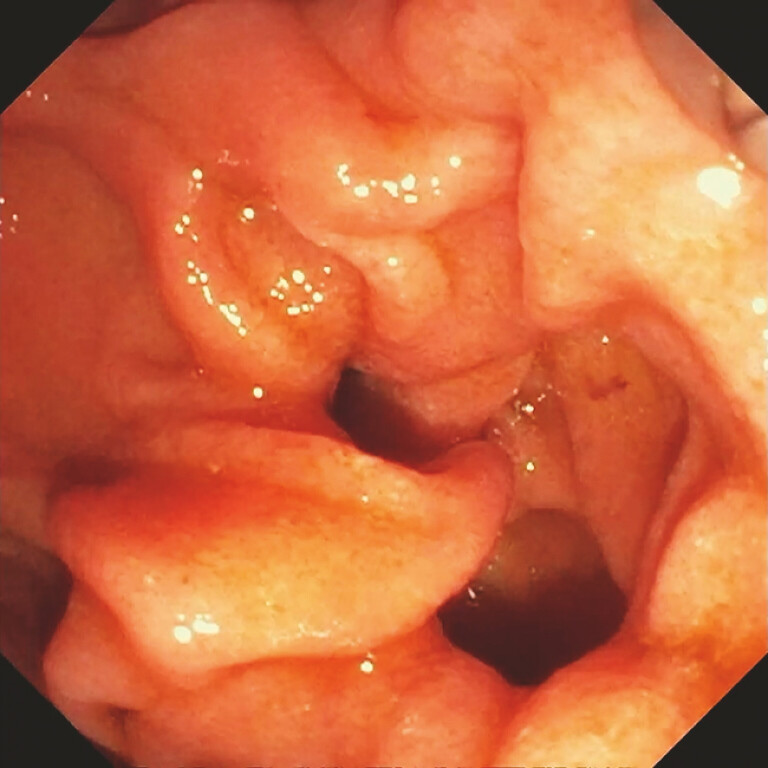 Fig. 1
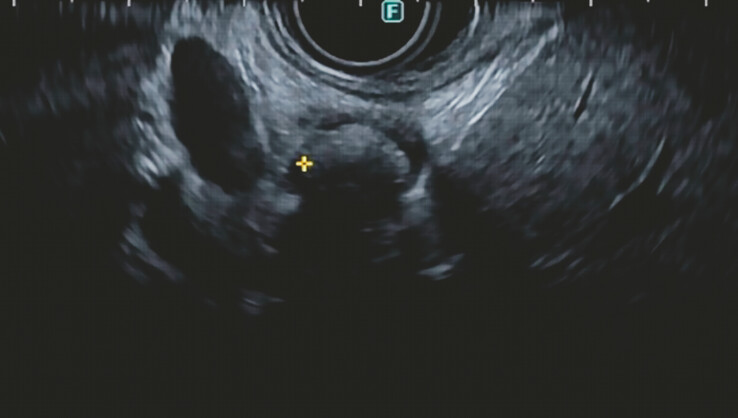 Fig. 2
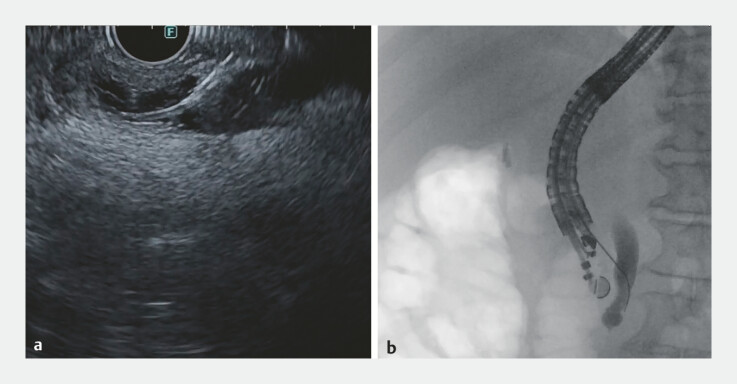 Fig. 3
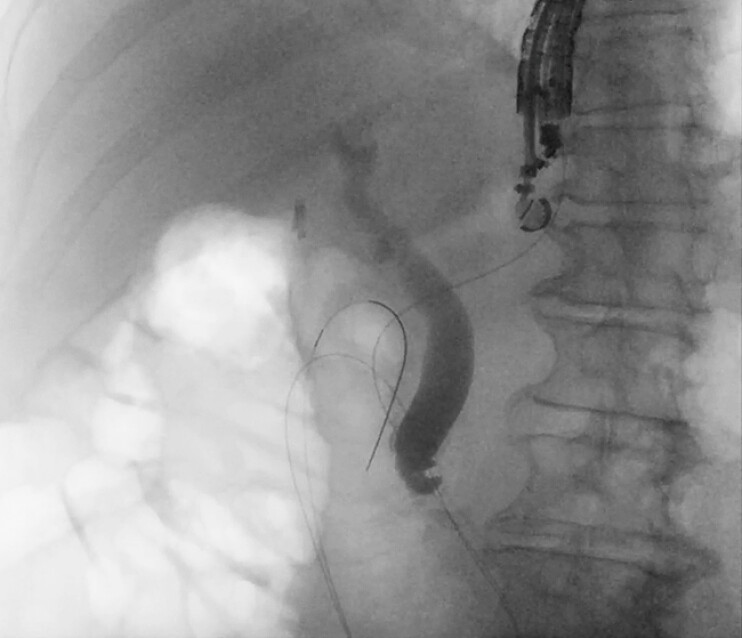 Fig. 4
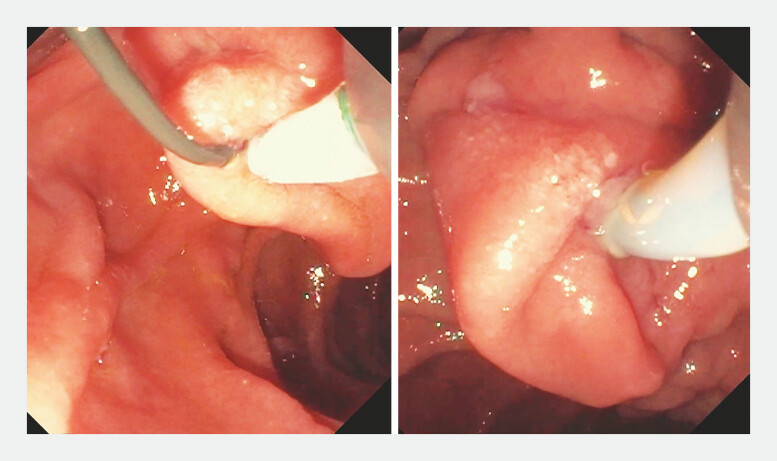 Fig. 5
Peer Reviews
No public reviews on file for this paper yet. If you reviewed it on a platform where reviews are public (OpenReview, ICLR, NeurIPS, ICML), you can paste yours below so the community can read it here.
Videos
No videos yet. Explain this paper in a talk, walkthrough, or lecture? Add one.
Taxonomy
TopicsEsophageal and GI Pathology · Gastrointestinal disorders and treatments · Diverticular Disease and Complications
An intradiverticular papilla is a significant challenge in pancreatobiliary endoscopy, frequently causing failed conventional ERCP 1 . The prevalence of periampullary diverticula increases with age, reaching up to 65% in the elderly 2 . We present an 81-year-old woman with recurrent abdominal pain and inconclusive imaging suggestive of choledocholithiasis. Two prior ERCP attempts failed due to the papilla’s intradiverticular location ( Fig. 1 ). Endoscopic ultrasound (EUS)-assisted biliary rendezvous (EUS-RV) was pursued as a salvage strategy, providing both conclusive imaging and ductal access in a single-session ( Video 1 ).
Intradiverticular major papilla visualized endoscopically.
Step-by-step endoscopic ultrasound-assisted rendezvous for choledocholithiasis in the setting of an intradiverticular papilla.Video 1
First, EUS revealed a 9-mm stone in the common hepatic duct with diffuse intra- and extrahepatic dilatation ( Fig. 2 ). After briefly confirming that attempts to locate or cannulate the papilla had failed, a 19-gauge needle was advanced transduodenally into the extrahepatic bile duct under EUS guidance, with proper positioning confirmed via cholangiogram ( Fig. 3 ). A 0.025-inch × 450-cm straight-tip guidewire (VisiGlide, Olympus Corp.) was then navigated antegrade through the ampulla into the duodenum ( Fig. 4 ). The echoendoscope was exchanged for a duodenoscope, preserving wire access. Although initial “along-the-wire” cannulation failed, backloading the wire into the duodenoscope enabled the “over-the-wire” approach, resulting in successful biliary cannulation ( Fig. 5 ). Therapeutic interventions, including stone extraction, were then completed without complications.
EUS image showing a 9-mm stone lodged in the common hepatic duct near the cystic duct take-off. Abbreviation: EUS, endoscopic ultrasound.
EUS-guided puncture of the extrahepatic bile duct (left); cholangiography confirming correct position of the 19-gauge needle (right). Abbreviation: EUS, endoscopic ultrasound.
Fluoroscopic view demonstrating the guidewire advanced in an antegrade fashion through the ampulla into the duodenum.
Cannulation attempt using the “along-the-wire” technique (left); successful biliary cannulation using the “over-the-wire” approach after backloading the guidewire into the duodenoscope (right).
Given the lack of comparative data on biliary cannulation methods for intradiverticular papilla, the European Society of Gastrointestinal Endoscopy does not provide a definitive algorithm 1 3 . When ERCP fails, various EUS-guided biliary drainage options may be considered, depending on underlying pathology (benign/malignant) and obstruction level (distal/hilar) 3 . The case highlights a complex intervention where EUS-RV offered both diagnostic confirmation and an alternative route for therapy. Although an established technique, it remains underutilized at most centers 4 . While EUS-RV may seem straightforward, it can be challenging even for advanced endoscopists. This video case provides a procedural blueprint and practical tips for endoscopists with limited exposure to the technique.
Endoscopy_UCTN_Code_TTT_1AR_2AB
The reference list from the paper itself. Each links out to its DOI / PubMed record.
- 1Testoni P Mariani A Aabakken L Papillary cannulation and sphincterotomy techniques at ERCP: European Society of Gastrointestinal Endoscopy (ESGE) Clinical Guideline Endoscopy 20164865768310.1055/s-0042-10864127299638 · doi ↗ · pubmed ↗
- 2Shemesh E Klein E Czerniak A Endoscopic sphincterotomy in patients with gallbladder in situ: the influence of periampullary duodenal diverticula Surgery 19901071631662099745 · pubmed ↗
- 3Van Der Merwe SW Van Wanrooij RLJ Bronswijk M Therapeutic endoscopic ultrasound: European Society of Gastrointestinal Endoscopy (ESGE) Guideline Endoscopy 20225418520510.1055/a-1717-139134937098 · doi ↗ · pubmed ↗
- 4Dhir V Top tips for EUS-guided biliary rendezvous (with video)Gastrointest Endosc 20229685786010.1016/j.gie.2022.07.01335863517 · doi ↗ · pubmed ↗