Fate of Residual Aorta After Surgery for Type A Aortic Dissection
Apeksha Mittal, Pankaj Aggarwal, Harkant Singh, Manphool Singhal, Arun Sharma, M. R. Mohamed Irshad, Nishit Santoki, Nitish Kumar, Dollphy Garg, Chandra Shekhar Singh Aswal, Richa Soni, A. Arun George

TL;DR
This study examines how the remaining aorta changes after surgery for type A aortic dissection and finds that partially thrombosed false lumens are linked to faster aortic growth.
Contribution
The study identifies patency and partial thrombosis of the false lumen as key factors in post-surgical aortic dilatation.
Findings
Persistent dissection flaps were found in 68% of patients after surgery.
The abdominal aorta showed the highest growth rate at 3.1 mm/year.
Partially thrombosed false lumens were associated with the most aortic dilatation.
Abstract
Surgical treatment of type A aortic dissection is essentially palliative. Many patients who undergo the procedure still have a dissection flap in the residual aorta, with a persistent patent or partially thrombosed false lumen leaving them susceptible to the dilatation of distal aorta and aneurysm formation. Patients who had undergone surgery for type A aortic dissection from January 2015 till December 2022 were recruited into the study. Two follow-up computed tomography scans were performed at least six months apart, the first one at least one month after the surgery. A persistent dissection flap was found in 34 (68%) patients. All segments of residual distal aorta showed dilatation with time. Growth rate was maximum for abdominal aorta - 3.1 (1.6 - 5.4) mm/year. Patency of false lumen was the only significant factor associated with growth of lower descending thoracic aorta and…
Genes, proteins, chemicals, diseases, species, mutations and cell lines named across the full text — each resolved to its canonical identifier and authoritative record.
Click any figure to enlarge with its caption.
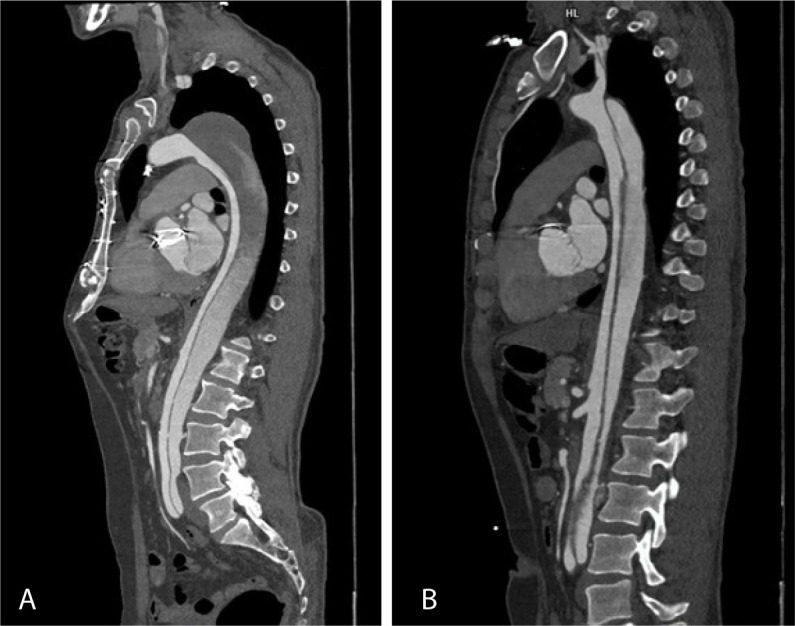 Figure 1
Peer Reviews
No public reviews on file for this paper yet. If you reviewed it on a platform where reviews are public (OpenReview, ICLR, NeurIPS, ICML), you can paste yours below so the community can read it here.
Videos
No videos yet. Explain this paper in a talk, walkthrough, or lecture? Add one.
Taxonomy
TopicsAortic Disease and Treatment Approaches · Aortic aneurysm repair treatments · Infectious Aortic and Vascular Conditions