Assessing diagnostic tests for shrimp allergy in children: A multicenter trial
Yuri Takaoka, Yuki Tsurinaga, Yukiko Hiraguchi, Masaaki Hamada, Atsuko Nakano, Tomoko Kawakami, Ikuo Okafuji, Nayu Iwakoshi, Masaaki Doi, Keita Otsuka, Yukiko Sugimoto, Norihito Iba, Junko Kumon, Rumi Ueno, Tamana Nakano, Tomohiro Yamaguchi, Yohei Fuksawa, Amane Shigekawa

TL;DR
This study evaluated diagnostic tests for shrimp allergy in children, finding that shrimp-specific IgE levels were more useful than skin prick tests.
Contribution
The study provides new insights into the diagnostic accuracy of IgE tests for pediatric shrimp allergy.
Findings
Shrimp-specific IgE levels were higher in children with persistent shrimp allergy compared to others.
Skin prick tests showed limited correlation with symptoms during oral food challenges.
No IgE cutoff accurately predicted a successful oral food challenge outcome.
Abstract
Clinical research on pediatric shrimp allergy is limited. We sought to evaluate the diagnostic accuracy and safety of testing methods for shrimp allergy. An oral food challenge (OFC) for shrimp was conducted on Japanese children with suspected shrimp allergy. Before the OFC, shrimp-, tropomyosin-, house dust mite–, and cockroach-specific IgE levels were measured, along with skin prick tests (SPTs). OFC results using epinephrine as a safety indicator determined persistent, mild, or tolerant shrimp allergy. Sixty-six children (median age, 6 years) underwent the OFC. All patients demonstrated house dust mite–specific IgE level exceeding 0.35 IUA/mL. Sixteen were diagnosed with persistent shrimp allergy, defined by Anaphylaxis Scoring Aichi scores greater than or equal to 10 or scores of 5 with urticaria. A 15-year-old required epinephrine for anaphylaxis. Eight children with negative…
Genes, proteins, chemicals, diseases, species, mutations and cell lines named across the full text — each resolved to its canonical identifier and authoritative record.
Click any figure to enlarge with its caption.
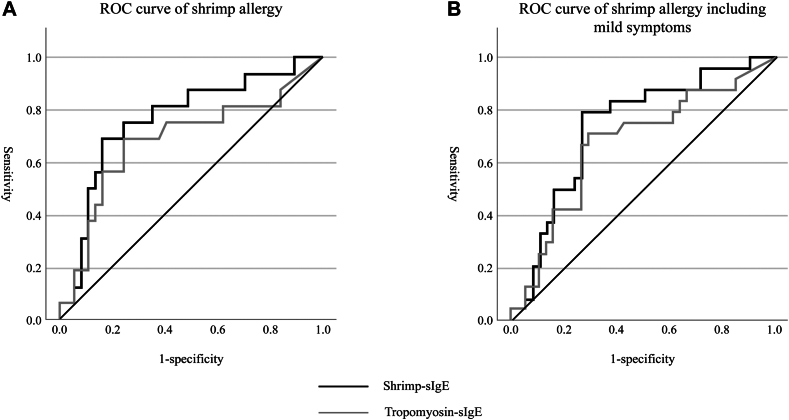 Figure 1
Peer Reviews
No public reviews on file for this paper yet. If you reviewed it on a platform where reviews are public (OpenReview, ICLR, NeurIPS, ICML), you can paste yours below so the community can read it here.
Videos
No videos yet. Explain this paper in a talk, walkthrough, or lecture? Add one.
Taxonomy
TopicsFood Allergy and Anaphylaxis Research · Date Palm Research Studies · Healthcare and Venom Research