Influence of Substrate Color on Oyster Shell Colonization
Pauline Lawrence, Samantha Dishong, Elizabeth Hamman

TL;DR
This study found that the color of artificial reef substrates influences which marine organisms settle and thrive, with blue favoring stationary species and red favoring mobile ones.
Contribution
The study reveals how substrate color affects marine community structure by influencing species-specific recruitment patterns.
Findings
Sessile organisms, especially serpulid worms, preferred blue substrates.
Motile species showed higher recruitment on red substrates.
Mud coverage and erosion impacted sessile species but not motile ones.
Abstract
This study investigated the influence of substrate color on the recruitment and colonization of Crassostrea virginica reef-associated organisms in an artificial reef system in the St. Mary’s River. Substrate color significantly affected community abundance, but the specific pattern depended on locomotion and species. The sessile community preferred blue substrate, which was largely driven by the strong settlement preference of tube-forming polychaetes (serpulid worms). Motile species showed recruitment preference for red shells. Mud coverage and erosion negatively affected the recruitment of sessile species but did not affect motile species recruitment.
Genes, proteins, chemicals, diseases, species, mutations and cell lines named across the full text — each resolved to its canonical identifier and authoritative record.
Click any figure to enlarge with its caption.
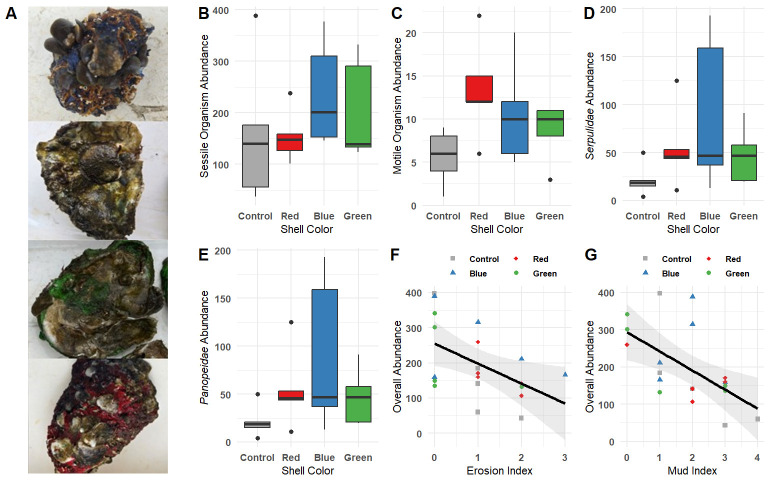 Figure 1
Peer Reviews
No public reviews on file for this paper yet. If you reviewed it on a platform where reviews are public (OpenReview, ICLR, NeurIPS, ICML), you can paste yours below so the community can read it here.
Videos
No videos yet. Explain this paper in a talk, walkthrough, or lecture? Add one.
Taxonomy
TopicsMaterials Engineering and Processing · Marine Bivalve and Aquaculture Studies · Metallurgy and Material Science