Revealing Rotational Characteristics of the Uniflagellate Mutant of Chlamydomonas reinhardtii through DeepLabCut-Based Autotracking
Azusa Kage, Ken H. Nagai, Takayuki Nishizaka, Kenta Ishimoto

TL;DR
This paper introduces an automated tracking method to study the rotation of a mutant green alga's flagellum, revealing differences in live and demembranated cells.
Contribution
A DeepLabCut-based autotracking method is applied to study rotational dynamics of a uniflagellate mutant in Chlamydomonas reinhardtii.
Findings
Live uni1 cells rotated counterclockwise under a coverslip when viewed from above.
Demembranated uni1 models showed slower, more clockwise rotation.
Differences in rotation are likely due to changes in the 3D flagellar waveform.
Abstract
Tracking eukaryotic flagella and cilia often requires manual clicking, even in the age of digital imaging. We developed an autotracking method using DeepLabCut, a CNN-based, marker-less tracking tool originally designed for animal behavior. Applying this method, we uncovered rotational characteristics of Chlamydomonas reinhardtii uni1 , a uniflagellate mutant. Live uni1 cells predominantly rotated counterclockwise under a coverslip when viewed from above, whereas demembranated models exhibited slower, more clockwise rotation. These differences likely stem from alterations in the three-dimensional flagellar waveform.
Genes, proteins, chemicals, diseases, species, mutations and cell lines named across the full text — each resolved to its canonical identifier and authoritative record.
Click any figure to enlarge with its caption.
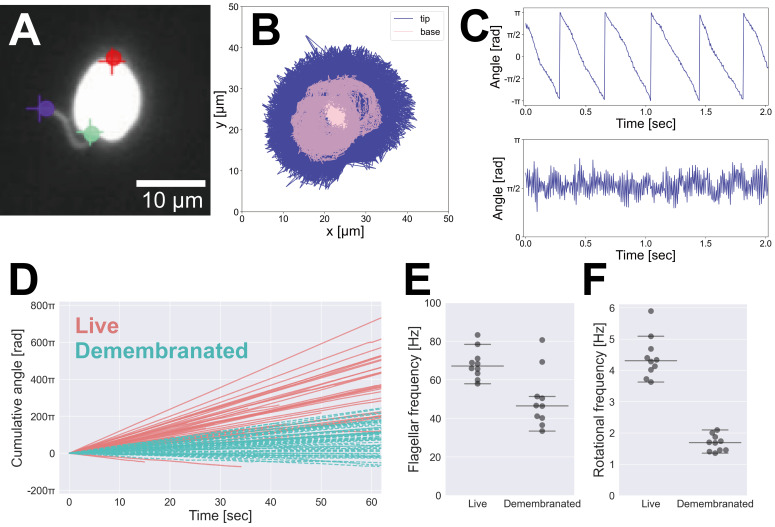 Figure 1
Peer Reviews
No public reviews on file for this paper yet. If you reviewed it on a platform where reviews are public (OpenReview, ICLR, NeurIPS, ICML), you can paste yours below so the community can read it here.
Videos
No videos yet. Explain this paper in a talk, walkthrough, or lecture? Add one.
Taxonomy
TopicsProtist diversity and phylogeny · Methane Hydrates and Related Phenomena