The effect of temperature on asexual reproduction in Hydra vulgaris
Jameelah Destry, Kelso Cochran, Aide Macias-Muñoz

TL;DR
This study shows that higher temperatures increase asexual reproduction and population growth in Hydra vulgaris.
Contribution
The novel finding is that increased temperature enhances asexual budding rates and population growth in Hydra vulgaris.
Findings
Hydra vulgaris populations grow faster at 25°C compared to 15°C.
Higher temperatures lead to increased budding rates and more buds per polyp.
Asexual reproduction is more active under warmer conditions.
Abstract
Hydra vulgaris is a model cnidarian used for interdisciplinary studies in biology, yet its reproductive responses to environmental changes remain underexplored. This study examined how temperature affects asexual reproduction (budding) rates and population growth in H. vulgaris . We placed Hydra in two thermal environments, 15°C and 25°C, to compare differences in population growth, number of budding polyps, number of buds, and budding rates under ‘cold’ and ‘hot’ conditions. Our findings indicate that Hydra populations exhibit increased growth through asexual budding at higher temperatures.
Genes, proteins, chemicals, diseases, species, mutations and cell lines named across the full text — each resolved to its canonical identifier and authoritative record.
Click any figure to enlarge with its caption.
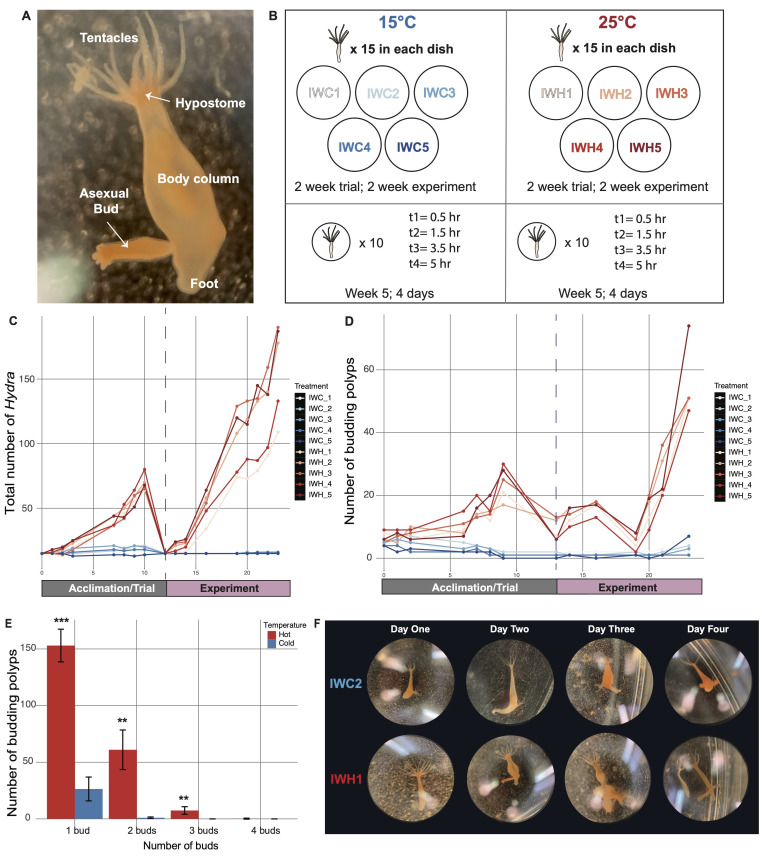 Figure 1
Peer Reviews
No public reviews on file for this paper yet. If you reviewed it on a platform where reviews are public (OpenReview, ICLR, NeurIPS, ICML), you can paste yours below so the community can read it here.
Videos
No videos yet. Explain this paper in a talk, walkthrough, or lecture? Add one.
Taxonomy
TopicsReproductive Health and Technologies