Delayed ischemic stroke after PED placement for aneurysms: optimal duration of dual antiplatelet therapy and risk factors
Chao Wang, Yangyang Zhou, Ying Zhang, Dachao Wei, Mirzat Turhon, Jian Liu, Yisen Zhang, Kun Wang, Hongqi Zhang, Tianxiao Li, Aisha Maimaitili, Guohua Mao, Donglei Song, Yunyan Wang, Wenfeng Feng, Yang Wang, Huaizhang Shi, Jieqing Wan, Jianmin Liu, Sheng Guan, Yuanli Zhao

TL;DR
This study finds that delaying the switch from dual antiplatelet therapy to monotherapy after a brain aneurysm procedure may reduce the risk of delayed stroke in certain patients.
Contribution
The study identifies optimal DAPT duration and risk factors for delayed ischemic stroke after PED placement.
Findings
Late switch to monotherapy was associated with a lower DIS rate compared to early switch.
Hypertension and immediate complete occlusion were significant risk factors for DIS.
Extending DAPT to at least six months may be safer for high-risk patients.
Abstract
Delayed ischemic stroke (DIS) is a rare complication that may occur in patients with cerebral aneurysms treated with the Pipeline Embolization device (PED). This study aims to evaluate the characteristics of DIS following PED placement and to investigate the optimal duration of dual antiplatelet therapy (DAPT) in relation to the incidence of DIS. We conducted a multicenter retrospective cohort study on consecutive cases of intracranial aneurysms treated with PED. Patients were divided into two groups based on the timing of DAPT switching to monotherapy: early (<6 months) and late (≥6 months). To adjust for potential biases between the groups, inverse probability of treatment weighting (IPTW) was applied. Kaplan–Meier survival analysis and multivariate Cox regression were used to calculate cumulative DIS rates, and risk factors for DIS. A total of 1,146 consecutive patients with 1,296…
Genes, proteins, chemicals, diseases, species, mutations and cell lines named across the full text — each resolved to its canonical identifier and authoritative record.
Click any figure to enlarge with its caption.
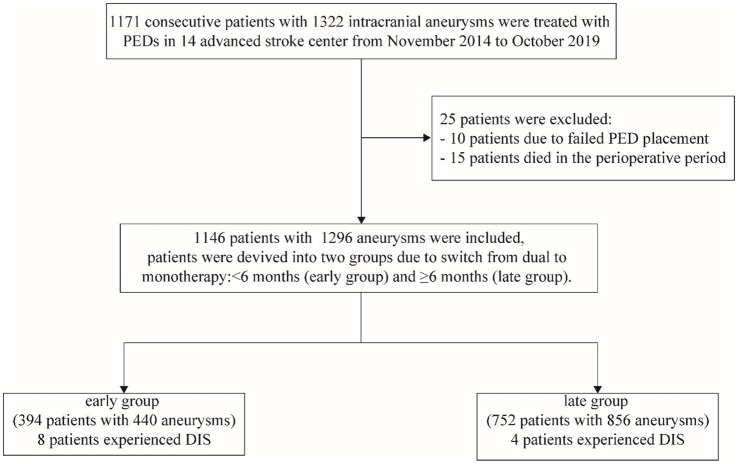 Figure 1
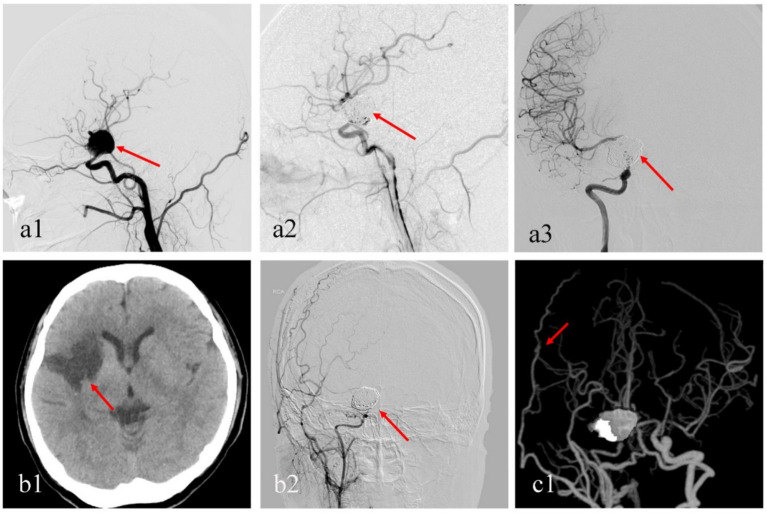 Figure 2
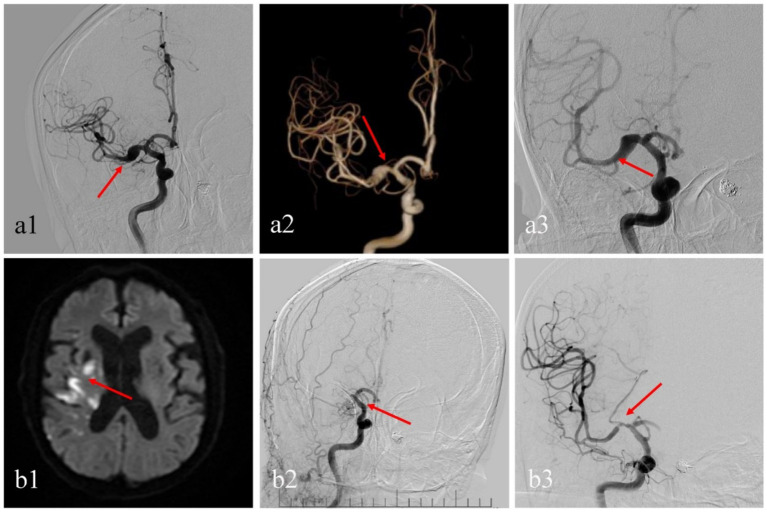 Figure 3
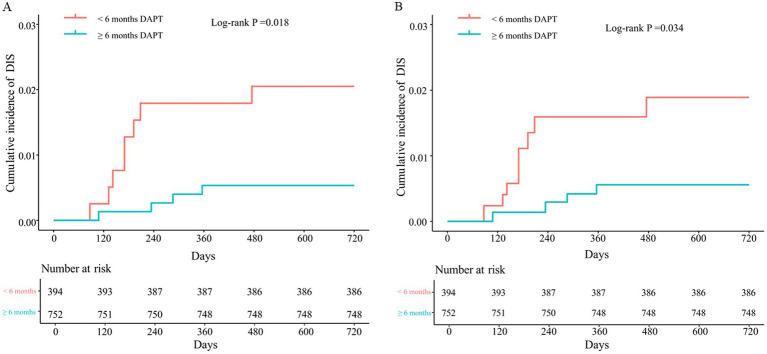 Figure 4
Peer Reviews
No public reviews on file for this paper yet. If you reviewed it on a platform where reviews are public (OpenReview, ICLR, NeurIPS, ICML), you can paste yours below so the community can read it here.
Videos
No videos yet. Explain this paper in a talk, walkthrough, or lecture? Add one.
Taxonomy
TopicsIntracranial Aneurysms: Treatment and Complications · Cerebrovascular and Carotid Artery Diseases · Neurosurgical Procedures and Complications