Genetically Distinct Acute Megakaryoblastic Leukemia following Low Hypodiploid B-Lymphoblastic Leukemia linked by TP53 Mutation
Jaryse C. Harris, Jeffrey Schubert, Brian Lockhart, Rachel Olson, Michele E. Paessler, Elizabeth Margolskee, Vinodh Pillai, Jinhua Wu, Netta Golenberg, Jiani Chen, Elizabeth H. Denenberg, Tammy Luke, Minjie Luo, Yiming Zhong, Marilyn M. Li, Gerald B. Wertheim

TL;DR
A patient developed two genetically distinct leukemias, linked by a shared TP53 mutation, suggesting a need for close monitoring of TP53-mutant tumors.
Contribution
Identifies a shared TP53 mutation in two distinct leukemias, challenging assumptions about their origin and highlighting clinical implications.
Findings
The AMKL and B-ALL were genetically distinct, lacking common AML-pCT markers.
Both leukemias shared an identical TP53 mutation not found in germline testing.
The case suggests a somatic TP53 mutation in a hematopoietic precursor cell.
Abstract
We report a case of acute myeloid leukemia with megakaryoblastic differentiation (AMKL) that developed after an initial B-lymphoblastic leukemia (B-ALL) with low hypodiploidy. Although the AMKL was initially thought either to be a phenotypic change from the original B-ALL or to have arisen as a result of treatment (acute myeloid leukemia, post cytotoxic therapy, AML-pCT [WHO]; AML, therapy related [ICC]), genetic evaluation of both the AMKL and the B-ALL suggest that neither of these considerations was correct. Rather, the AMKL did not harbor the most common genetic hallmark of AML-pCT–rearrangement of KMT2– and was genetically distinct from the B-ALL. Both the B-ALL and the AMKL, however, showed an identical TP53 mutation by next generation sequencing (NGS), while germline testing was negative for this mutant allele. Hence, either the patient had a tissue restricted constitutional TP53…
Genes, proteins, chemicals, diseases, species, mutations and cell lines named across the full text — each resolved to its canonical identifier and authoritative record.
Click any figure to enlarge with its caption.
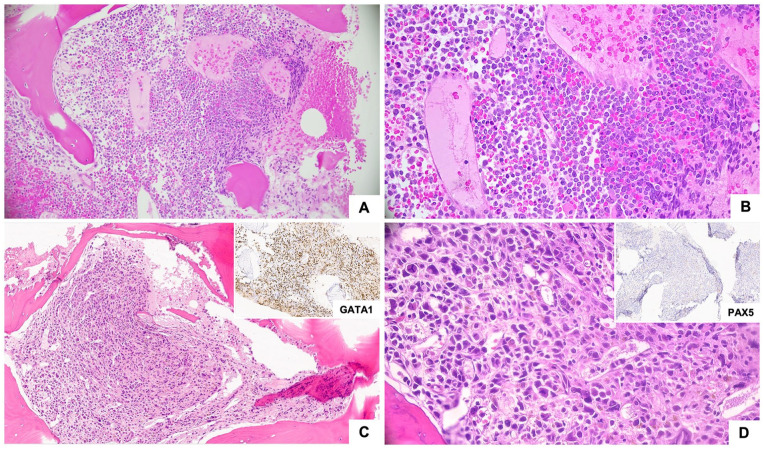 Figure 1
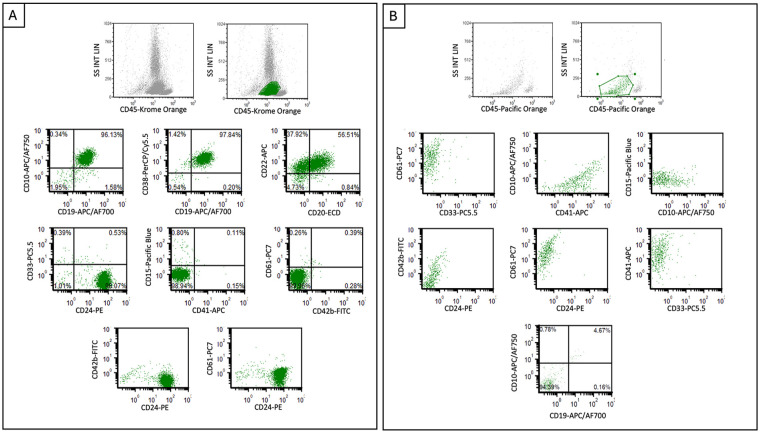 Figure 2
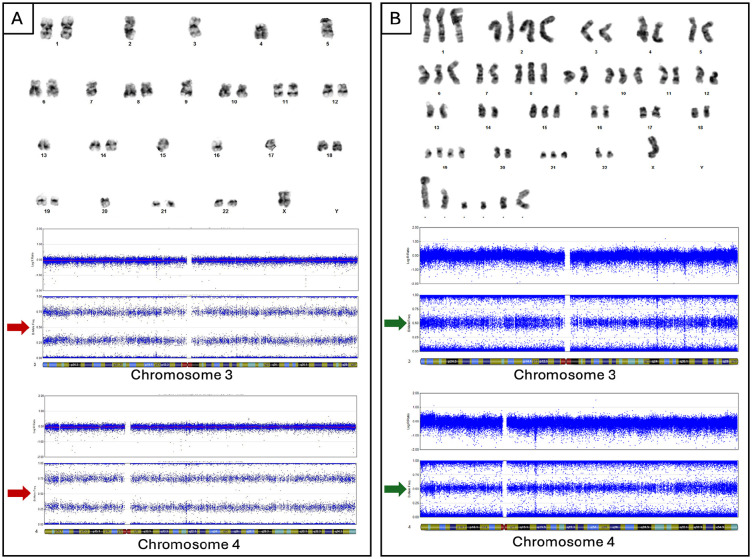 Figure 3
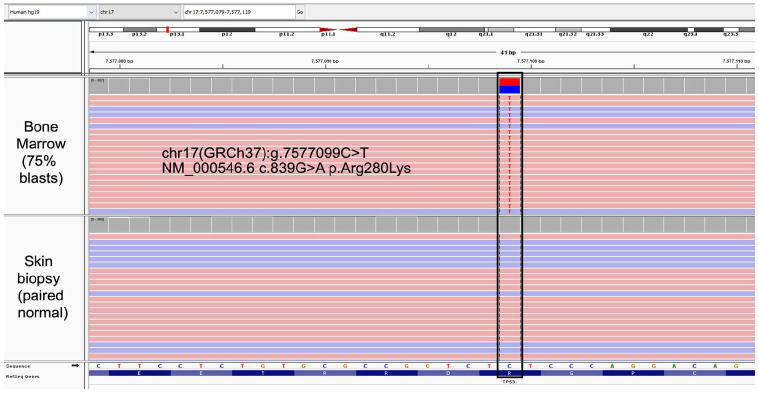 Figure 4
 Figure 5
Peer Reviews
No public reviews on file for this paper yet. If you reviewed it on a platform where reviews are public (OpenReview, ICLR, NeurIPS, ICML), you can paste yours below so the community can read it here.
Videos
No videos yet. Explain this paper in a talk, walkthrough, or lecture? Add one.
Taxonomy
TopicsAcute Myeloid Leukemia Research · Acute Lymphoblastic Leukemia research · Chronic Myeloid Leukemia Treatments