Evaluation of BRCA1/2 testing rates in epithelial ovarian cancer patients: lessons learned from real-world clinical data
Lieke Lanjouw, Claire J. H. Kramer, Arja ter Elst, Geertruida H. de Bock, Katja N. Gaarenstroom, Refika Yigit, Lieke P. V. Berger, Christi J. van Asperen, Sabrina Z. Commandeur-Jan, Dimas M. X. van der Hall, Mathilde Jalving, Marjolein J. Kagie, Nienke van der Stoep

TL;DR
This study evaluates BRCA1/2 testing rates in ovarian cancer patients in the Netherlands, finding disparities in access and suggesting ways to improve testing.
Contribution
The study provides insights into real-world BRCA1/2 testing practices and identifies factors influencing test completion in epithelial ovarian cancer patients.
Findings
69.8% of EOC patients completed the BRCA1/2 test-pathway over four years.
Younger patients and those with high-grade tumors were more likely to complete testing.
Inequalities in testing access were observed among older and lower socioeconomic status patients.
Abstract
Identification of somatic and germline BRCA1/2 pathogenic variants in epithelial ovarian cancer (EOC) patients is essential for determining poly-(ADP-ribose)-polymerase (PARP) inhibitor sensitivity and genetic predisposition. In the Netherlands, BRCA1/2 testing changed to a tumor-first approach to efficiently identify both somatic and germline pathogenic variants in all patients. Here, we performed an in-depth evaluation of the first four years of the tumor-first test-pathway. Data of consecutive series of patients diagnosed with EOC in two regions were obtained from the Netherlands Cancer Registry. Tumor and/or germline test data were retrieved from hospital databases. The primary outcome was the percentage of patients completing the BRCA1/2 test-pathway, defined as having a negative tumor test or a referral for a germline test in case of a positive tumor test or no tumor test. Factors…
Genes, proteins, chemicals, diseases, species, mutations and cell lines named across the full text — each resolved to its canonical identifier and authoritative record.
Click any figure to enlarge with its caption.
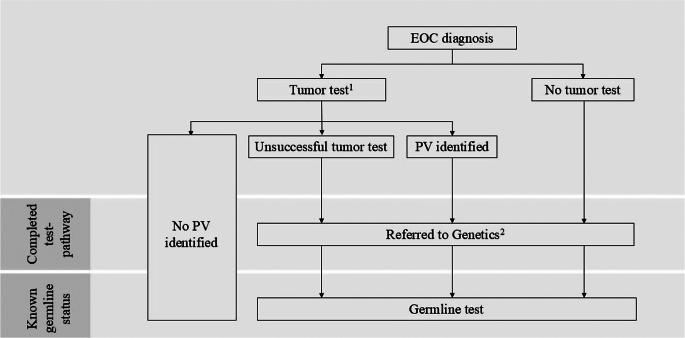 Figure 1
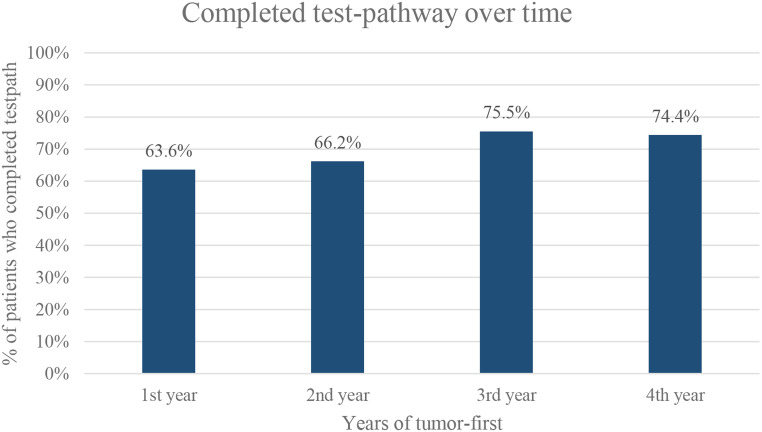 Figure 2
Peer Reviews
No public reviews on file for this paper yet. If you reviewed it on a platform where reviews are public (OpenReview, ICLR, NeurIPS, ICML), you can paste yours below so the community can read it here.
Videos
No videos yet. Explain this paper in a talk, walkthrough, or lecture? Add one.
Taxonomy
TopicsPARP inhibition in cancer therapy · BRCA gene mutations in cancer · Ovarian cancer diagnosis and treatment