Transient DREADD Manipulation of the Dorsal Dentate Gyrus in Rats Impairs Initial Learning of Place‐Outcome Associations
J. Lim, A. Souiki, P. Ahmad, C. A. Oomen, G. J. Huis in ’t Veld, C. S. Lansink, C. M. A. Pennartz, U. Olcese

TL;DR
This study shows that temporarily inhibiting a part of the rat hippocampus called the dorsal dentate gyrus disrupts the initial learning of location-reward associations.
Contribution
The study provides novel evidence that the dorsal dentate gyrus is acutely involved in initial acquisition learning of place-reward associations.
Findings
Bilateral DREADD modulation of the dorsal dentate gyrus impaired initial acquisition learning of place-reward associations.
Performance recovered to baseline levels within the same session after DG modulation.
Reward sensitivity and alternation behavior were temporally linked to DG-dependent impairment during learning.
Abstract
The dentate gyrus subfield of the hippocampus is thought to be critically involved in the disambiguation of similar episodic experiences and places in a context‐dependent manner. However, most empirical evidence has come from lesion and gene knock‐out studies in rodents, in which the dentate gyrus is permanently perturbed and compensation of affected functions via other areas within the memory circuit could take place. The acute and causal role of the dentate gyrus herein remains therefore elusive. The present study aimed to investigate the acute role of the dorsal dentate gyrus in disambiguation learning using reversible inhibitory DREADDs. Rats were trained on a location discrimination task and learned to discriminate between a rewarded and unrewarded location with either small (similar condition) or large (dissimilar condition) separation. Reward contingencies switched after applying…
Genes, proteins, chemicals, diseases, species, mutations and cell lines named across the full text — each resolved to its canonical identifier and authoritative record.
Click any figure to enlarge with its caption.
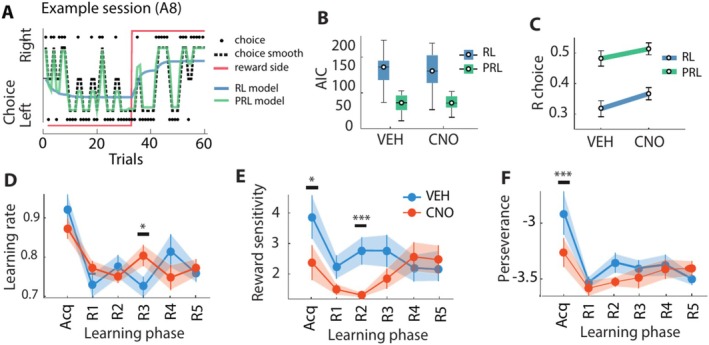 Figure 1
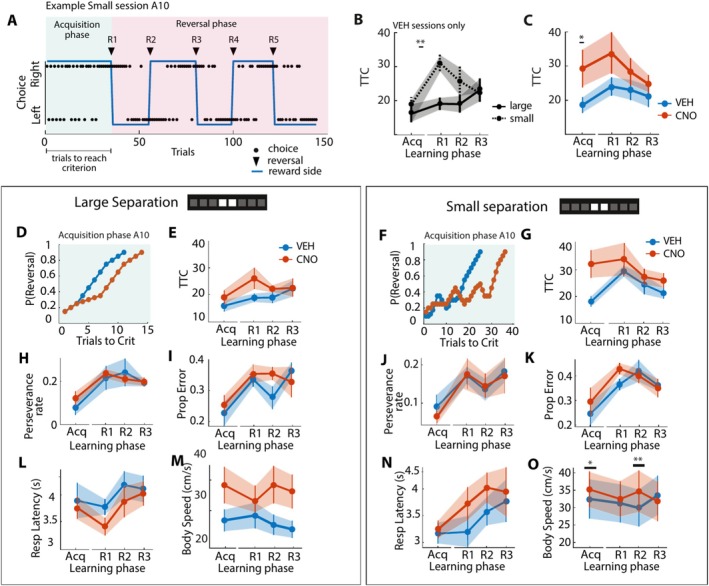 Figure 2
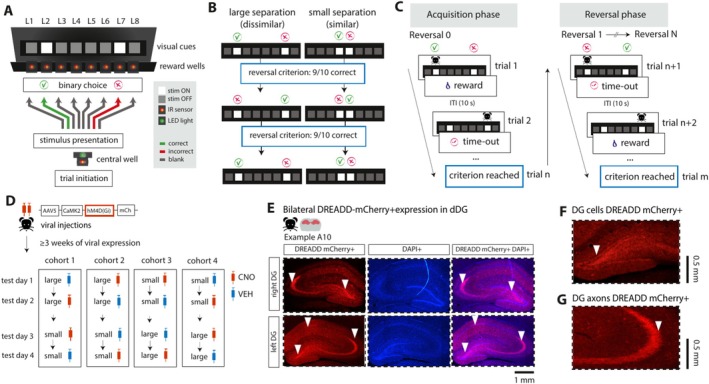 Figure 3
Peer Reviews
No public reviews on file for this paper yet. If you reviewed it on a platform where reviews are public (OpenReview, ICLR, NeurIPS, ICML), you can paste yours below so the community can read it here.
Videos
No videos yet. Explain this paper in a talk, walkthrough, or lecture? Add one.
Taxonomy
TopicsMemory and Neural Mechanisms · Neuroscience and Neuropharmacology Research · Stress Responses and Cortisol