Exploring the role of directly coupled alternating electric fields on chondrocyte morphology and redifferentiation capacity with a focus on sex differences
Zezhong Song, Vivica Freiin Grote, Franziska Sahm, Julius Zimmermann, Christoph Lutter, Anika Jonitz‐Heincke, Rainer Bader

TL;DR
This study shows that electrical stimulation can help chondrocytes redifferentiate, with male cells responding better than female cells.
Contribution
The study reveals sex-based differences in chondrocyte response to electric fields, offering insights for cartilage repair therapies.
Findings
Electric fields at 15–20 V/m increased the Col2/Col1 ratio and chondrocyte-like morphology.
Female chondrocytes showed higher Col1 synthesis and a lower Col2/Col1 ratio compared to male cells.
Male chondrocytes were more prone to redifferentiate after electrical stimulation.
Abstract
In cell‐based therapies addressing articular cartilage lesions, a central challenge is to avoid the formation of fibrous cartilage resulting from dedifferentiation processes. Electrical stimulation emerges as a promising approach for promoting chondrocytic redifferentiation. This study investigated the effects of varying electric fields on morphological changes and the redifferentiation capacity of human chondrocytes with regard to alterations in sex. Chondrocytes, isolated from the articular cartilage of male and female patients undergoing total knee replacement, were exposed to alternating electric fields of varying strengths ranging from 0.8 to 1.2, 15 to 20 and 100 to 140 V/m. Afterwards, cell morphology and viability, as well as the deposition of collagen (Col) 1 and 2, were evaluated. Following electrical stimulation, in particular at 15–20 V/m, an increase in the Col2/Col1…
Genes, proteins, chemicals, diseases, species, mutations and cell lines named across the full text — each resolved to its canonical identifier and authoritative record.
Click any figure to enlarge with its caption.
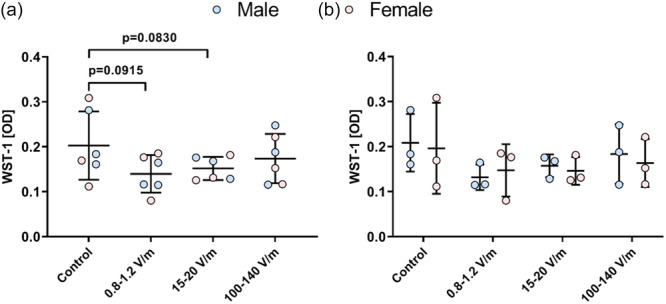 Figure 1
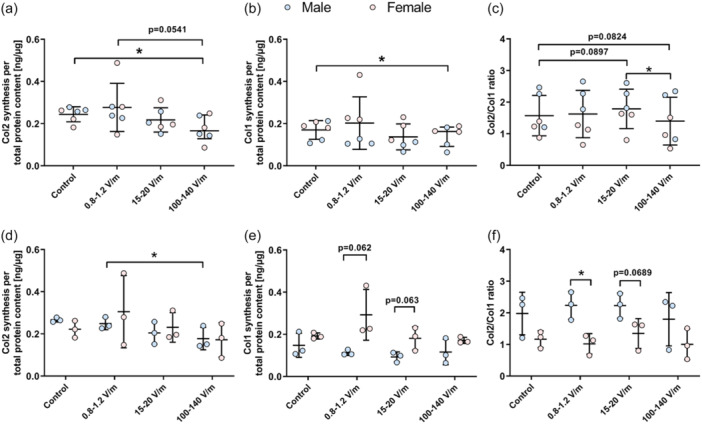 Figure 2
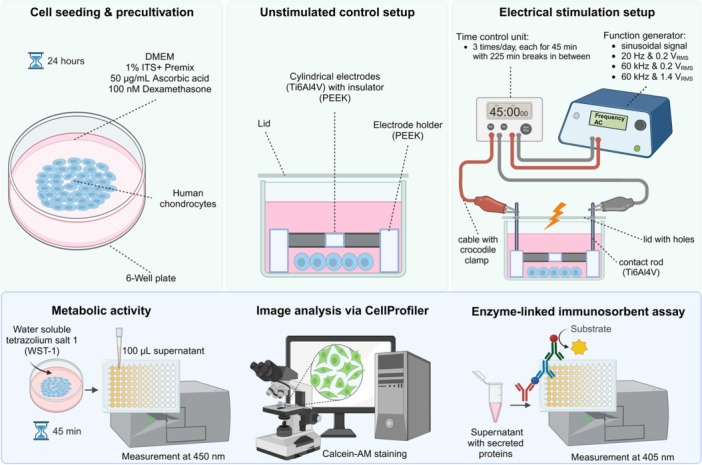 Figure 3
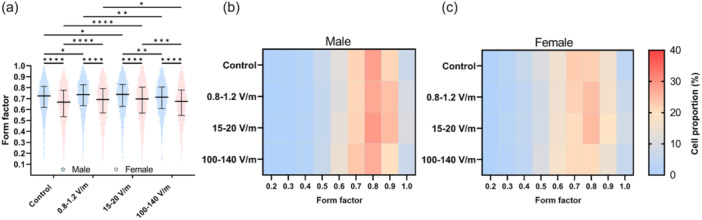 Figure 4
Peer Reviews
No public reviews on file for this paper yet. If you reviewed it on a platform where reviews are public (OpenReview, ICLR, NeurIPS, ICML), you can paste yours below so the community can read it here.
Videos
No videos yet. Explain this paper in a talk, walkthrough, or lecture? Add one.
Taxonomy
TopicsPlanarian Biology and Electrostimulation · Osteoarthritis Treatment and Mechanisms · 3D Printing in Biomedical Research