An exploratory analysis on diastolic function in the intensive compared with less intensive blood pressure control to prevent adverse cardiac remodelling in children with chronic kidney disease (HOT-KID): a parallel-group, open-label, multicentre, randomised, controlled trial
Haotian Gu, John M. Simpson, Janette Cansick, Eric Finlay, Rodney Gilbert, Andrew Lunn, Heather Maxwell, Henry Morgan, Mohan Shenoy, Rukshana Shroff, Pushpa Subramaniam, Jane Tizard, Yincent Tse, Phil Chowienczyk, Manish D. Sinha, Janette Cansick, Janette Cansick, Abdel Douiri

TL;DR
This study explores whether stricter blood pressure control in children with chronic kidney disease improves heart function, finding some benefits in diastolic function measures.
Contribution
The study provides new insights into the effects of intensive blood pressure control on diastolic function in children with CKD.
Findings
Intensive BP control showed a slower decline in E/A ratio and septal e’ velocity compared to standard control.
Left atrial volume index increased more in the standard treatment group.
No significant differences in adverse events were observed between treatment groups.
Abstract
Relationship between blood pressure (BP) control and left ventricular (LV) diastolic function in children with chronic kidney disease (CKD) is uncertain. The aim of this study is to investigate whether achieving lower BP yields a favourable impact on diastolic function. We performed an exploratory analysis in the HOT-KID, a parallel group, open-label, multicentre, randomised, controlled trial (ISRCTN25006406). Children with CKD were randomised to standard (50th–75th percentile) or intensive (<40th percentile) standardised office systolic BP targets. Echocardiograms were performed at baseline and at follow-up visits. Diastolic function was assessed by early (E) and late mitral inflow (A) E/A ratio, mitral annular motion of myocardial relaxation (e’) and atrial contraction (a’) velocity, LV compliance of E/e’ and e’/a’ ratio, and left atrial volume index (LAVi) by a blinded observer.…
Genes, proteins, chemicals, diseases, species, mutations and cell lines named across the full text — each resolved to its canonical identifier and authoritative record.
Click any figure to enlarge with its caption.
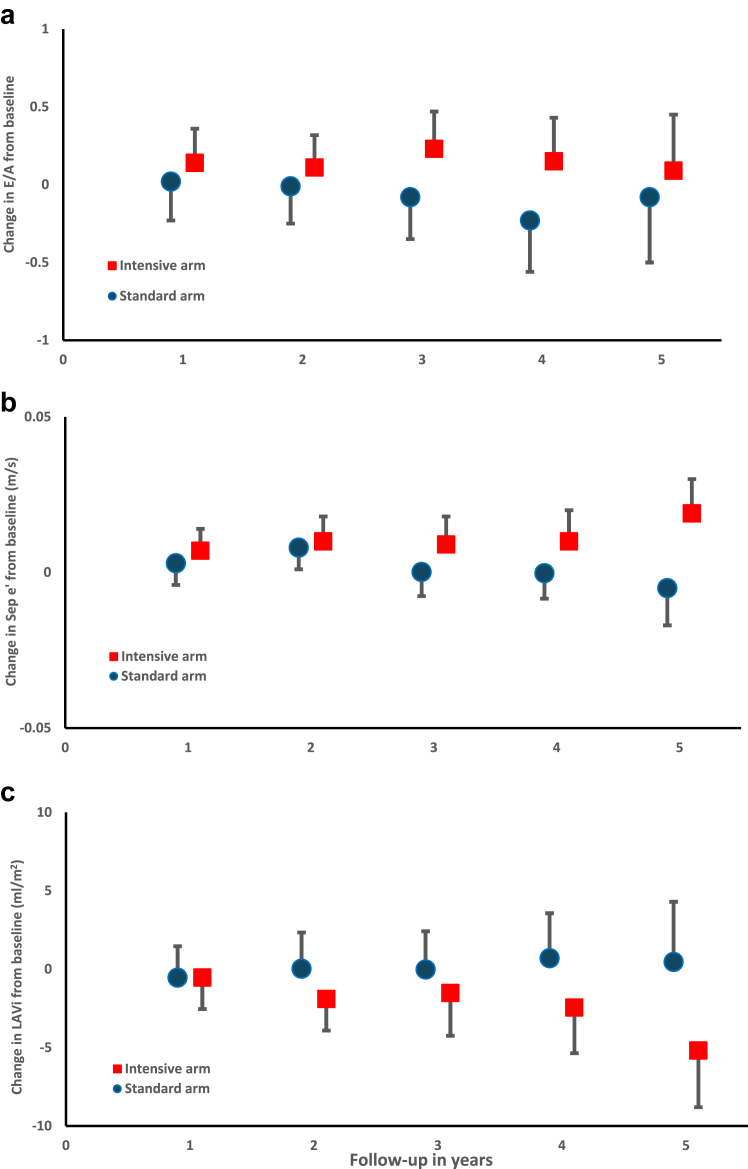 Figure 1
Peer Reviews
No public reviews on file for this paper yet. If you reviewed it on a platform where reviews are public (OpenReview, ICLR, NeurIPS, ICML), you can paste yours below so the community can read it here.
Videos
No videos yet. Explain this paper in a talk, walkthrough, or lecture? Add one.
Taxonomy
TopicsCardiovascular Function and Risk Factors · Heart Failure Treatment and Management · Congenital Heart Disease Studies