Association between weight-adjusted waist index and 20-meter shuttle run test in Chinese children and adolescents: a multicenter cross-sectional survey
Zhen Zhang, Nana Tang, Mengjin Yao, Zhimin Zhao

TL;DR
This study explores how a new body measurement called weight-adjusted waist index relates to cardiopulmonary fitness in Chinese children and adolescents.
Contribution
The study introduces the weight-adjusted waist index (WWI) as a novel indicator and examines its relationship with cardiopulmonary fitness in Chinese children.
Findings
There is an inverted 'U' relationship between WWI and 20-meter shuttle run test (SRT) performance in children and adolescents.
Both low and high WWI values are associated with lower SRT scores, with a stronger effect observed in boys.
SRT scores increase with age, peaking in the 15–17-year-old group.
Abstract
Cardiopulmonary fitness is associated with several physical health indicators in children and adolescents and has shown a downward trend in recent years. The 20-m SRT has received widespread attention from scholars as a recognized indirect measure for evaluating cardiopulmonary fitness. However, few studies have analyzed the association between the weight-adjusted waist index (WWI), a novel indicator, and cardiopulmonary fitness in Chinese children and adolescents. In this study, 41,523 children and adolescents aged 6–17 years in China were assessed for weight, waist circumference, 20-m SRT, and related covariates. One-way ANOVA, LSD, and curvilinear regression analyses were used to analyze the associations that existed between WWI and 20-m SRT. Comparison of WWI and 20-m SRT scores among Chinese children and adolescents of different ages showed statistically significant differences…
Genes, proteins, chemicals, diseases, species, mutations and cell lines named across the full text — each resolved to its canonical identifier and authoritative record.
Click any figure to enlarge with its caption.
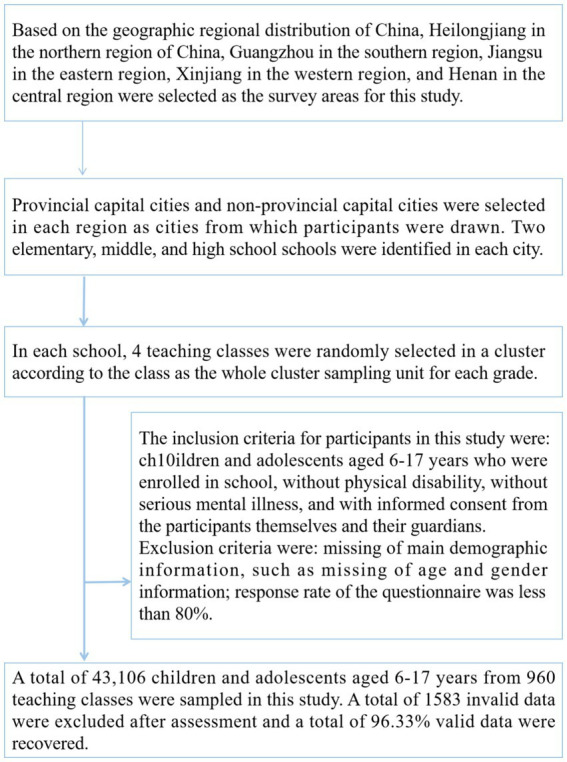 Figure 1
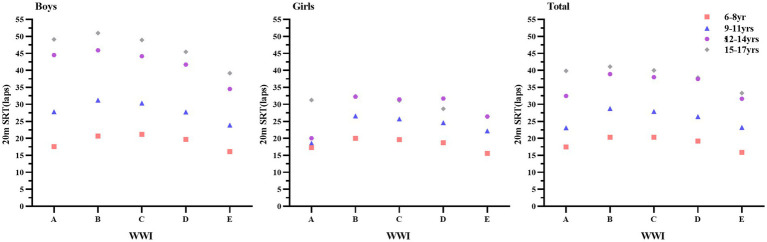 Figure 2
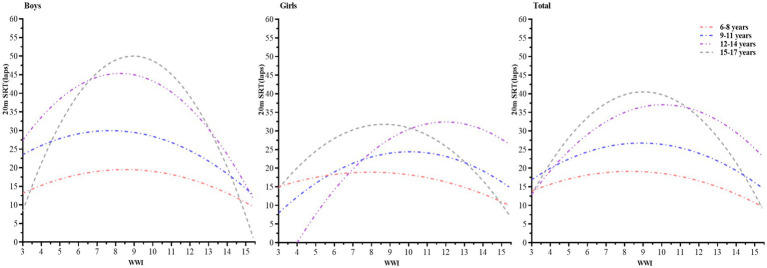 Figure 3
Peer Reviews
No public reviews on file for this paper yet. If you reviewed it on a platform where reviews are public (OpenReview, ICLR, NeurIPS, ICML), you can paste yours below so the community can read it here.
Videos
No videos yet. Explain this paper in a talk, walkthrough, or lecture? Add one.
Taxonomy
TopicsBody Composition Measurement Techniques · Cardiovascular Disease and Adiposity · Occupational Health and Performance