Aplasia Cutis Congenita Type V Associated With Fetus Papyraceus in a Dichorionic Diamniotic Twin Pregnancy
Julie Baverman, Mariah Fleischman, David Brooks

TL;DR
A male baby was born with skin defects linked to a twin pregnancy where the other fetus died early.
Contribution
This case uniquely connects type V ACC with fetal papyraceus in a twin pregnancy.
Findings
The neonate had bilateral stellate-shaped truncal lesions consistent with type V ACC.
The condition was associated with fetal papyraceus in a dichorionic diamniotic twin pregnancy.
The case highlights the need for further research into ACC's association with fetal demise.
Abstract
A male neonate was born at 40 weeks and 3 days gestation with bilateral, stellate shaped truncal lesions, consistent with type V aplasia cutis congenita (ACC). The infant was the survivor of a dichorionic diamniotic twin pregnancy, with fetal demise documented at 13 weeks gestation. Here we present a unique case of ACC associated with fetal papyraceus, along with a review of the current literature on this heterogeneous group of disorders.
Genes, proteins, chemicals, diseases, species, mutations and cell lines named across the full text — each resolved to its canonical identifier and authoritative record.
Click any figure to enlarge with its caption.
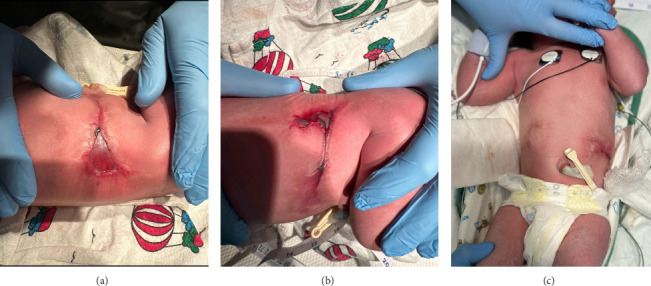 Figure 1
Peer Reviews
No public reviews on file for this paper yet. If you reviewed it on a platform where reviews are public (OpenReview, ICLR, NeurIPS, ICML), you can paste yours below so the community can read it here.
Videos
No videos yet. Explain this paper in a talk, walkthrough, or lecture? Add one.
Taxonomy
TopicsSkin and Cellular Biology Research · Connective tissue disorders research · Cell Adhesion Molecules Research