Unveiling the impact of high-involvement work practices on team creativity: Exploring the interplay of team reflexivity and work demand attributes
Abdul Waheed, Zhu Yongyue, Salma Waheed, Shahbaz Hussain

TL;DR
This study explores how high-involvement work practices affect team creativity in Pakistan's hospitality industry, considering the roles of team reflexivity and work demands.
Contribution
The study introduces cognitive workload theory to examine how work demand attributes moderate the relationship between high-involvement work practices and team creativity.
Findings
Team reflexivity partially mediates the relationship between high-involvement work practices and team creative performance.
Workload and physical work environment moderate the relationship between high-involvement work practices and team reflexivity.
Cognitive workload theory is supported in the context of team creative performance.
Abstract
This study aims to investigate the association between high-involvement work practices (HIWPs) and team creative performance (TCP) in Pakistan’s hospitality industry. Moreover, the mediating role of team reflexivity (TR) and moderating role of work demand elements workload (WL) and physical work environment (PWE) have also been studied by introducing cognitive workload theory (CWT) in the TCP context. The data were collected from 408 hotel industry employees through a structured questionnaire. The data was analyzed using different statistical techniques including factor analysis, correlation and structure equation modeling, and slope analysis. Results indicate a successful moderation between HIWPs (power, information, and reward) and TR with WL and PWE. Moreover, the results of this study suggest that team reflexivity partly mediates the association between the HIWP and TCP. Results…
Genes, proteins, chemicals, diseases, species, mutations and cell lines named across the full text — each resolved to its canonical identifier and authoritative record.
Click any figure to enlarge with its caption.
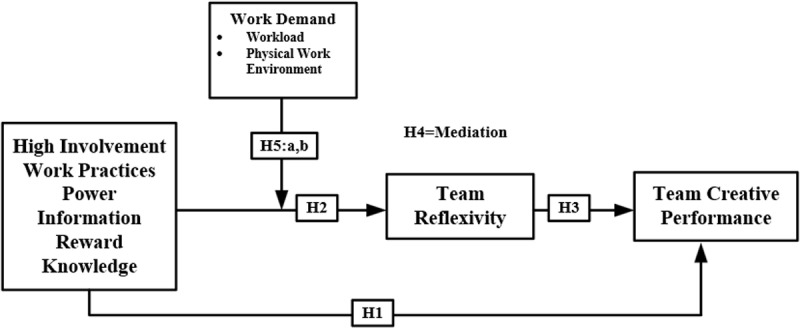 Figure 1
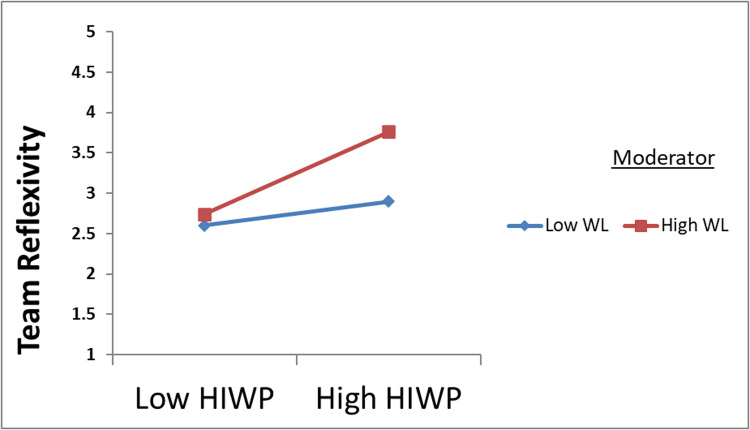 Figure 2
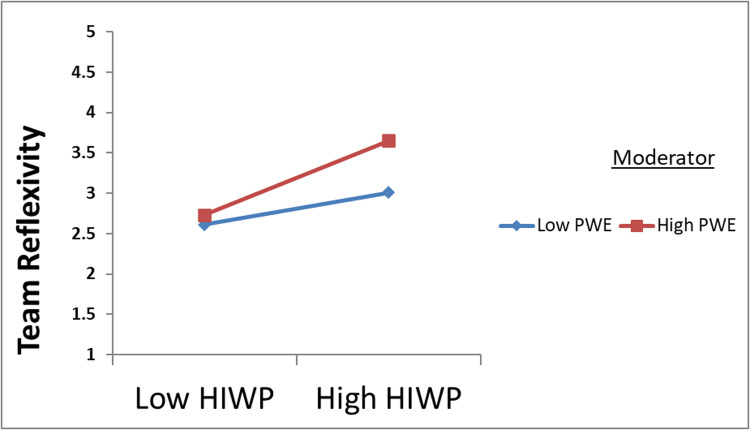 Figure 3
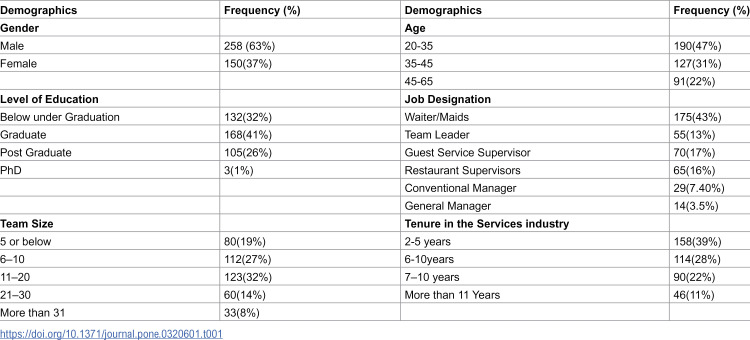 Figure 4
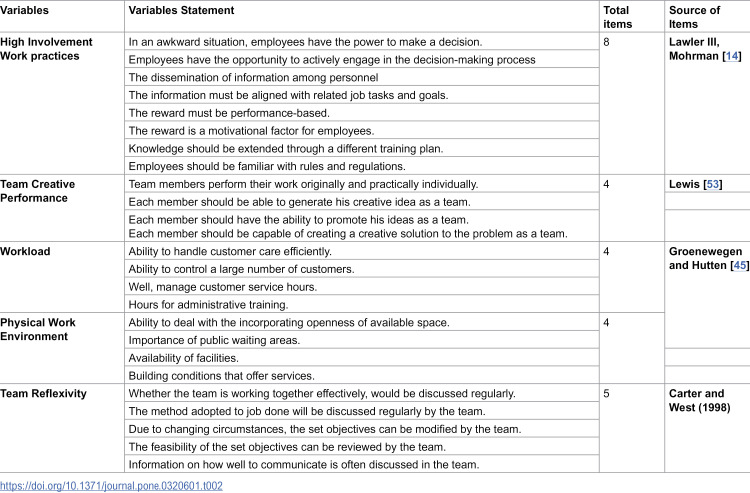 Figure 5
 Figure 6
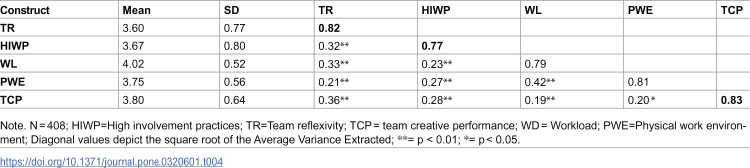 Figure 7
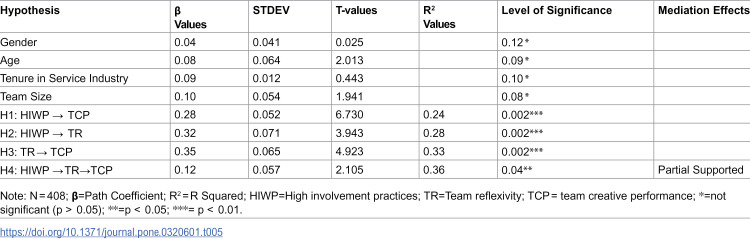 Figure 8
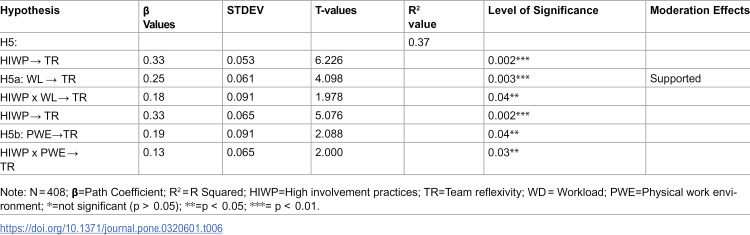 Figure 9
Peer Reviews
No public reviews on file for this paper yet. If you reviewed it on a platform where reviews are public (OpenReview, ICLR, NeurIPS, ICML), you can paste yours below so the community can read it here.
Videos
No videos yet. Explain this paper in a talk, walkthrough, or lecture? Add one.
Taxonomy
TopicsCreativity in Education and Neuroscience · Job Satisfaction and Organizational Behavior · Customer Service Quality and Loyalty