The mitochondrial genomes of Macrotermes termites endemic to Ethiopia
P. Conrad Williams, Ahmed Ahmed, Bianka Franks, Daniel Debelo, Kamal M. Ibrahim

TL;DR
This study analyzes mitochondrial genomes of two Macrotermes termite species from Ethiopia to better understand their taxonomy and biodiversity.
Contribution
The study provides new mitochondrial genome sequences and phylogenetic insights into under-researched Macrotermes termites in Africa.
Findings
The mitochondrial genomes of Macrotermes subhyalinus (SE7) and Macrotermes herus (WE3) are nearly identical in length and gene order.
Phylogenetic analysis shows WE3 is closely related to a West African M. subhyalinus, while SE7 is closely related to M. falciger.
The findings support prior phylogenetic work and emphasize the need for more taxonomic sampling in the Macrotermes clade.
Abstract
The study of the fungus-growing termites genus Macrotermes in Africa remains notably limited, with the genus harboring hidden diversity that has eluded conventional taxonomy. Characterization of the mitochondrial genomes of these termite species represents an important biodiversity resource that could assist in resolving taxonomic ambiguities. The mitochondrial genomes of the two samples we sequenced, nominally Macrotermes subhyalinus (SE7) and Macrotermes herus (WE3), are 16,374 and 16,372 bp long respectively. We report congruent gene order for the two samples. Phylogenetic analysis using all protein coding genes in the mitochondrial genome recovered our WE3 mitochondrial genome as sister to a West African M. subhyalinus (JX144937) while our M. subhyalinus (SE7) mitochondrial genome is sister to M. falciger (KY224460). Our findings largely corroborate previous phylogenetic work on…
Genes, proteins, chemicals, diseases, species, mutations and cell lines named across the full text — each resolved to its canonical identifier and authoritative record.
Click any figure to enlarge with its caption.
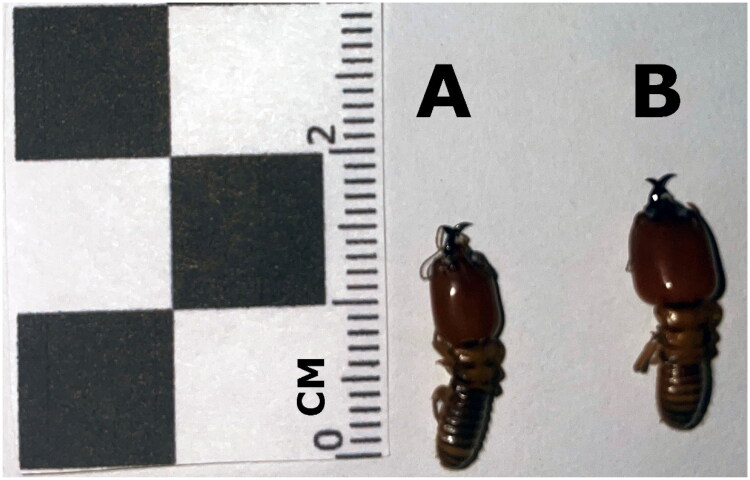 Figure 1
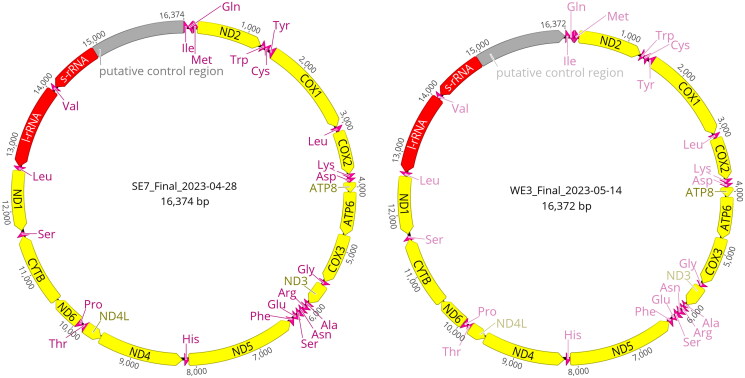 Figure 2
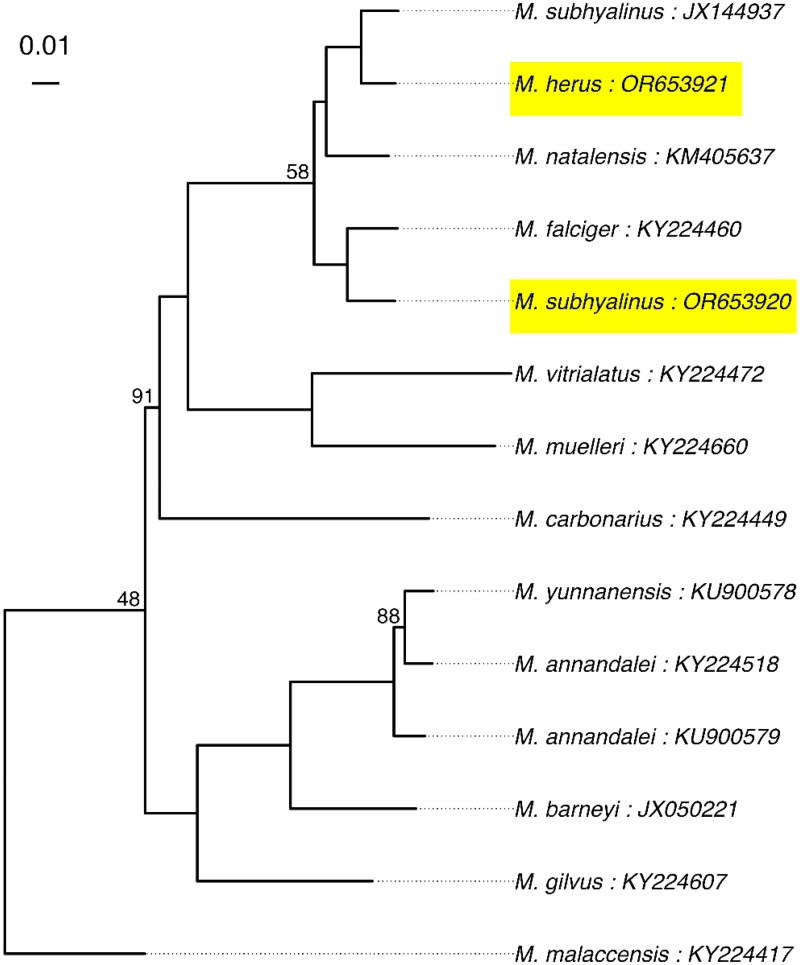 Figure 3
Peer Reviews
No public reviews on file for this paper yet. If you reviewed it on a platform where reviews are public (OpenReview, ICLR, NeurIPS, ICML), you can paste yours below so the community can read it here.
Videos
No videos yet. Explain this paper in a talk, walkthrough, or lecture? Add one.
Taxonomy
TopicsInsect and Arachnid Ecology and Behavior · Evolution and Genetic Dynamics · Plant and animal studies