Capturing Ultrafast Spin Dynamics in Single-Molecule Magnets Using Femtosecond X-ray Emission Spectroscopy
Kyle Barlow, Ryan Phelps, Julien Eng, Rebecca A. Ingle, Dmitry Khakhulin, Mykola Biednov, Sharmistha Paul Dutta, Yifeng Jiang, Frederico A. Lima, Vandana Tiwari, Christopher Milne, Tetsuo Katayama, Marco Coletta, Euan K. Brechin, Thomas J. Penfold, J. Olof Johansson

TL;DR
Researchers used ultrafast X-ray techniques to study how single-molecule magnets change their spin states after laser excitation, which could help develop faster data storage.
Contribution
The study introduces femtosecond X-ray emission spectroscopy as a novel method to probe ultrafast spin dynamics in single-molecule magnets.
Findings
Femtosecond X-ray emission spectroscopy reveals Jahn–Teller distorted structure switching in Mn(acac)3 after photoexcitation.
Spin state distributions in Mn3 are observed within 100 fs using Kβ signals.
The technique highlights the need for multi-spectrum probes to understand exchange-coupled complexes.
Abstract
Achieving ultrafast photomagnetic switching of single-molecule magnets (SMMs) could lead to simultaneous fast and dense data storage devices. To facilitate this, a thorough understanding of the ultrafast dynamics emerging after ultrashort laser pulse excitation is essential. However, the complex nature of these materials means there is a lack of established experimental techniques that can probe the spin dynamics in SMMs. Herein, we perform femtosecond time-resolved Mn K-edge X-ray emission spectroscopy on a Mn(III)-based trinuclear SMM (Mn3) and the model system Mn(acac)3. The spectral changes of Mn(acac)3 are consistent with switching between Jahn–Teller distorted structures expected after photoexcitation. A similar result is observed for Mn3; however, the Kβ signal also reveals insight into the distribution of spin states populated within 100 fs. The importance of using probes across…
Genes, proteins, chemicals, diseases, species, mutations and cell lines named across the full text — each resolved to its canonical identifier and authoritative record.
Click any figure to enlarge with its caption.
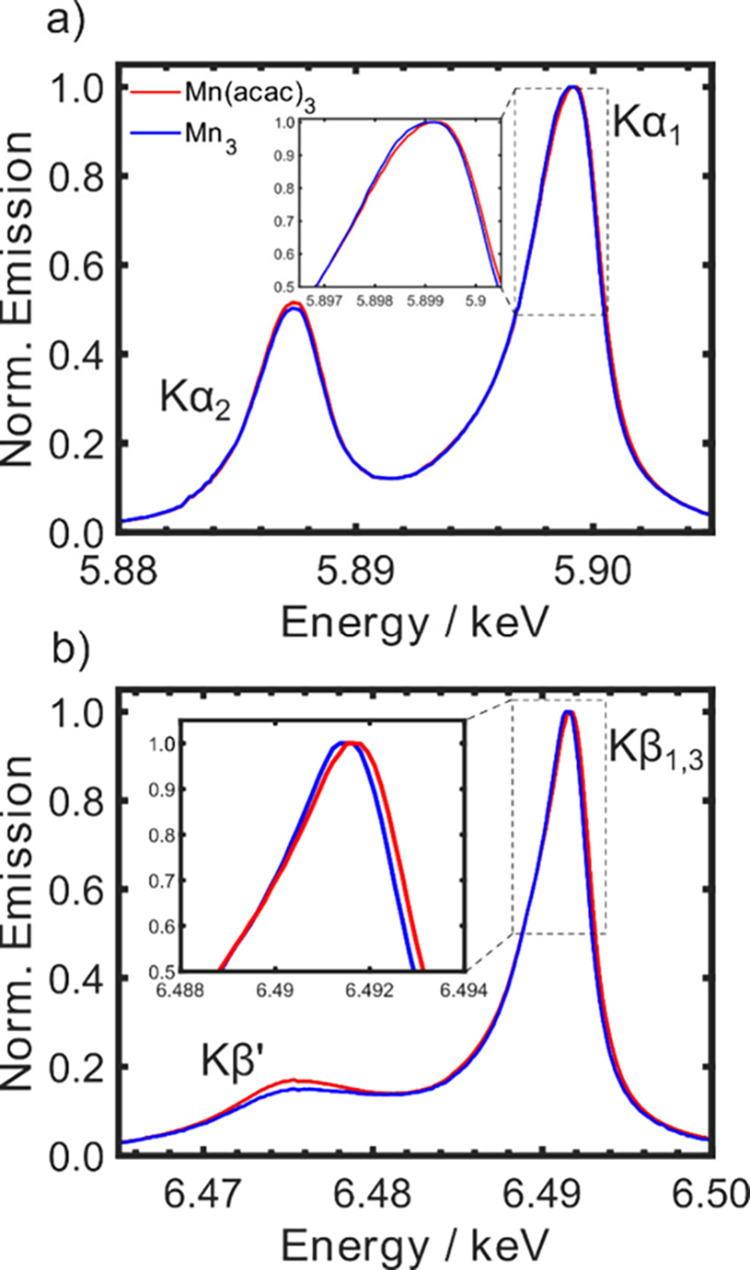 Figure 1
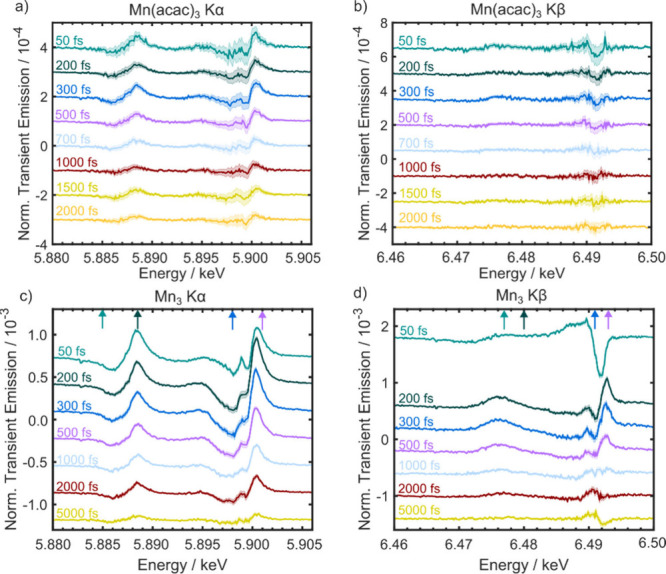 Figure 2
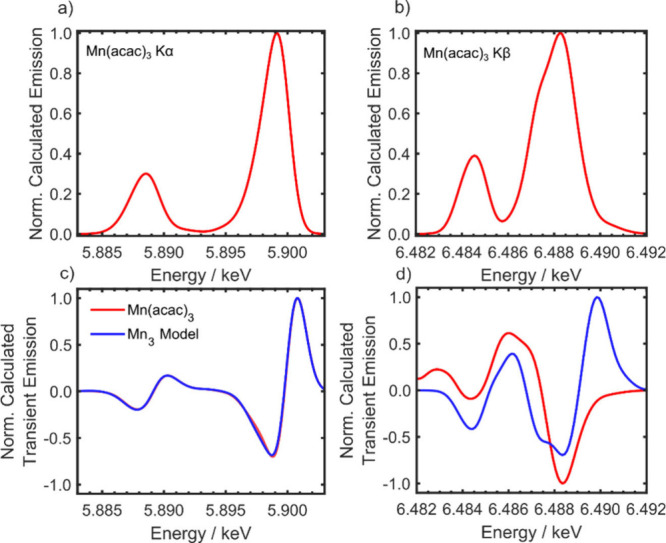 Figure 3
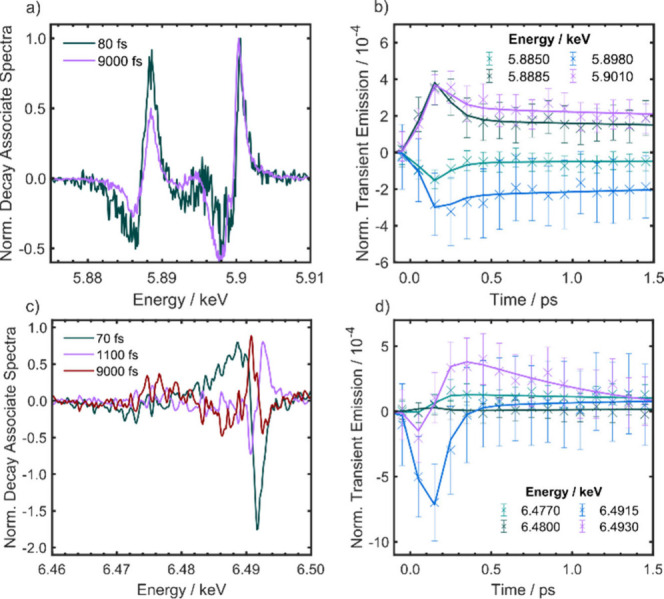 Figure 4
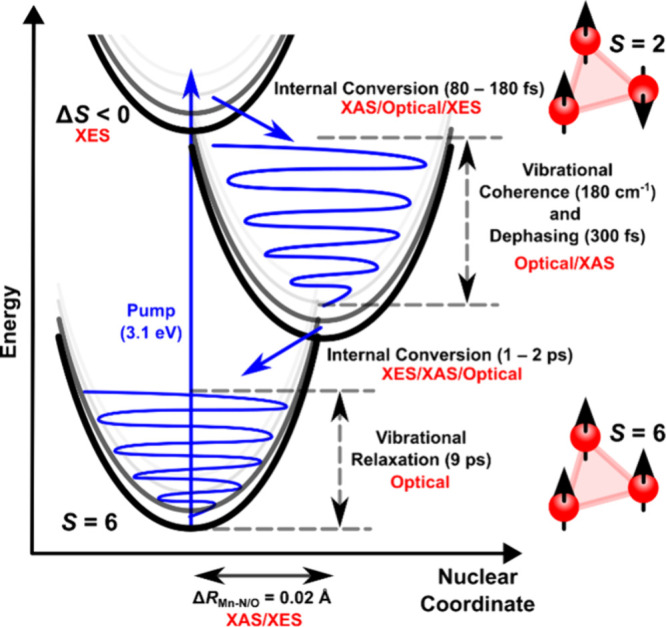 Figure 5
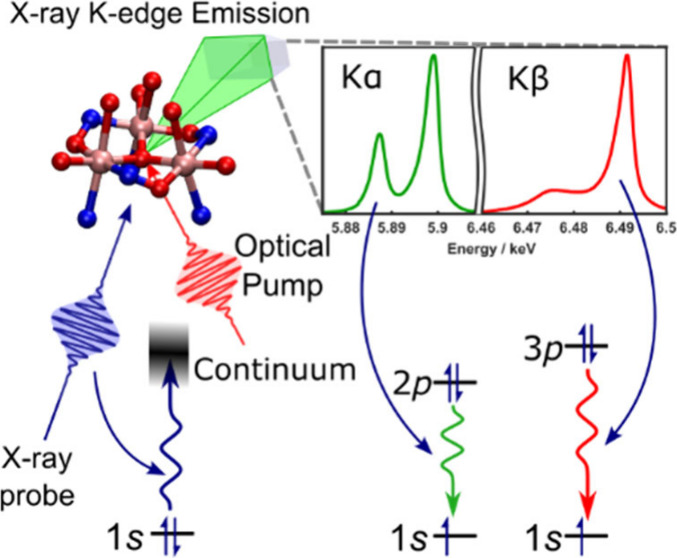 Figure 6
Peer Reviews
No public reviews on file for this paper yet. If you reviewed it on a platform where reviews are public (OpenReview, ICLR, NeurIPS, ICML), you can paste yours below so the community can read it here.
Videos
No videos yet. Explain this paper in a talk, walkthrough, or lecture? Add one.
Taxonomy
TopicsMagnetism in coordination complexes · Advanced NMR Techniques and Applications · Electron Spin Resonance Studies