Benchmarking Stochasticity behind Reproducibility: Denoising Strategies in Ta2O5 Memristors
Anna Nyáry, Zoltán Balogh, Botond Sánta, György Lázár, Nadia Jimenez Olalla, Juerg Leuthold, Miklós Csontos, András Halbritter

TL;DR
This paper benchmarks noise in Ta2O5 memristors and proposes denoising strategies to improve reproducibility in artificial synapses.
Contribution
A novel noise benchmarking and reduction protocol for memristors, including voltage-dependent noise tracking and subthreshold denoising.
Findings
Voltage-dependent noise characteristics were tracked along resistive switching I(V) curves.
Voltage cycling schemes can tune noise levels in filamentary Ta2O5 memristors.
Subthreshold voltage cycles enable denoising without resistive switching.
Abstract
Reproducibility, endurance, driftless data retention, and fine resolution of the programmable conductance weights are key technological requirements against memristive artificial synapses in neural network applications. However, the inherent fluctuations in the active volume impose severe constraints on the weight resolution. In order to understand and push these limits, a comprehensive noise benchmarking and noise reduction protocol is introduced. Our approach goes beyond the measurement of steady-state readout noise levels and tracks the voltage-dependent noise characteristics all along the resistive switching I(V) curves. Furthermore, we investigate the tunability of the noise level by dedicated voltage cycling schemes in our filamentary Ta2O5 memristors. This analysis highlights a broad order-of-magnitude variability of the possible noise levels behind seemingly reproducible…
Genes, proteins, chemicals, diseases, species, mutations and cell lines named across the full text — each resolved to its canonical identifier and authoritative record.
Click any figure to enlarge with its caption.
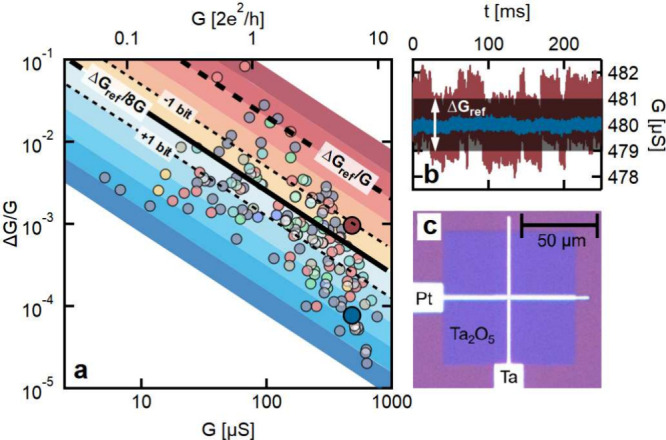 Figure 1
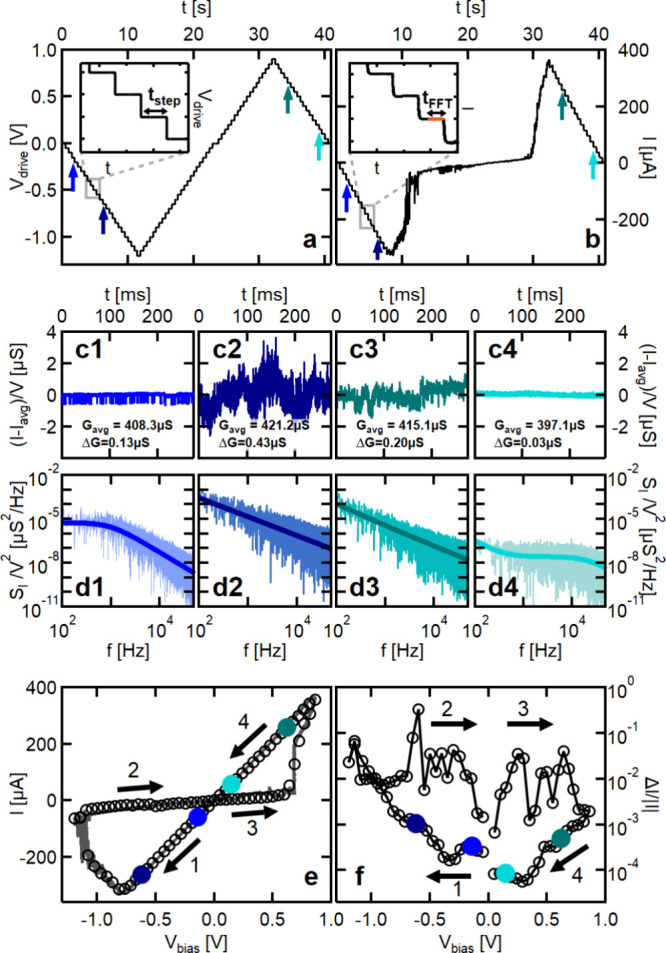 Figure 2
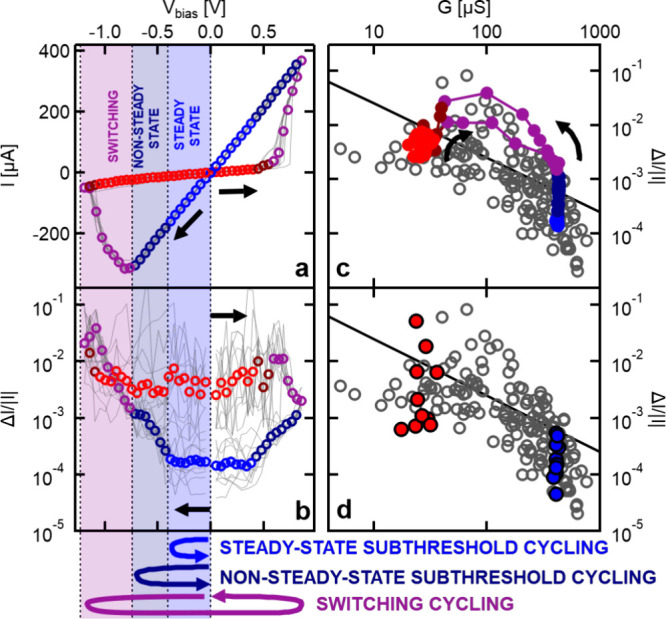 Figure 3
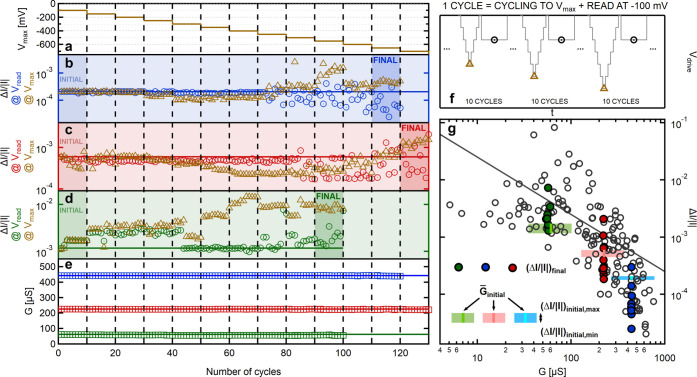 Figure 4
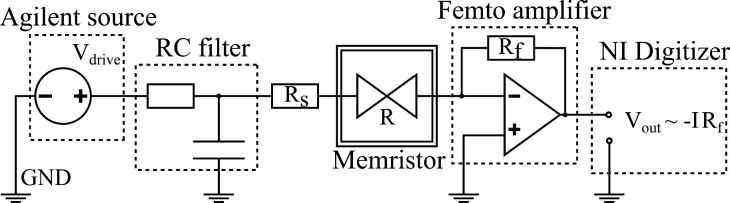 Figure 5
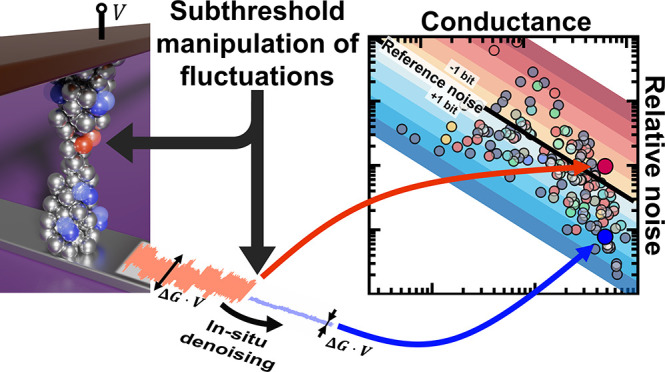 Figure 6
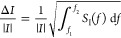 Figure 7
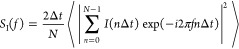 Figure 8
Peer Reviews
No public reviews on file for this paper yet. If you reviewed it on a platform where reviews are public (OpenReview, ICLR, NeurIPS, ICML), you can paste yours below so the community can read it here.
Videos
No videos yet. Explain this paper in a talk, walkthrough, or lecture? Add one.
Taxonomy
TopicsAdvanced Memory and Neural Computing · Ferroelectric and Negative Capacitance Devices · Neuroscience and Neural Engineering