Heterohybridomas producing human immunoglobulin light chains using CD138-selected bone marrow cells
P. Zhou, X. Ma, S. Scalia, D. Toskic, X. Wu, T. Fogaren, Nancy Coady Lyons, Luis del Pozo-Yauner, R.L. Comenzo

TL;DR
Researchers developed new cell lines that produce human light chains, offering tools to study their behavior and test therapies.
Contribution
The novel heterohybridoma cell lines produce high levels of human free light chains for in vitro and in vivo research.
Findings
Heterohybridomas from MM and PG patients produced human FLC with high intracellular fluorescence and in vivo dimer formation.
Higher mononuclear and CD138+ cell counts correlated with successful heterohybridoma production.
In vivo implants showed increased dimer formation compared to in vitro cultures.
Abstract
Light chain research is hampered by lack of mammalian cell lines producing human light chains (FLC). Therefore, we used heterohybridoma (HH) technology to produce clones making FLC thereby providing tools to study light chain behavior. Marrow CD138+ cells from patients with multiple myeloma (MM) and polyclonal gammopathy (PG) were selected, fused with B5-6 T cells and cultured in hypoxanthine-aminopterin-thymidine medium (HAT). HH clones were selected based on ELISA for human immunoglobulins and flow cytometry for intracellular (IC) FLC. We compared marrow cell counts and HH yields by diagnosis, evaluated clones making only FLC by flow and by dimer/monomer (D/M) ratios in vitro and in vivo, and sequenced FLC genes with RT-PCR. Marrows from 13 patients with active disease, 10 MM and 3 PG, were no different in mononuclear or CD138-selected cell counts. HH FLC clones (7 λ, 1 κ) were…
Genes, proteins, chemicals, diseases, species, mutations and cell lines named across the full text — each resolved to its canonical identifier and authoritative record.
Click any figure to enlarge with its caption.
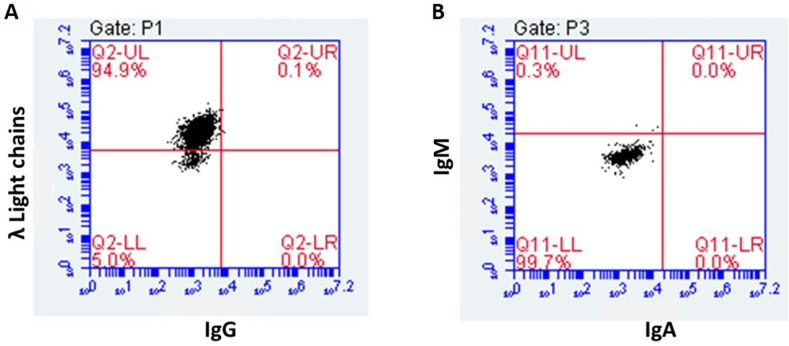 Figure 1
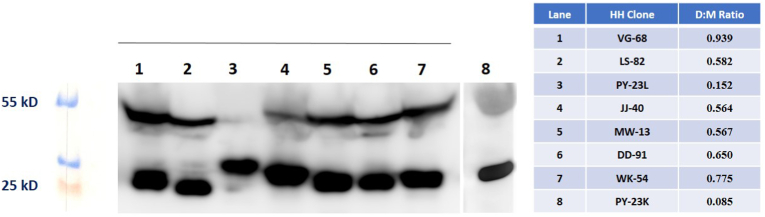 Figure 2
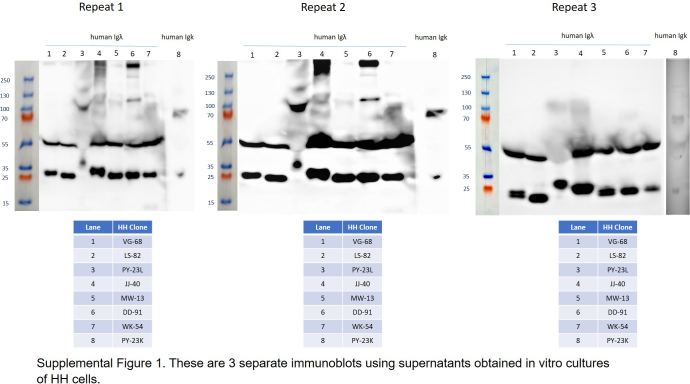 Figure 3
Peer Reviews
No public reviews on file for this paper yet. If you reviewed it on a platform where reviews are public (OpenReview, ICLR, NeurIPS, ICML), you can paste yours below so the community can read it here.
Videos
No videos yet. Explain this paper in a talk, walkthrough, or lecture? Add one.
Taxonomy
TopicsMultiple Myeloma Research and Treatments · Peptidase Inhibition and Analysis · Monoclonal and Polyclonal Antibodies Research