An Atypical Kappa‐Class Chaperone‐Usher Fimbriae of a Human Enterotoxigenic Escherichia coli Strain Shows Multi‐Host Adherence and Distinct Phylogenetic Feature
Hiharu Inoue, Yoshihiko Tanimoto, Dongming Zheng, Erika Ban‐Furukawa, Miyoko Inoue, Yuko Omori, Yoshihiro Yamaguchi, Taro Tachibana, Hisashi Aso, Weiping Zhang, Eriko Kage‐Nakadai, Yoshikazu Nishikawa, Takayuki Wada

TL;DR
A unique fimbriae in a human E. coli strain helps it stick to multiple animal cells, possibly due to a newly evolved protein.
Contribution
Discovery of a novel adhesin (FayG1) in ETEC with multi-host adherence and distinct evolutionary origins.
Findings
F4O169 fimbriae mediate adhesion to human, bovine, and porcine epithelial cells.
FayG1 is a major adhesin contributing to human cell adhesion.
FayG1 and FayG2 show low homology with other E. coli strains, indicating unique evolutionary origins.
Abstract
The pathogenesis of enterotoxigenic Escherichia coli (ETEC) involves the colonization of hosts by colonization factors (CFs) and the secretion of enterotoxins. CFs, especially chaperone‐usher fimbriae, mediate bacterial adhesion to host cells, with extensive genetic diversity observed among isolates. One ETEC strain, O169YN10, possessed a unique plasmid (pEntYN10) encoding three CFs, CS6, and two novel homologs of CS8 and F4 (CS6O169, CS8O169, and F4O169). In this study, F4O169 was found to play a major role in adhesion to multiple hosts, including human, bovine, and porcine epithelial cells, whereas the other two CSs were less functional. Inhibition assays using antibodies showed that FayG1, one of the two major paralogous adhesins of F4O169, directly contributes to human cell adhesion. Despite the established function of FayG1, the FayG2 protein was not detected under the in vitro…
Genes, proteins, chemicals, diseases, species, mutations and cell lines named across the full text — each resolved to its canonical identifier and authoritative record.
Click any figure to enlarge with its caption.
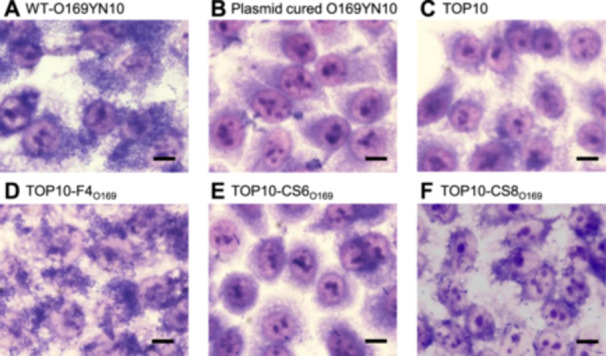 Figure 1
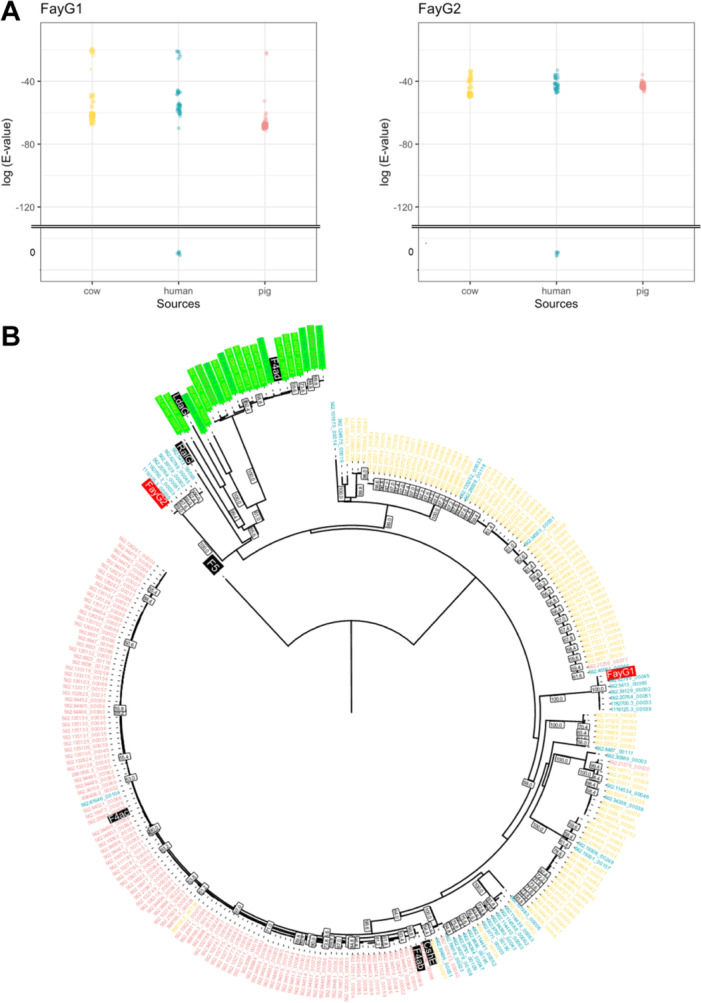 Figure 2
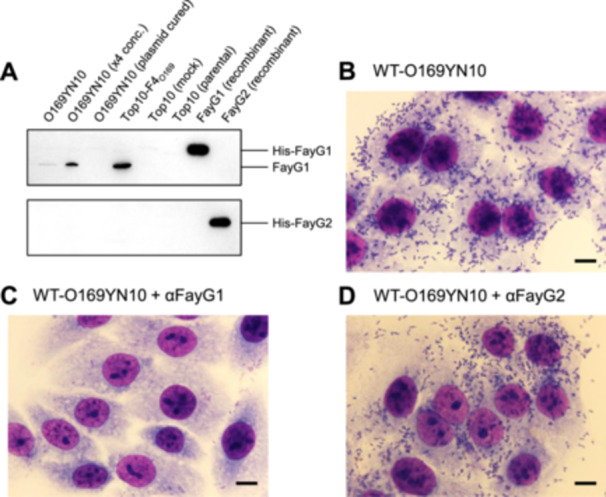 Figure 3
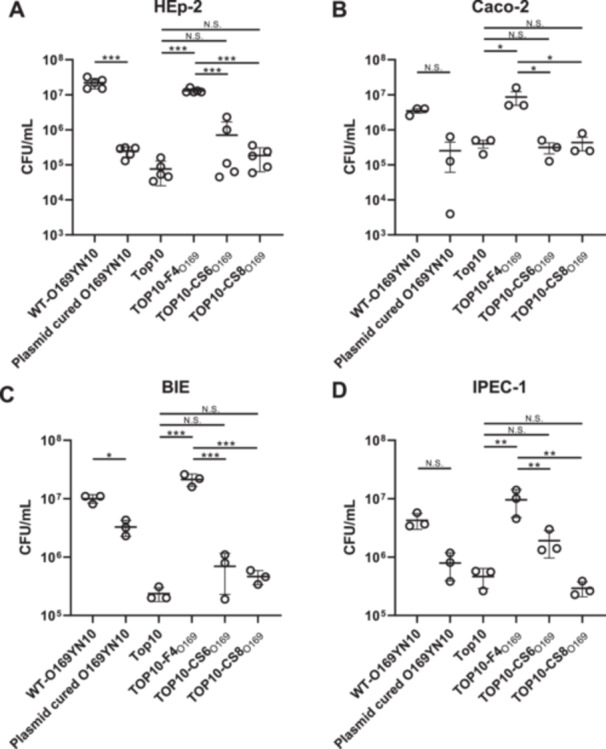 Figure 4
Peer Reviews
No public reviews on file for this paper yet. If you reviewed it on a platform where reviews are public (OpenReview, ICLR, NeurIPS, ICML), you can paste yours below so the community can read it here.
Videos
No videos yet. Explain this paper in a talk, walkthrough, or lecture? Add one.
Taxonomy
TopicsEscherichia coli research studies · Bacterial Genetics and Biotechnology · Bacteriophages and microbial interactions