Hospital-Acquired Pressure Injury Reduction: A Nurse-Led Quality Improvement Initiative in Qatar
Thabit Melhem, Valarmathi Varadharajan, Ian S Mcdonald, Mariam N Al-Mutawa, Dyna George, Dona Thomas, Nabila Chaabna, Abdulqadir J Nashwan

TL;DR
A nurse-led initiative in Qatar successfully reduced hospital-acquired pressure injuries by over 60% using targeted quality improvement strategies.
Contribution
This study demonstrates the effectiveness of a nurse-led quality improvement initiative in significantly reducing hospital-acquired pressure injuries in a real-world healthcare setting.
Findings
The project achieved a 64.4% reduction in hospital-acquired pressure injury (HAPI) incidence.
Medical device-related pressure injuries decreased by 66% following the implementation of evidence-based interventions.
Nurse-led quality improvement efforts using the CUSP model proved highly effective in reducing HAPI rates.
Abstract
Hospital-acquired pressure injuries (HAPIs) pose a considerable challenge for healthcare systems, not only for their impact on patient well-being but also for the significant financial burden imposed on healthcare facilities. Between 2020 and 2021, Hamad Medical Corporation (HMC) reported an average of 60±5 monthly HAPI incidents, with medical devices contributing to approximately 50% of these cases. This project aimed to reduce the incidence of pressure injuries across hospital units. A quality improvement (QI) project using the Comprehensive Unit-Based Safety Program (CUSP) model was implemented to reduce HAPI incidence by 50% by September 2022. The interventions included staff training, electronic documentation review, spot audits on SSKIN (surface, skin inspection, keep moving, incontinence, and nutrition) care bundle compliance policy updates, and enhanced utilization of…
Genes, proteins, chemicals, diseases, species, mutations and cell lines named across the full text — each resolved to its canonical identifier and authoritative record.
Click any figure to enlarge with its caption.
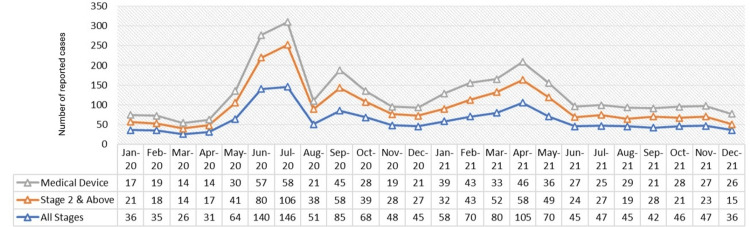 Figure 1
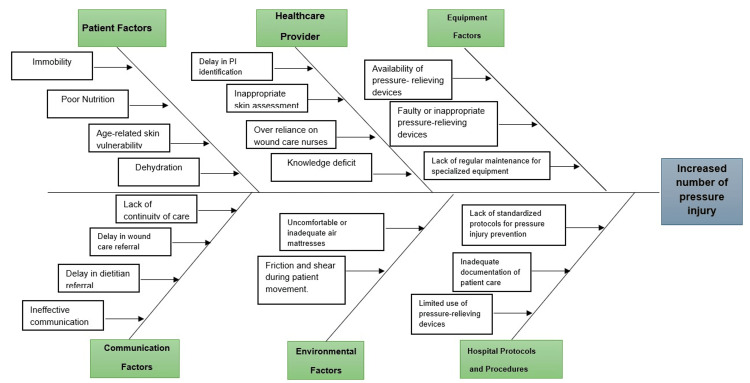 Figure 2
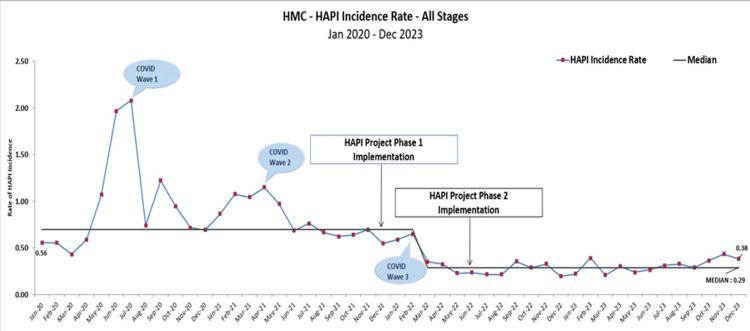 Figure 3
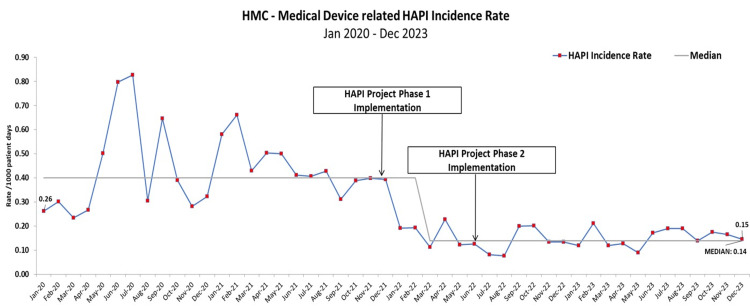 Figure 4
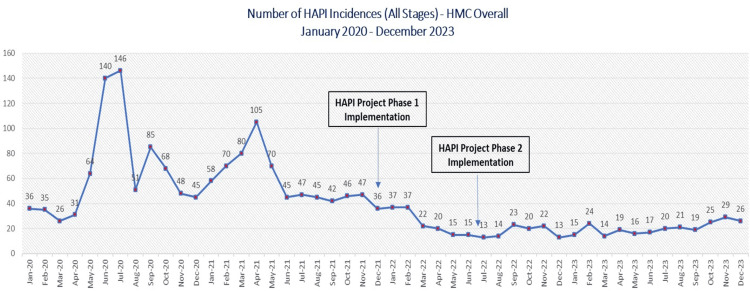 Figure 5
Peer Reviews
No public reviews on file for this paper yet. If you reviewed it on a platform where reviews are public (OpenReview, ICLR, NeurIPS, ICML), you can paste yours below so the community can read it here.
Videos
No videos yet. Explain this paper in a talk, walkthrough, or lecture? Add one.
Taxonomy
TopicsPressure Ulcer Prevention and Management · Diabetic Foot Ulcer Assessment and Management · Diagnosis and Treatment of Venous Diseases